
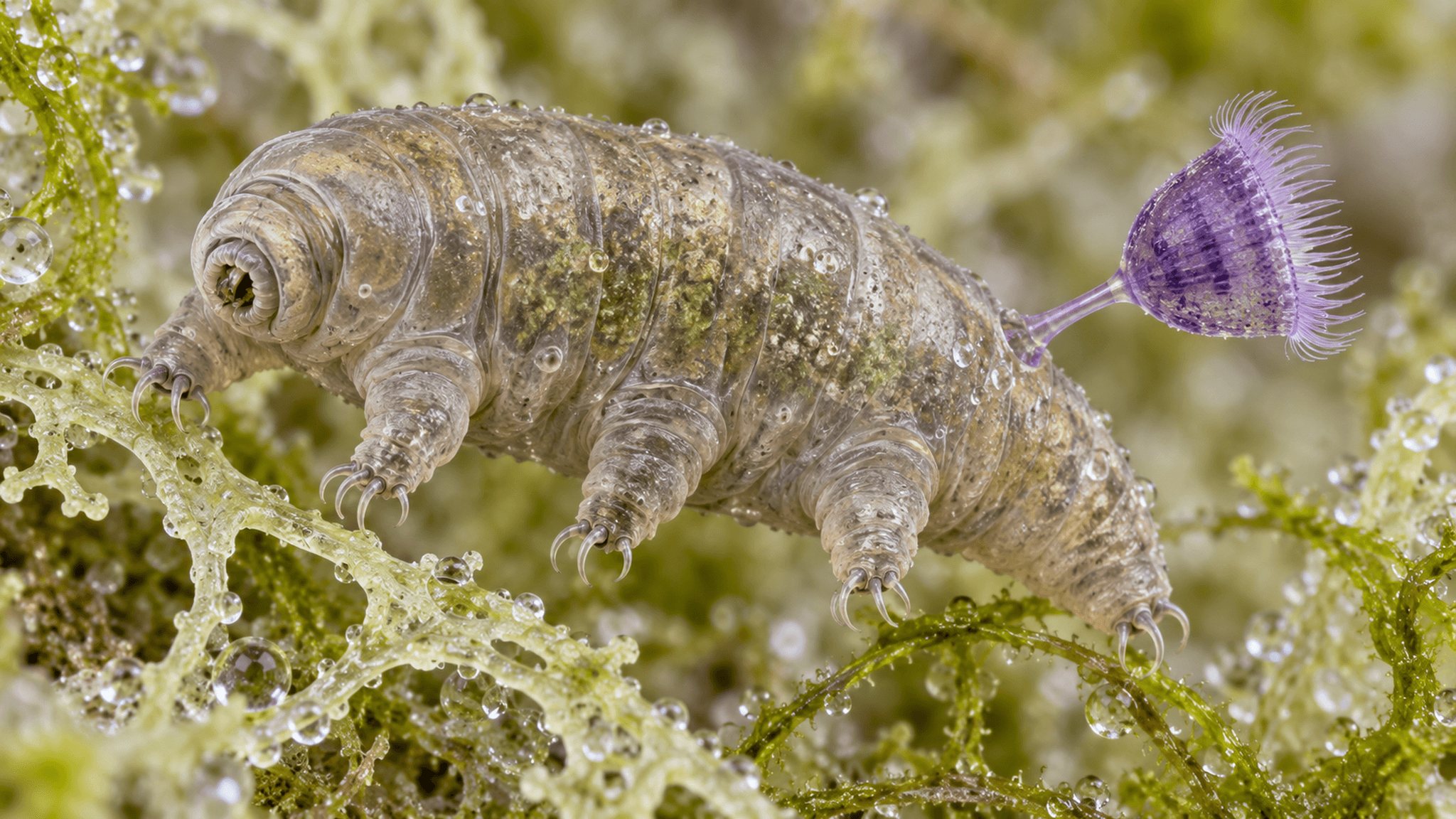
A team led by Karol Wałach of Jagiellonian University reports the findings in the Zoological Journal of the Linnean Society. The little passenger is called Propyxidium tardigradum. Five further records came from nature enthusiasts who had shared their observations on the online platform iNaturalist.
Suddenly it is clinging to mites too
Until now, the single-celled organism was known only as a passenger on tardigrades. The study now shows it for the first time on mites, on a rotifer — another tiny animal — on a tardigrade egg and on specks of dirt. The hitchhiker therefore climbs aboard far more surfaces than anyone had expected.
Which carriers it prefers remains unclear. The authors explicitly describe their answers to this question as preliminary. Four new tardigrade hosts, some identified only provisionally, have also joined the list.
Even so, one clear pattern emerges. Tardigrades are divided into major groups, and every infested animal belonged to the eutardigrades. Animals from the other branch were crawling around in three samples, but not one carried a passenger.
One twig, 400 tardigrades and twice as many passengers
A Canadian twig only a few centimetres long shows just how crowded life on a tardigrade can become. Researchers counted around 400 tardigrades on it and at least twice as many hitchhikers. The twig was covered in yellow lichen, a leaf-like growth formed by a fungus and an alga.
Within this mesh, a tardigrade stomps through damp lobes and crevices on eight stubby legs. Its passenger sits towards the rear of its body, behind the third pair of legs — exactly where the researchers found most of the single-celled organisms. Wherever the tardigrade crawls, the hitchhiker gets a free ride.
Tardigrades live worldwide, mainly in mosses and lichens, especially in their uppermost layers. These become wet quickly after every shower and dry out just as fast. The animals are at home even in Antarctica.
Ten records in almost sixty years
According to the authors, only ten published records of the species existed worldwide by August 2022. For the new study, the team deliberately collected lichens from trees: 23 samples in England and 21 in Scotland. Yellow foliose lichens in particular went under the microscope.
There is also a practical reason why the passenger remained overlooked for so long. The authors warn that it can easily be confused with a close relative that grows in groups on branching stalks. Its place in the family tree was disputed for years as well, and the study now formally gives it its genus name — the name of its closest group of relatives.
Dried out but still aboard
When the lichen dries out, the tardigrade contracts into a tiny barrel shape and shuts down its metabolism. Specialists call this state anhydrobiosis: life without water. When rain returns, the animal wakes again, and this is how species in Antarctica survive both drought and frost.
The new observations suggest that the single-celled organism remains firmly attached to its carrier during this dormant state. Once moistened, it may itself come back to life. It would simply sit out the dry spell on its carrier’s back.
The Antarctic passengers look different
In the Antarctic samples, the researchers found single-celled organisms with a visibly different structure. Under a scanning electron microscope, an instrument that magnifies surfaces to an extreme degree, it is primarily their outer cell covering that differs. The authors regard this as a possible new species, which must first be confirmed through further investigations using several methods.
From Scotland to the eternal ice
The study records the single-celled organism in North America and the region around Australia for the first time. Australia, Canada, Italy, Lithuania and the USA are new additions to its list of countries. A passenger considered rare for almost sixty years has now been documented on tardigrades from Scotland to Antarctica — and it clings to more kinds of carrier than expected.
---