A team led by Donglin He of the University of Chinese Academy of Sciences reports the finding in Royal Society Open Science.
One flap becomes two
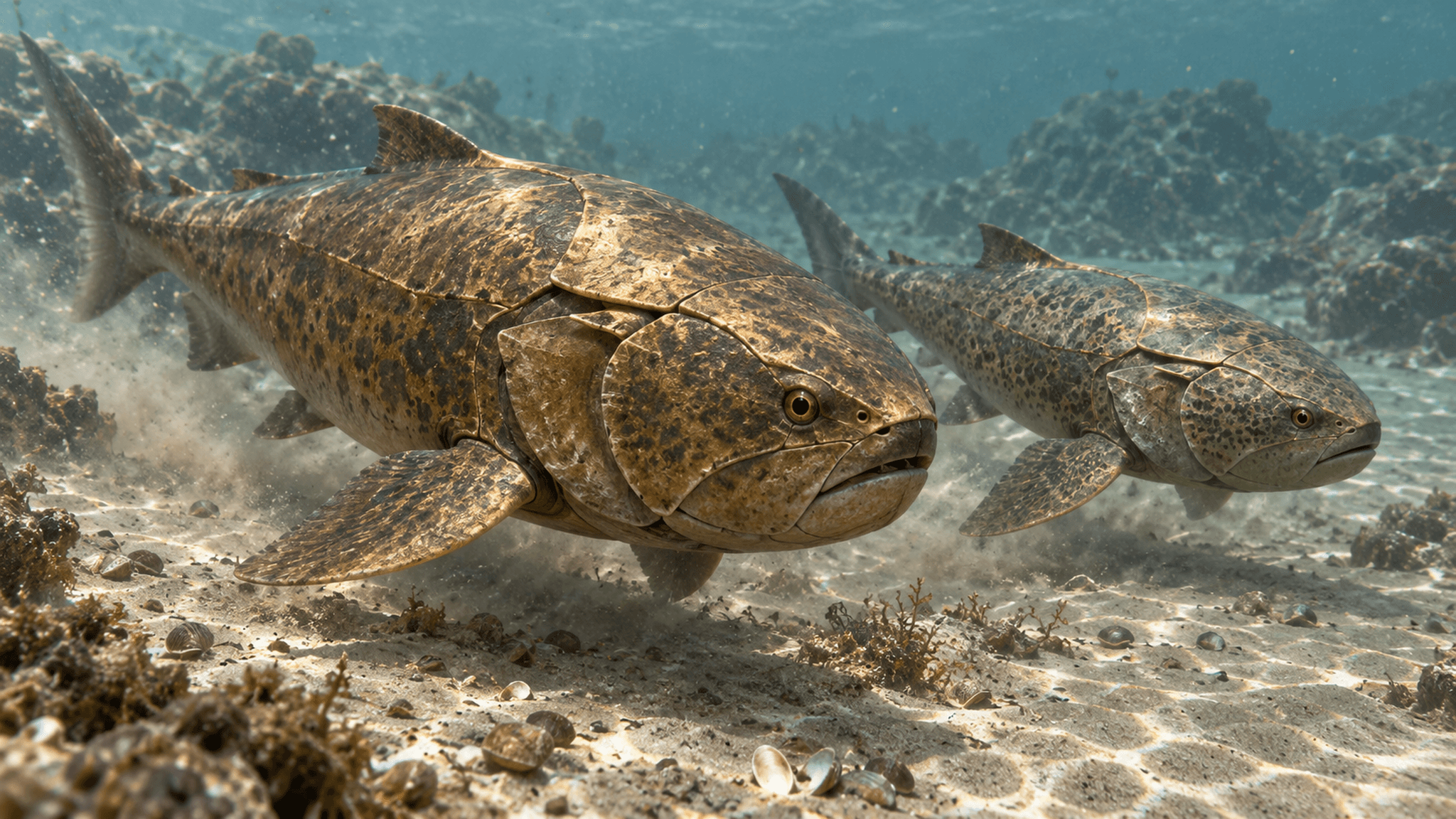
Gill covers are the flaps that shield a fish’s delicate gills. In armoured fish, early fishes encased in bony armour, this area is known to carry a single plate. That was also how Entelognathus primordialis had been described: one flap, suspended from a piece of cartilage.
A research team has now re-examined the holotypes – the original specimens on which the species descriptions are based. Two methods looked through the rock. Synchrotron scanning uses an extremely bright X-ray beam produced by a particle accelerator, while micro-CT is computed tomography for minute structures.
The result for Entelognathus primordialis: two gill-cover plates, one at the front and another directly behind it. The larger rear plate carries a robust projection along its upper front edge.
The cartilage that was not cartilage
This very projection had previously been interpreted as gill-cover cartilage from which the flap was supposedly suspended. The scans reassign it: it belongs to the bony plate itself. That leaves the old suspension model without its key component.
A second detail now takes centre stage. Both plates lie extensively beneath the skull roof. The armour of the head reaches far across them.
Qilinyu follows suit: one plate, the same hallmarks
Now the second fish enters the story: Qilinyu rostrata. Like Entelognathus primordialis, it belongs to the so-called maxillate placoderms. Its single gill-cover plate was thought to connect to the skull through a joint made of dermal bone, resembling the arrangement in antiarchs, another group of armoured fish.
Here too, the scans reveal a different structure from the one previously described. There is still only one plate, but it bears the same pronounced projection at its upper front edge. The skull roof also extends far across it.
Two fish with different numbers of flaps therefore follow the same structural principle. Comparison with the gill covers of other early jawed vertebrates sharpens the discovery further. According to the study, this combination occurs only in maxillate placoderms.
Flaps that could slide beneath the armour
The broad overlap also reveals something about movement. According to the study, it suggests that the gill covers of both species could slide along the inside of the skull roof. Picture a sliding door moving beneath a canopy.
The fossilised plates cannot show how far the flaps moved or exactly what purpose that movement served. Their structure is established. The movement remains a well-founded possibility.
Two new features for the family tree
For research into evolutionary relationships, the discovery is a gain. The team introduces two new features around the gill cover and revises several existing ones. Such features are the building blocks used to calculate the family trees of early jawed vertebrates.
The new analysis produces a signal with consequences. It indicates that at least some maxillate placoderms form a single, complete group of relatives. In other words, they descend from a common ancestor, and the group includes all of that ancestor’s descendants.
The two original fossils had been known since their first descriptions. Only under X-ray did they surrender their true structure. Sometimes the early history of jaws needs no new discovery, because a second look at an old one is enough.
---