A team led by Teresa Alonso-Hartyanyi of the Museo Nacional de Ciencias Naturales presents the newcomers in the Zoological Journal of the Linnean Society. They are called Osedax emmae, Osedax martini and Osedax teoi. The team identified them as distinct species from their anatomy and genetic material.
Bacteria Do the Digesting
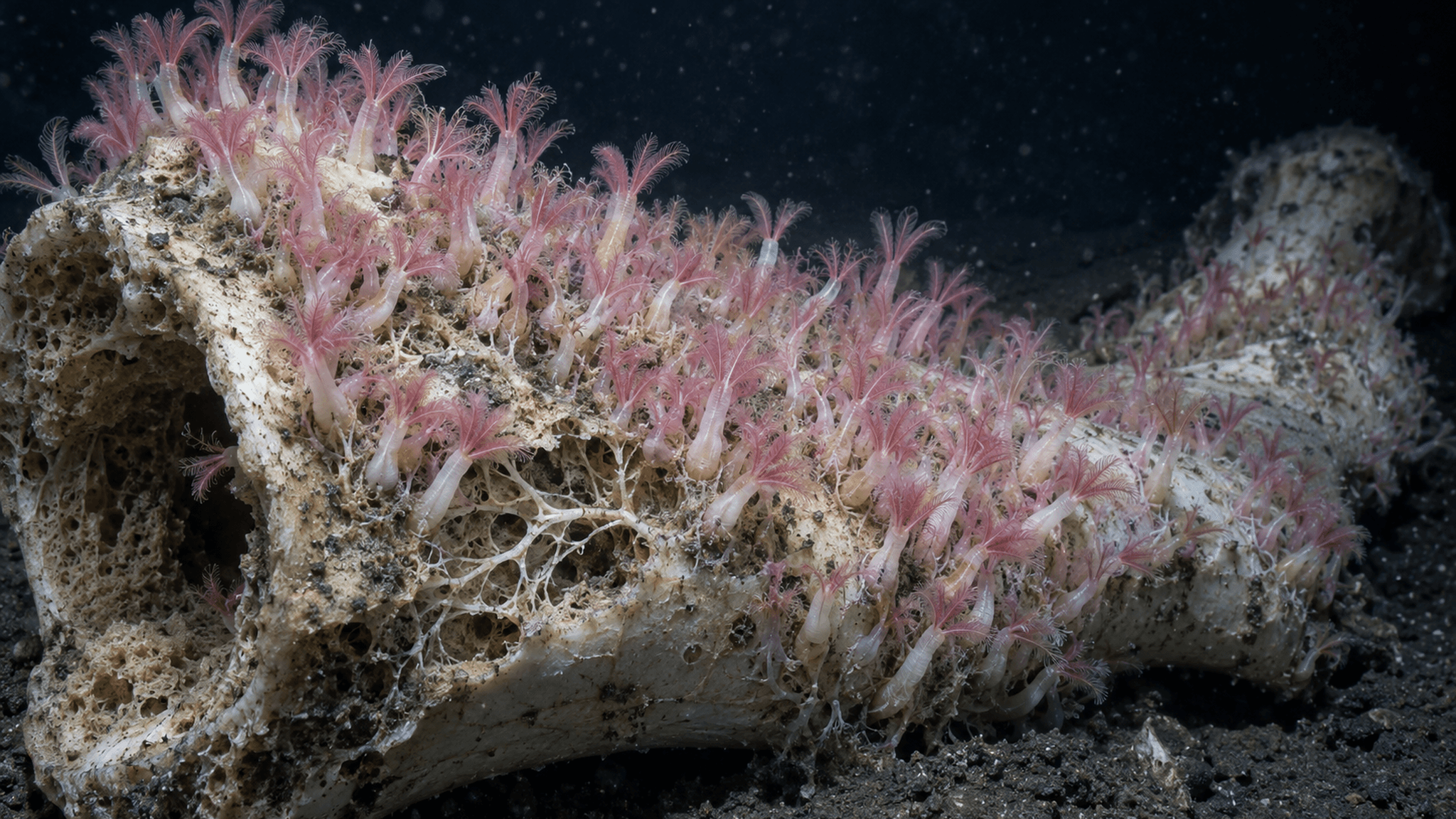
This is how it might look: in the twilight of the deep, a bare bone lies on the seabed. Worms sit on it, anchored inside the bone by root-like extensions. Not one of them can eat.
Bacteria perform the work in an obligate symbiosis, a partnership without which the worm cannot survive. The bacteria break down the organic material inside the bone. That sustains the worm.
Reproduction in this genus is unusual too. Among the first species described, every collected animal was female. Tiny, larva-like dwarf males packed with sperm lived inside them.
A Dead Whale Gave the Worms Away
The story of the bone eaters begins with a whale carcass. In 2002, researchers came across a dead whale in Monterey Canyon off California at a depth of about 2,900 metres. The worms covered it densely. Two years later, Greg Rouse, Shana Goffredi and Robert Vrijenhoek named the genus Osedax in the journal Science, Latin for ‘bone-eating’.
At first, the worms were known only from whale carcasses in the north-east Pacific, at depths of 1,500 to 3,000 metres. Then, in 2005, researchers described Osedax mucofloris from a deliberately submerged minke whale off Sweden’s west coast, in just 125 metres of water. Before the new study, 34 species had been named across all the world’s oceans.
Until now, Osedax mucofloris was the only known species in the north-east Atlantic. Off Portugal, it had been recorded in the Setúbal Canyon at a depth of 1,000 metres. Three Iberian species now join it.
A Black Spot Never Seen on a Bone Eater Before
In Osedax martini, the team encountered something never previously observed in any species of the genus: a black spot. All other known species display only different colours.
Osedax emmae is the sister species of Osedax priapus, meaning its closest relative. It lacks the fine pinnules on its palps. The authors interpret this as a loss: its ancestors carried them, but Osedax emmae shed them again.
The Strait of Gibraltar Cannot Stop the Worms
For two of the three new species, the team compared genetic material from worms collected in different areas. It found no genetic break between animals from the Mediterranean and those from the Gulf of Cádiz. This suggests that the populations mix across the Strait of Gibraltar.
The authors believe larvae drifting for long periods in open water make this possible. That is how the worms bridge great distances.
They also reproduce at an extraordinary rate. One female can produce around 300 larvae a day, more than twelve every hour. The researchers see this as the reason for the great genetic diversity across the entire genus.
The Same Four Bacteria Also Live in an Antarctic Worm
Finally, the team examined the worms’ bacterial partners. It tested whether each of the three species housed its own bacterial community. To do so, the researchers read a specific fragment of bacterial genetic material that acts like an identity card, revealing which bacteria are present.
The result: the species do not each have a bacterial community of their own. Instead, four bacteria appeared as a stable core in all three Iberian species. The researchers found the same four in Osedax deceptionensis, a species from Antarctica.
This fits a previous study by Hewitt and colleagues from 2020. It attributed differences between the bacterial communities of different Osedax species probably more to their environment than to the worms’ relationships, and the new study broadly supports that interpretation. The available evidence leaves the role of the four core bacteria inside the worm unresolved.
Europe’s Bone Eaters Were Right off the Coast
Three species of bone eater unknown to science were living around the Iberian Peninsula. They became visible only when a team placed cow and pig bones on the seabed. The worms arrived by themselves.
---