A team led by André O. Fonseca of the Federal University of Santa Maria in Brazil reports the discovery in the journal Royal Society Open Science. The researchers used the many early dinosaur finds made over the past decade to rearrange the evolutionary history of the spine.
The Ancestor’s Blueprint: 9 Neck, 16 Back and 2 Pelvic Vertebrae
Nine neck vertebrae, 16 back vertebrae and two sacral vertebrae: this was probably the spine of the last common ancestor of all dinosaurs. The researchers call this basic set the ancestral vertebrae. Starting from it, they can trace where later dinosaurs remodelled the structure.
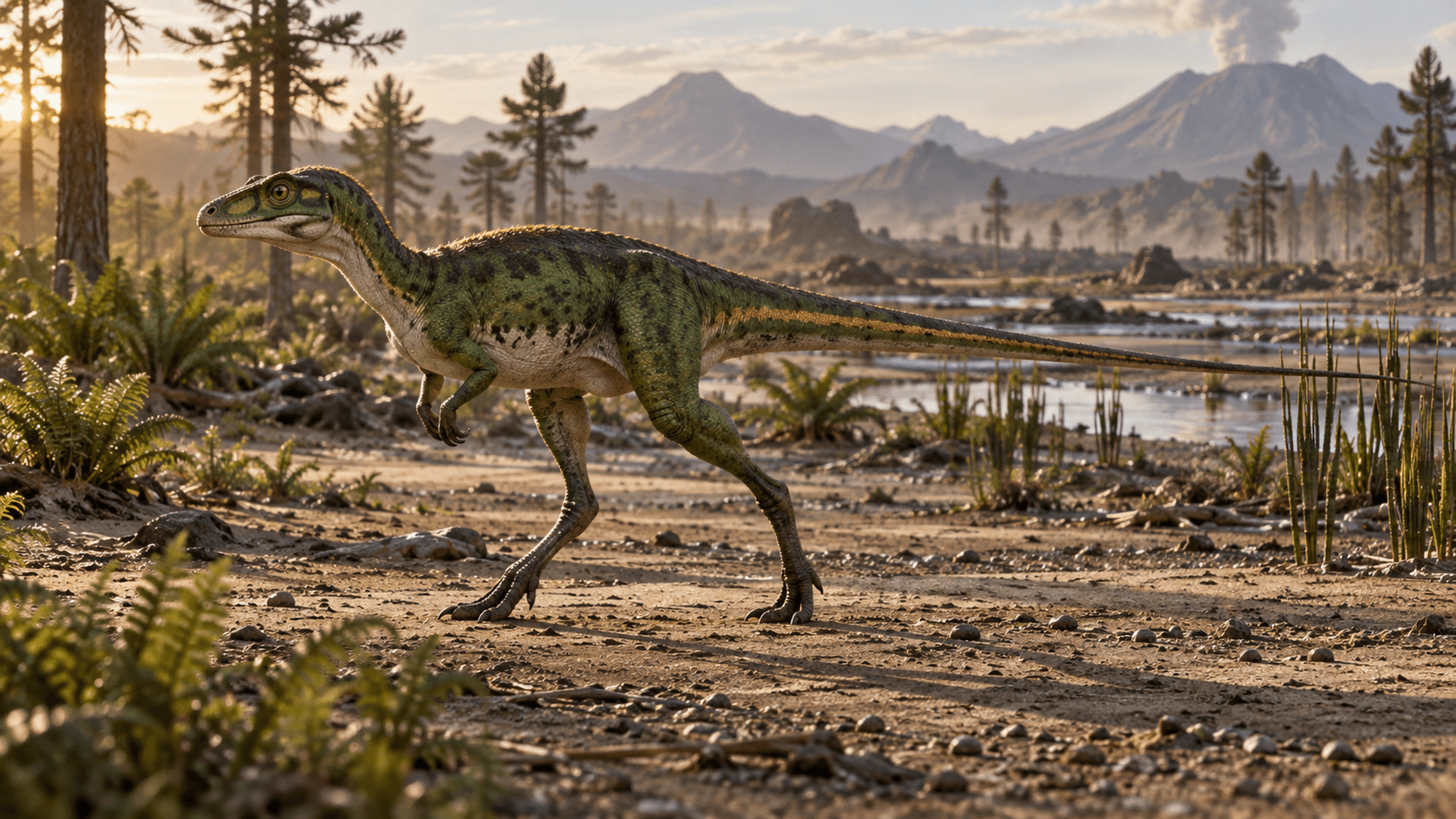
In the reconstruction, such an ancestor strides through the Triassic landscape on its hind legs. With every step, the weight of its trunk and tail presses through the sacrum into the pelvis and from there into the legs. Adding a vertebra at this point alters the body precisely where it carries the load.
Saurischians Kept Their Vertebral Count
Saurischians later gave rise to the predatory dinosaurs and the sauropods, the giant plant-eaters. Their early representatives held on to the spine they had inherited. The researchers found no sign that vertebrae had been added or lost in front of the pelvis.
Ornithischians Remodelled Their Spines Dramatically
The ornithischians, the second great dinosaur lineage, were a very different story. Early in their history, an additional vertebra pushed in between the original ancestral vertebrae. Their classic representatives apparently retained it.
And that was not all: within this lineage, vertebrae in front of the pelvis disappeared and others were added. The evidence is clear.
The researchers also place silesaurids in this lineage. Their position in the family tree has been contested for years: around 2010, they were regarded as the sister group of the dinosaurs, their closest relatives outside the group. Several studies published since 2016 instead identify them as early forerunners of the ornithischians.
Silesaurids lived roughly 245 to 202 million years ago. Their fossils have been found in places including Poland, Tanzania and Brazil.
One Vertebra in the Pelvis Costs One in the Back
One vertebra moves into the pelvis. One disappears from the back. That is what happened in every dinosaur examined.
The body builds nothing new; it reassigns what it already has. A back vertebra changes jobs and begins supporting the pelvis. In a two-legged dinosaur, it then sits directly above the hip joints, where the weight of the trunk meets the legs with every step.
Experts call this change of role a homeotic transformation: the vertebra remains, but its function changes. According to the study, such role changes shaped the early dinosaur spine. Genuine gains or losses in the total count — known technically as meristic changes — appear only in later, more derived representatives.
Fused Pelvic Vertebrae, 233 Million Years Old
A find from southern Brazil reveals how early dinosaur pelvic vertebrae fused together. In 2020, researchers described two partially fused sacral vertebrae from the Candelária Sequence, around 233 million years old. They are considered the oldest unambiguous evidence of fused pelvic vertebrae in dinosaurs.
Fused sacral vertebrae also occurred in relatives such as silesaurids, while the earliest dinosaur ancestors still had separate vertebrae. It remains unclear whether the common ancestor of all dinosaurs already possessed a fused sacrum or whether fusion evolved independently in the individual lineages.
This brings the origin of the dinosaur pelvis into sharper focus. Early dinosaurs built their sacrum by remodelling back vertebrae they already possessed.
---