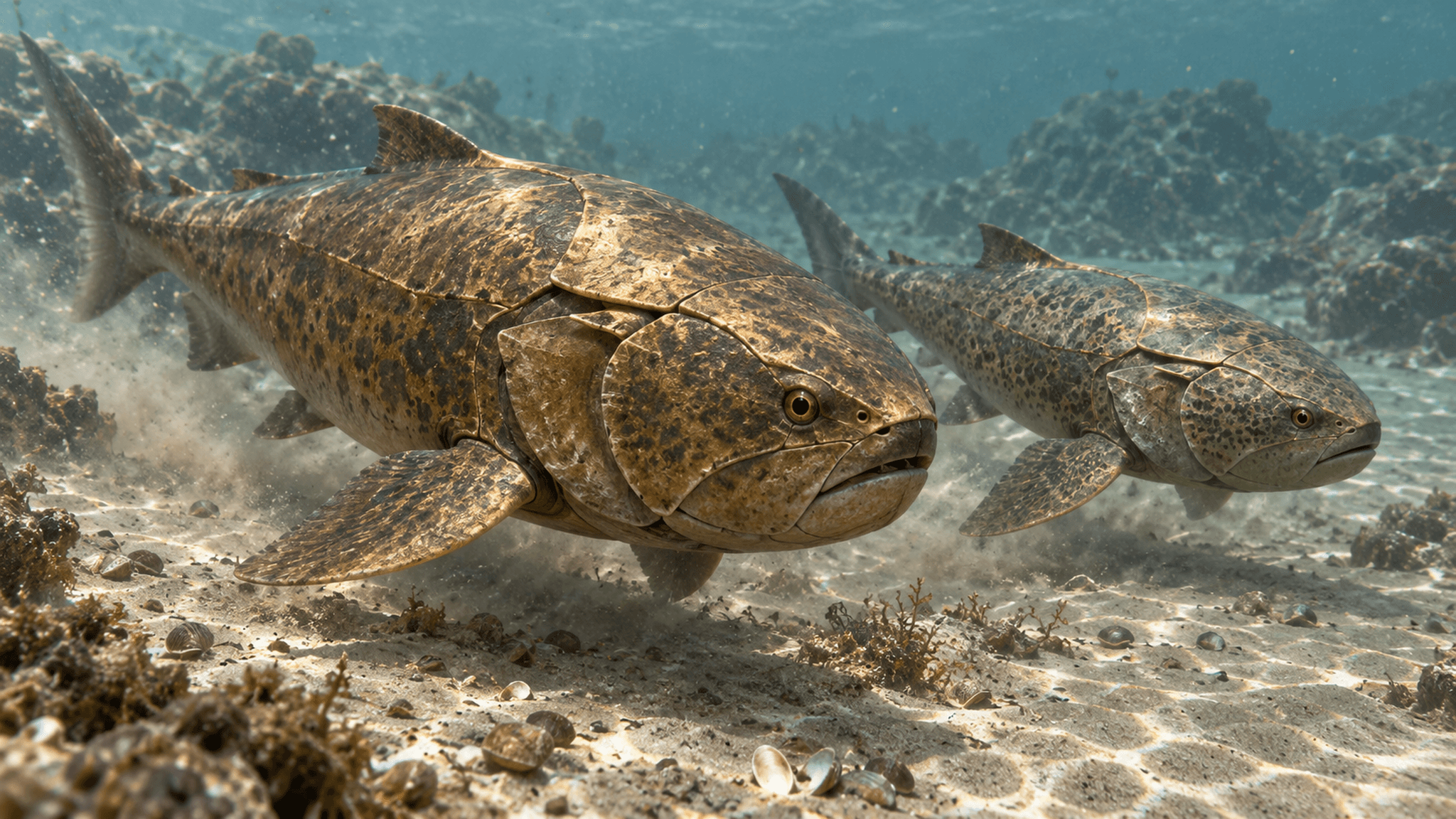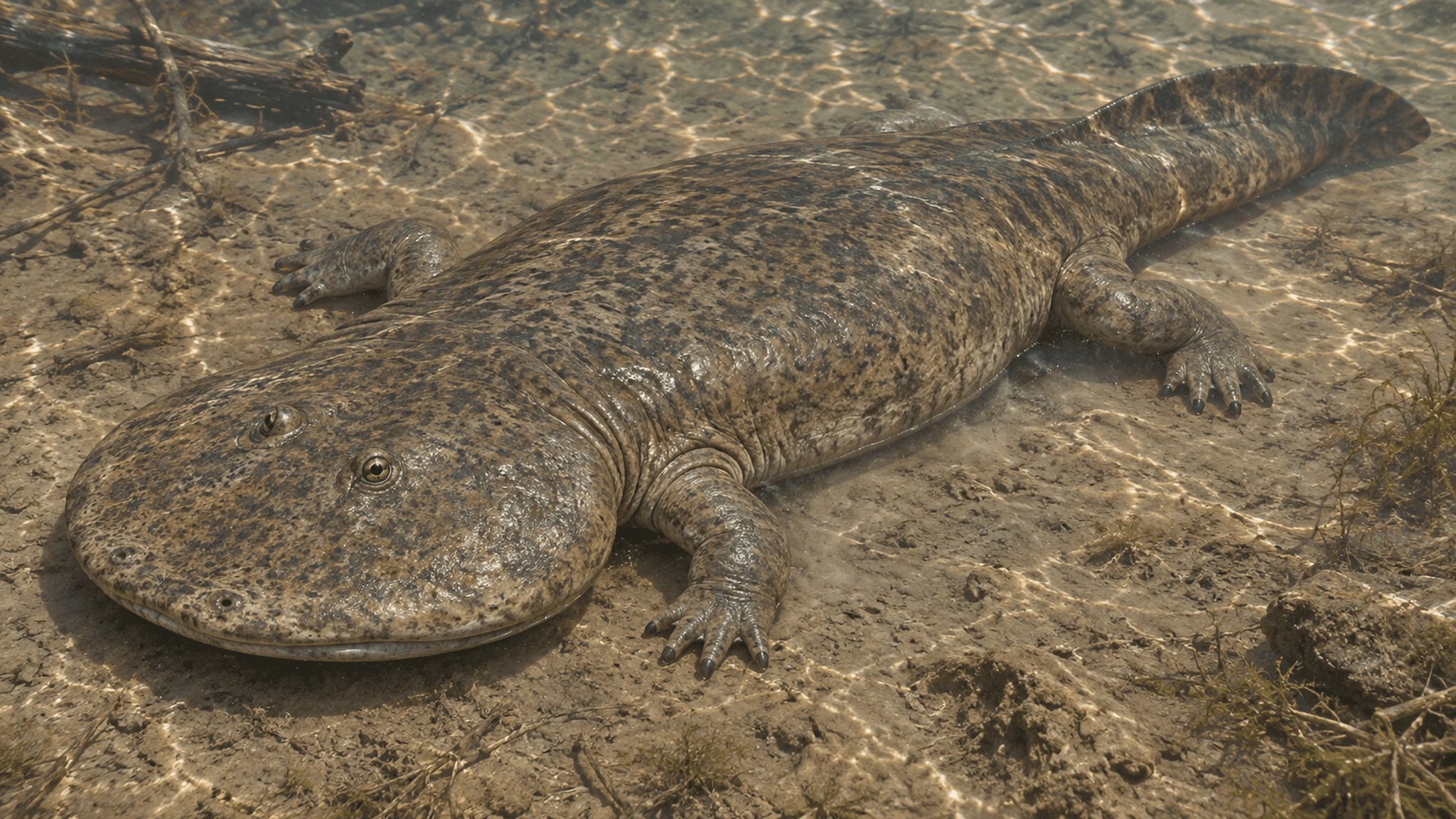
A team led by Daniel Schwarz of the State Museum of Natural History Stuttgart reports the findings in the Journal of Anatomy. The researchers examined more than 40 specimens of Mastodonsaurus giganteus. Their 3D model was based on a fully articulated skull scanned using micro-CT.
Reading muscles from traces on bone
Muscles do not fossilise, but they leave scars, ridges and hollows on bones. The team searched for these traces on the skull and compared them with the heads of living relatives. The researchers stained their muscles and then digitally dissected them in the scanner.
Every statement about flesh and cartilage therefore remains a reasoned reconstruction. The team itself classifies the tongue, cartilage pulley, ballast bones and suction as merely probable or possible. And because the relationship between these early amphibians and modern frogs and salamanders remains uncertain, the researchers tested several muscle variants side by side.
A giant longer than a small car
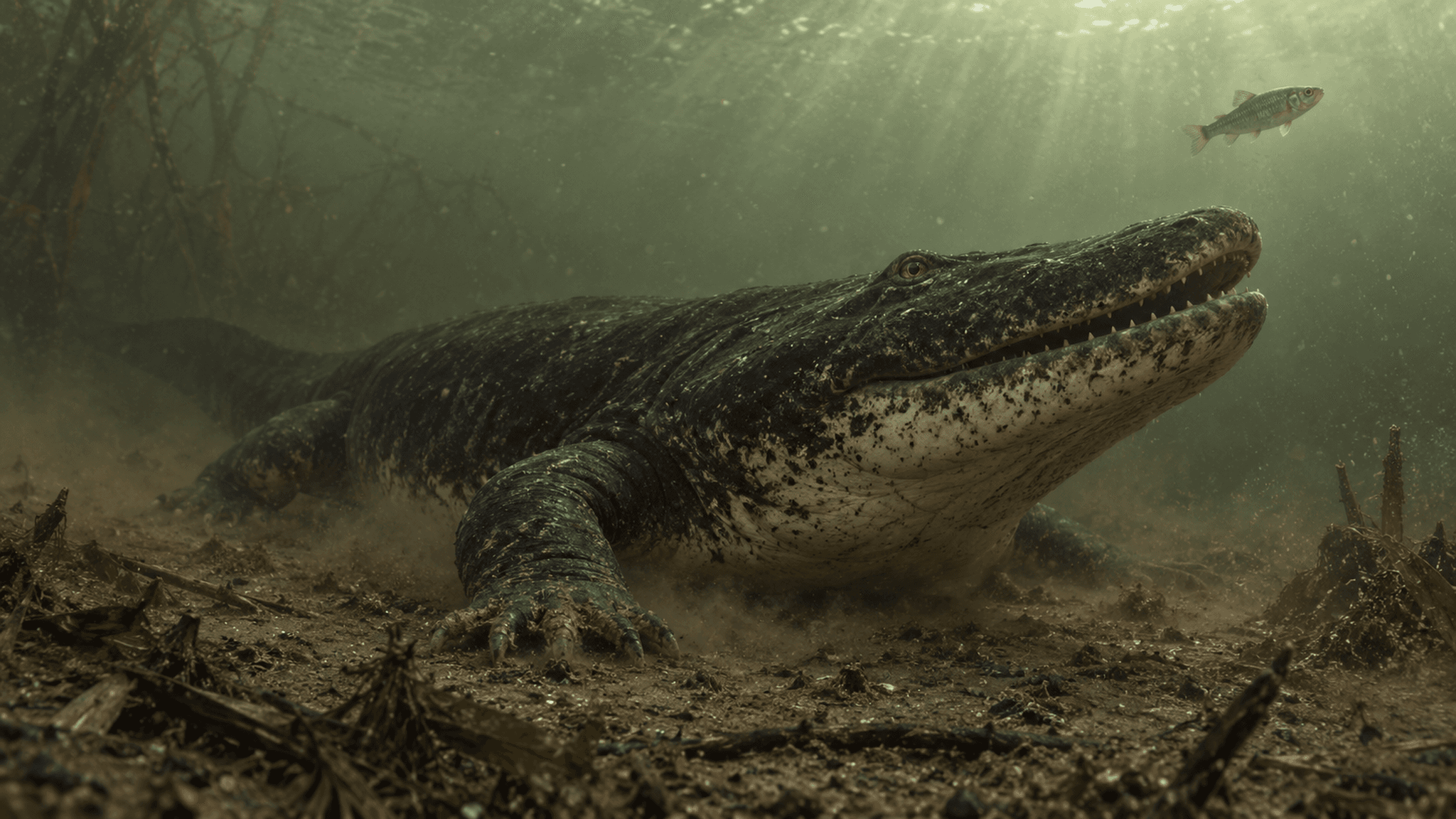
Mastodonsaurus lived about 247 to 235 million years ago in swamps, lakes and river deltas. Its skull measured roughly 1.2 metres, while the whole animal reached about five metres. A 2024 growth study describes it as an apex predator that lived almost entirely in water.
The authors interpret heavily ossified bones in the shoulder girdle as ballast that held the colossus on the bottom. They see the same pattern in the related Metoposaurus. The hunt can therefore be imagined as a reconstruction: the giant rests in the mud, a fish passes overhead through murky water, one sudden jerk — and the mouth flies open.
The wrong picture for almost 150 years
At London’s Crystal Palace in 1854, a Mastodonsaurus stood as a lumbering giant toad. Footprints wrongly attributed to it were to blame, and Zdeněk Burian still painted it that way in 1955. Only in 1999 did Rainer Schoch use fossils from Kupferzell to reveal a slender, crocodile-like hunter with a long tail.
Schoch is also part of the new team. Now his crocodile amphibian has gained the muscles it was missing.
Hidden muscles beneath the palate
The biggest surprise lay out of sight. On the upper surfaces of the pterygoids, two flat bones in the palate, the researchers found attachment sites for pterygoid muscles. Such jaw-closing muscles had never before been demonstrated in this group of early amphibians.
They were overlooked for a simple reason: in a complete skull, this surface cannot be seen from the outside. The authors read the traces as evidence of additional closing force. The muscles may also have helped the animal wrench its mouth open at lightning speed.
The large main jaw muscles now look different too. Earlier reconstructions treated them as two rough bundles. The Stuttgart team divides them into individual strands, revealing a much more finely structured biting apparatus.
A cartilage pulley redirects the force
According to the reconstruction, a small piece of cartilage sat in the lower jaw and worked like the wheel of a pulley. A chewing muscle passed over it, changed its direction of pull and transferred its force to the jaw. Modern crocodiles and some turtles possess exactly this kind of component.
The Stuttgart researchers did not invent the pulley from scratch. Scientists had previously proposed one for the related Parotosuchus helgolandicus.
Biting and holding like a crocodile
The weak tongue could barely move prey. But Mastodonsaurus had a powerful neck and specially shaped front ribs. The authors interpret this combination as a crocodile-like feeding method: bite, hold on and never let go.
They also assign it to a feeding method specialists call kinetic-inertial feeding.
The trick behind the opening strike
Here the apparent contradiction between the weak tongue and powerful muscular system is resolved. The earliest tetrapods — the first vertebrates with legs rather than fins — sucked their prey in underwater. Over time, they relied increasingly on seizing it with their jaws.
In Mastodonsaurus, opening and closing worked more evenly than previously thought, according to the reconstruction. When the giant wrenched its mouth open, the model suggests that suction could have drawn in water and prey. The amphibian bit like a crocodile while carrying an inheritance from its fish-like ancestors inside its skull.
In the transitional animal Tiktaalik roseae, half fish and half tetrapod, a 2021 X-ray analysis revealed sliding joints in the skull. These allowed it to widen its head sideways and suck, but also to bite. The skull of Mastodonsaurus, by contrast, was rigid, although opening its jaws rapidly may have produced additional suction.
A blueprint for the conquest of land
Computer models of feeding in early tetrapods are only as good as the muscles built into them. The Stuttgart giant now provides a precisely reasoned muscular blueprint. Researchers hope to use it to discover how the first land vertebrates broke free from the water, bite by bite.
---