
One important point first: the findings come from a presentation delivered at the 177th Annual Meeting of the Palaeontological Society of Japan at Osaka Metropolitan University on 27 June 2026. No peer-reviewed study has yet been published. Other specialists have therefore not examined the findings through a formal review process.
The case begins in Kaizuka
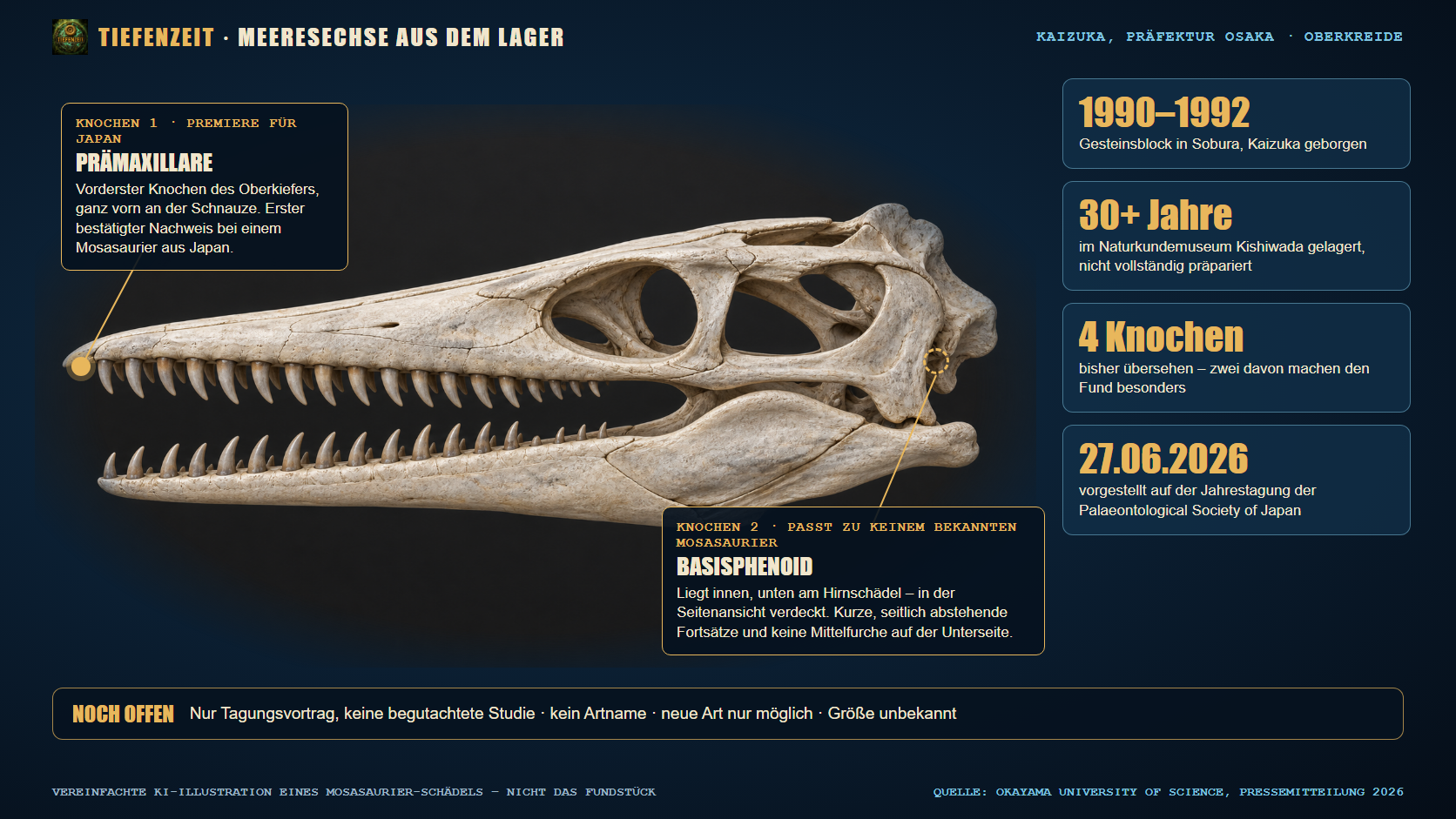
The block came to light between 1990 and 1992. It was found in Sobura, in the city of Kaizuka, Osaka Prefecture. The rock contained the remains of a mosasaur.
The block went to the Natural History Museum of Kishiwada City. There it remained for more than three decades. The material had not been fully prepared — in other words, it had not been completely freed from the surrounding rock.
At the time, researchers could not determine everything hidden inside it. They lacked comparative specimens. Identifying a single bone requires suitable counterparts from other finds. In the early 1990s, that collection was still limited.
Who were the mosasaurs?
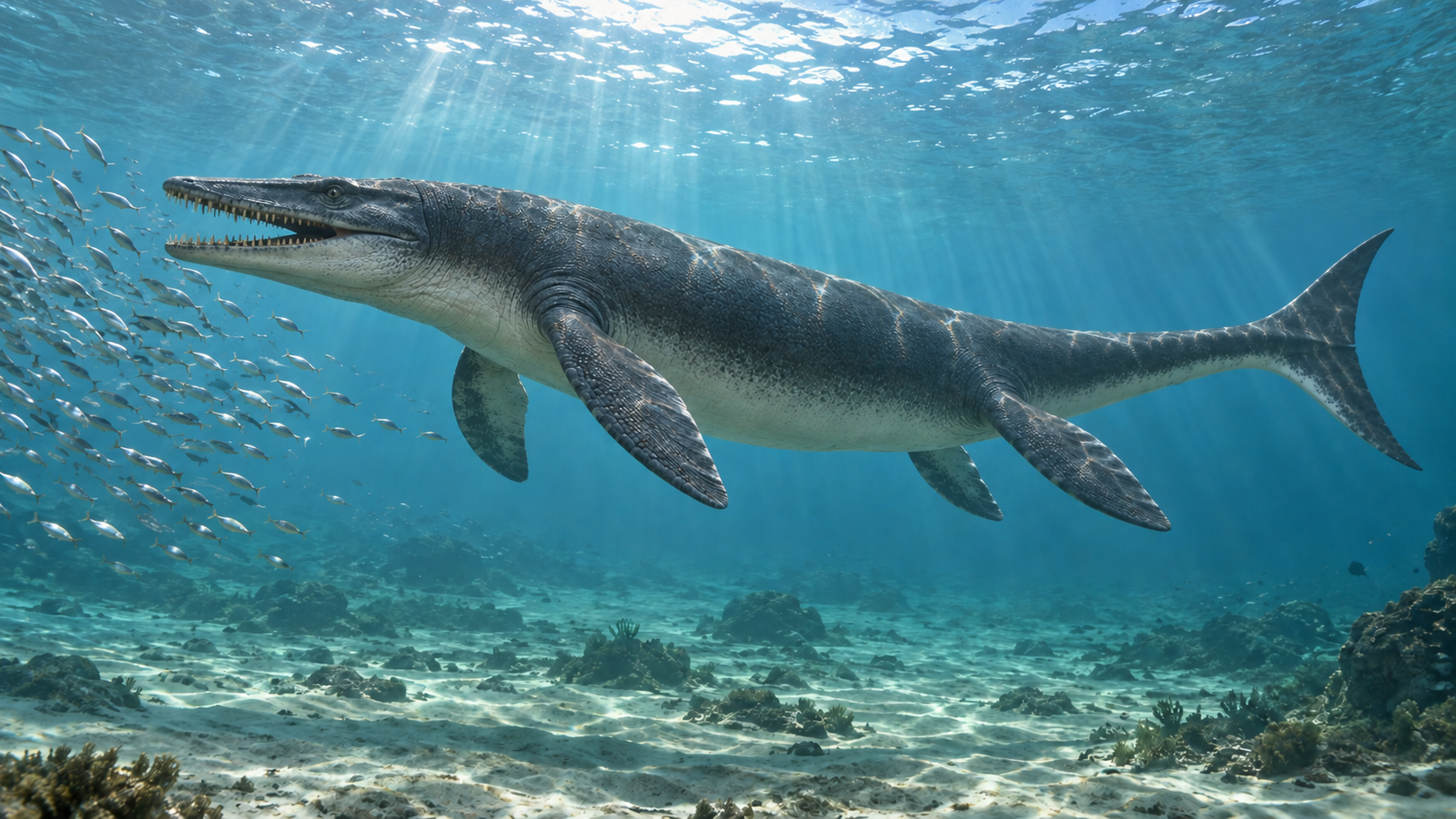
Mosasaurs were marine reptiles from the Late Cretaceous. The press release dates this period to roughly 98 to 66 million years ago.
The release does not reveal how large the animal from Kaizuka was. Nor does it name a genus. The case hinges on individual bones — and those bones pack a punch.
A fresh look at an old block
A new examination turned the case around. Researchers from several Japanese institutions, including Okayama University of Science and the museum in Kishiwada, returned to the rock.
By then, mosasaur research around the world had amassed many comparative specimens. That knowledge allowed the team to read what had remained unreadable for decades.
The result: four bones that nobody had previously recognised as such. They were trapped in material that had not been fully prepared. Two make the find remarkable.
A first for Japan: the foremost upper jaw
The first is a premaxilla. This is the foremost bone of the upper jaw, right at the tip of the snout.
According to the team, it is the first confirmed record of this bone in a mosasaur from Japan. The researchers rank it among the most important results of their investigation.
But this jawbone is a first for Japan, not a mystery to science. The release does not say that it matches no known mosasaur. The real surprise sits farther back in the skull.
The “horns” are inside the skull
The second key bone is the basisphenoid. It forms part of the braincase, the bony structure surrounding the brain.
Two features stand out. Short, horn-like projections jut from its sides. And its underside lacks a median groove — a channel running along the midline.
Anyone now picturing a horned marine reptile has the wrong idea. These “horns” are short bony projections on the braincase. They would not have been visible from outside the living animal.
According to the team, this exact combination sets the specimen apart from all mosasaurs described so far. A forgotten block has become a candidate for something new.
A new species? Not yet
The researchers consider it possible that the bones belong to a previously unknown species. At the same time, they make the limit clear: further investigation must determine whether that is true.
There is no species name. There is no formal species description either. And a conference presentation is not a peer-reviewed publication.
That is more than a formality. In a scientific paper, researchers set out their comparisons in detail, and independent specialists examine them before publication. Only then can the strength of the reported differences be assessed reliably.
What is still missing
The press release does not identify the other two rediscovered bones in detail. It also leaves open how much of the animal survives in the block overall.
The biggest question concerns the basisphenoid. Do its lateral projections and missing median groove truly mark a distinct species? That is precisely what the team intends to investigate further. Until then, the new marine reptile remains a possibility.
The storeroom becomes a fossil site
The story shows what may lie dormant in museum collections. The Kaizuka block was not a new discovery. What was new was the way researchers looked at it.
More than three decades after its recovery, the rock has delivered a first for Japan and a skull bone with an unusual combination of features. Whether it becomes a new species will be decided not by the headline, but by further research.
Source
Yasuaki Takano, Shoji Hayashi, Yasuhisa Nakajima, Satoshi Utsunomiya, Yuma Asai, Miho Kazama and Katsunori Watanabe: presentation at the 177th Annual Meeting of the Palaeontological Society of Japan, Osaka Metropolitan University, 27 June 2026. No peer-reviewed publication, no DOI. Press release: *First identification of a Mosasaur Premaxilla in Japan*. [EurekAlert](https://www.eurekalert.org/news-releases/1136715)