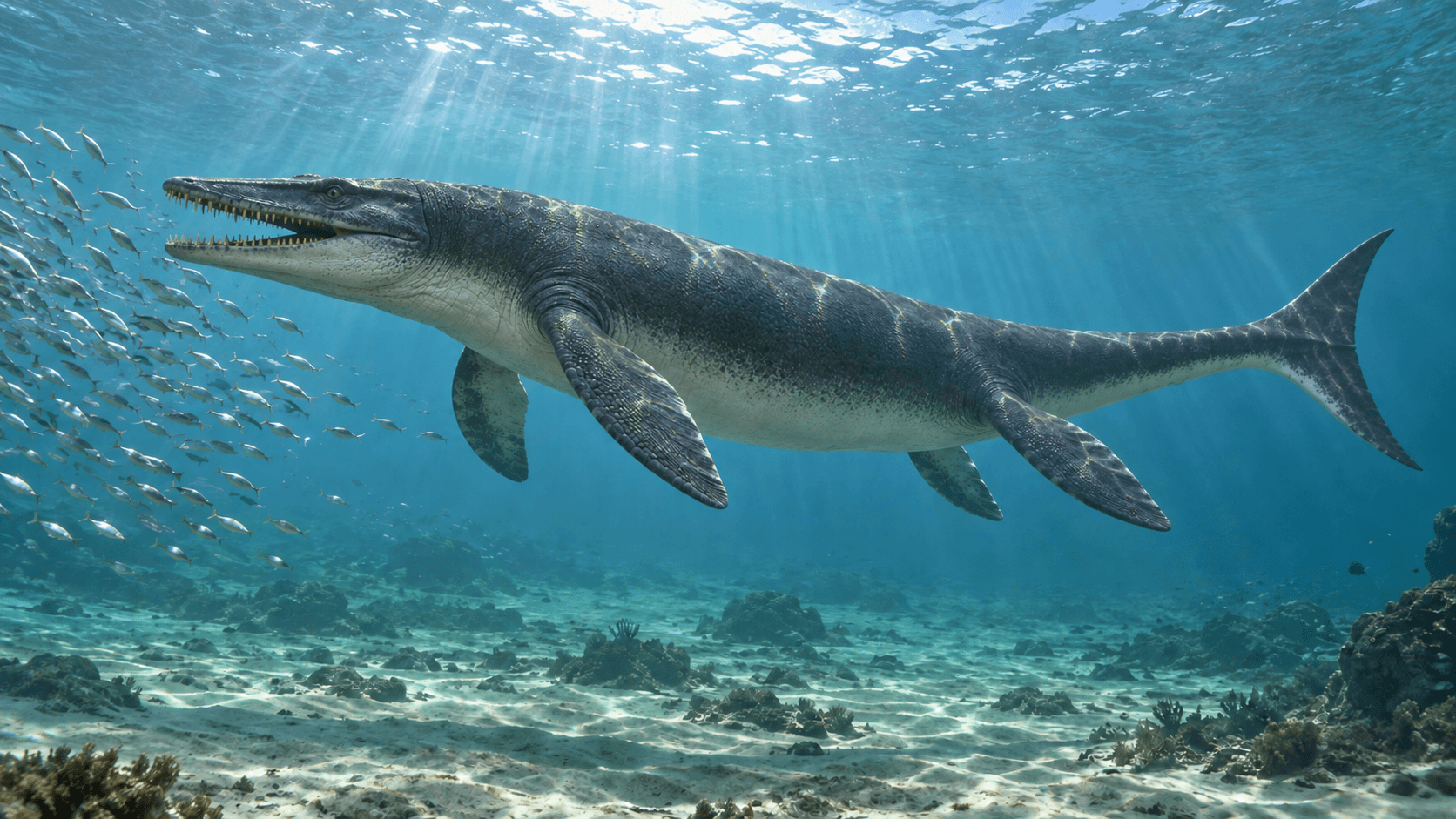
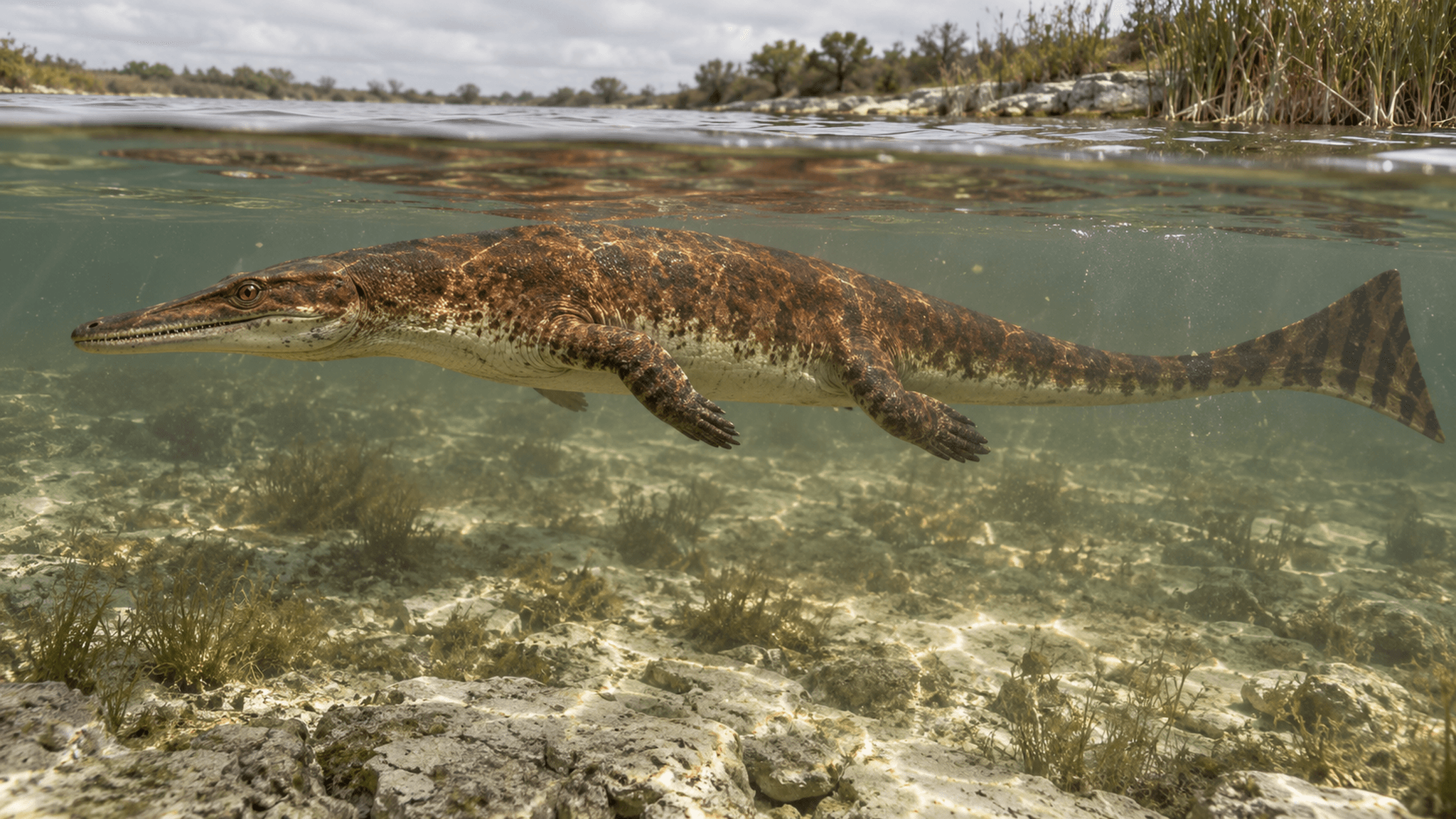
A team led by Nathalie Bardet of the Centre de Recherche en Paléontologie in Paris presents the new species in Peer Community Journal. The bones come from the Santonian, a stage of the Late Cretaceous dating from about 86 to 84 million years ago. At that time, most mosasaurs ploughed through the open sea with flippers, long skulls and laterally flattened tails.
Flippers? Not Here. This Animal Had Legs
Garamaudo bauciensis breaks with that body plan. Its limbs look as though they once carried an animal across solid ground. A sacrum locks the pelvis to the spine.
Then there are the heavy bones. At least the vertebrae and upper arm are unusually dense and massive inside, a condition specialists call osteosclerosis. Seven centimetres of the slender upper arm survive. The pelvis measures 14 centimetres, roughly the length of a biro.
The shapes of the individual bones fit this picture too. The two ends of the upper-arm bone sit at almost a right angle to each other. In the pelvis, the bones are fused around the hip socket where the thigh bone sits. The ilium, the upper pelvic bone, is eight centimetres long and points backwards. The pubis measures 8.3 centimetres.
Early mosasaurs looked much like this. They had legs like land animals, bodies like monitor lizards and lived in shallow coastal waters. According to the authors, the upper arm, pelvis and lower jaw of the new find resemble these early forms.
Limestone from the Lake Bed Reveals Its Home
Beside the RD8 road in Bouc-Bel-Air lies a small outcrop, an exposed rock face. Beige-brown marl, a clay-rich rock containing lime, alternates there with grey limestone beds deposited on the floor of a freshwater lake. Traces of Earth’s magnetic field, frozen into the rock, probably pin the layers to the Santonian.
The strata provide strong evidence that the animal lived in a freshwater environment. Garamaudo probably stayed in shallow water there. The bones do not reveal what it ate or how it hunted.
Hungary’s Freshwater Giant Has Company
The newcomer was not alone. Since 2000, researchers have recovered bones of Pannoniasaurus, the first known freshwater mosasaur, from the Iharkút bauxite mine in Hungary. It also dates from the Santonian, grew up to six metres long and, according to geochemical measurements, lived permanently in freshwater.
In recent years, researchers have also discovered mosasaur remains in freshwater deposits at several other sites on what was then the European mainland. They date from the Santonian and the Campanian stage that followed it.
Garamaudo and Pannoniasaurus share a long, slender rear section of the lower jaw, measuring about 12.8 centimetres in the Provence specimen. The articular processes of their vertebrae also project far forwards. That places two named freshwater mosasaurs from the Santonian side by side.
When it comes to legs, however, the Hungarian evidence leaves researchers in the dark because Pannoniasaurus is known mainly from skull and vertebral remains. The Provence find now provides pelvic and limb bones from another freshwater mosasaur.
The Trail to Morocco Closes the Circle
A third relative lived earlier and farther south. Tethysaurus comes from rocks about 93 to 89 million years old near Goulmima in Morocco, remained under three metres long and gave the tethysaurines their name. It was long regarded as a link between very early species and later mosasaurs, but more recent analyses now classify it differently.
Its lower jaw and pelvis resemble those of the new find. Only one projection at the jaw joint is longer, more triangular and more obliquely oriented in Tethysaurus.
As early as 2013, specialists noted that Tethysaurus and Pannoniasaurus had retained the old construction of the legs and pelvis. The authors now add Garamaudo bauciensis to that group, along with a previously described mosasaur from Villeveyrac. The surviving limb and pelvic bones tip the balance.
Only One Lineage Moved into the Lakes
According to the study, several freshwater forms evolved exclusively among the tethysaurines, and this was precisely the lineage that held on to the old legs and pelvis. At the same time, most other mosasaurs remodelled their limbs into flippers and conquered the open sea.
The researchers see this as a possible division of habitats within a single animal group. Some retained the body plan of their early relatives and probably occupied new freshwater niches. The others conquered the open sea.
For the authors, this means that mosasaur evolution followed more varied paths than previously assumed. The great marine reptiles of the Cretaceous had relatives that probably lived in lakes.
---