
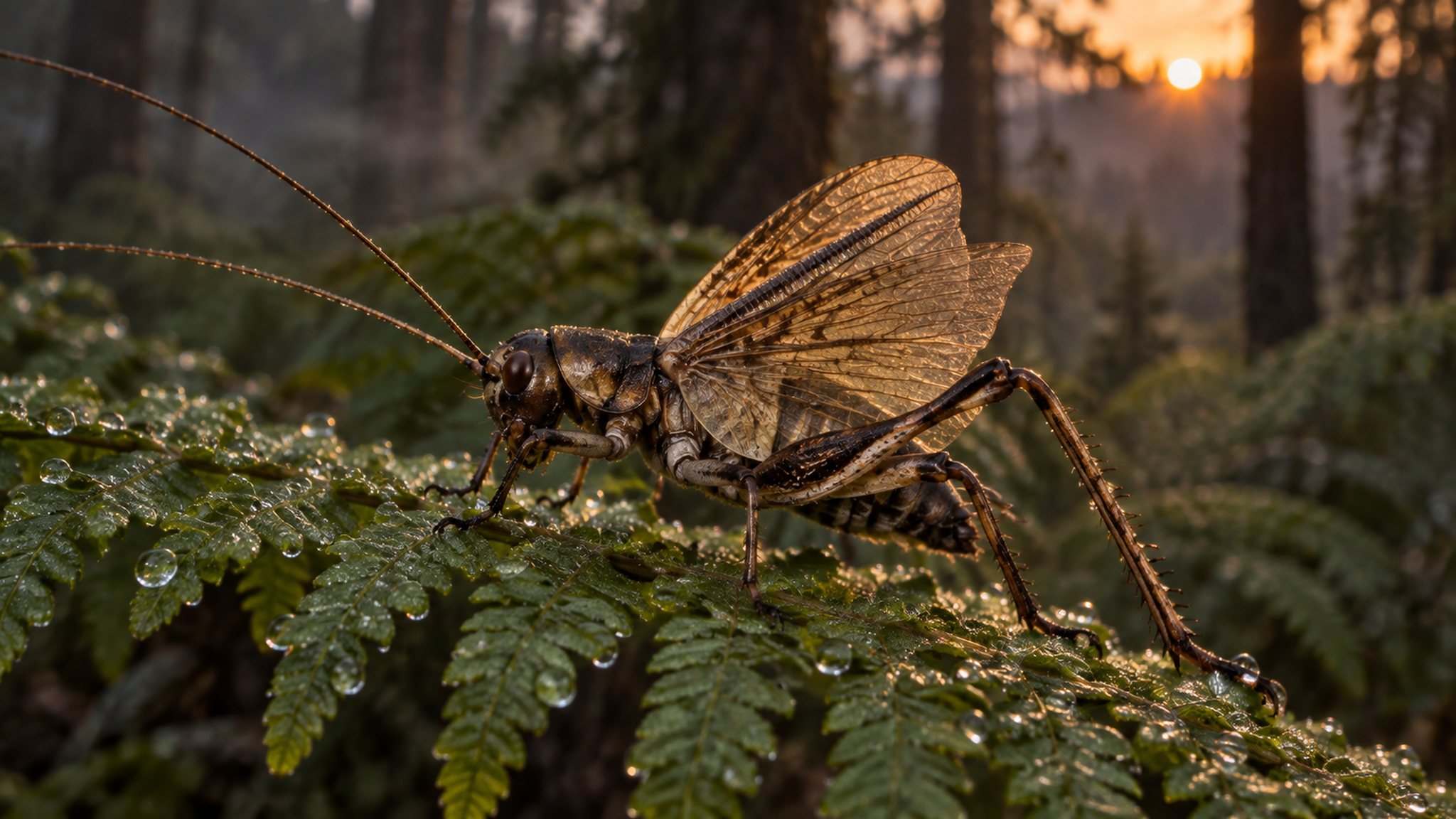
The prey sings. The hunter listens.
A call carries a message through the surroundings. It also reveals something about where its sender is sitting. For singing insects, that creates a conflict: communication makes them interesting to their enemies too.
The new study brings that connection into focus. Its reconstructions reveal pure-tone calls, signals concentrated at a single frequency. The authors interpret this form of song as an adaptation that made it harder for listening predators to pinpoint the singers.
That gives the chirping a sharper edge. The connection between the prey's signal and the hunter's hearing becomes central to the story. Understanding these insects' soundscape means looking at both ends: the wing producing the sound and the ears picking it up.
One singer crossed into ultrasound
The standout finding concerns exactly one of the nine species studied. Its reconstructed call lies above 20 kilohertz, in the ultrasonic range. The study thus traces this form of insect communication back to the Middle Jurassic.
Bats emerged much later, in the Eocene. They can therefore be ruled out as the trigger for this early ultrasonic call. The little singer beat them to it: its high frequencies belonged to a soundscape that existed long before these flying hunters.
Attention turns to earlier listeners. The researchers draw on the evolution of mammalian hearing thresholds. They connect the history of insect song with the question of which signals early mammals could detect.
The authors propose an acoustic arms race with early listening predators that helped shape both insect song diversity and the hearing systems of mammals and insects; this does not establish mammals as the cause. The precise identities of the hunters involved remain unknown.
Twenty fossils, nine different singers
The trail leads to the Jiulongshan Formation in Inner Mongolia, China. All 20 insect fossils examined come from one locality. They represent nine species of ensiferans, the group that includes crickets and their relatives.
Even this selection opens up a varied soundscape. The reconstructed calls differ in frequency and repertoire. Alongside the single ultrasonic singer, the study captures the wider range of signals among the insects examined.
That variety has a physical basis. The study connects it to differences in wing size and specialised shapes of the sound-producing files. These animals had differently built tools for making sound, and those differences shaped their songs.
The locality brings the different singers together in one investigation. Individual specimens combine into a picture of acoustic diversity during the Middle Jurassic. A small collection of fossil insects opens a window onto a world of signals.
The instrument is in the wing
In male crickets and their relatives, the tools for making sound sit on the forewings. A file and a corresponding edge, called a plectrum, form the sound-producing apparatus. Both structures can be recognised and measured in suitable fossils.
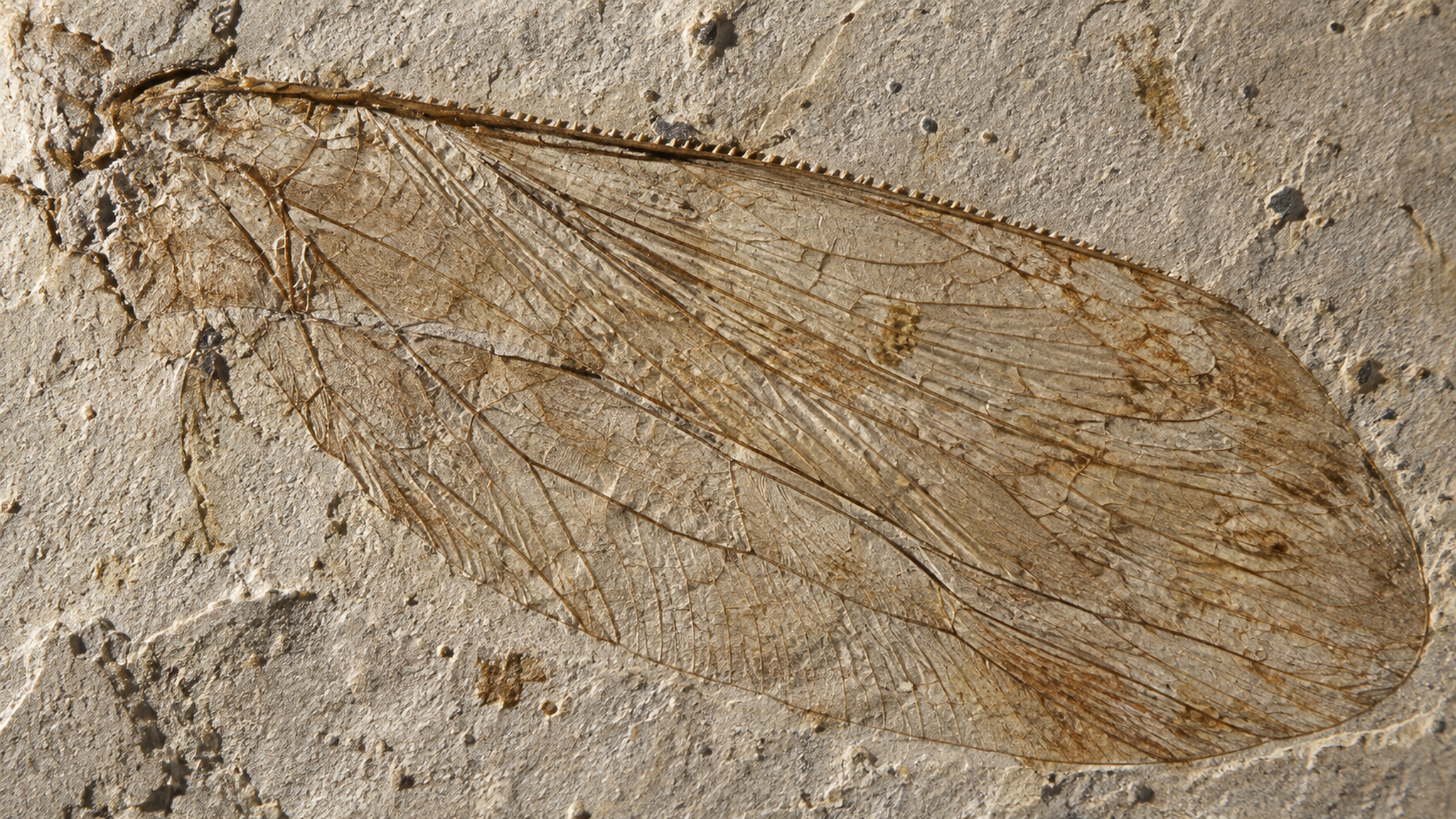
Their decisive advantage lies in the material: they belong to the hardened outer covering. These hard parts preserve well enough for their shape to be examined. Soft vocal organs in vertebrates, by contrast, rarely survive well in fossils.
An unassuming wing becomes a valuable witness. Its construction carries an acoustic fingerprint. The preserved shape offers clues to the signal this instrument once produced.
The research starts with the singer's own equipment. Size and construction can be compared and combined with the insects' evolutionary relationships. This approach already allowed researchers to estimate call pitch in fossil insects.
A laser helps decode the song
The new work goes beyond pitch to investigate wing vibrations and the timing of songs. The team combines evolutionary analysis with computer simulations, an AI-based approach and laser measurements of vibration. The measurement technique, laser Doppler vibrometry, detects motion without contact.
The approaches work together: preserved structures, evolutionary relationships and vibration behaviour jointly provide the material for reconstruction. From fossil wings, the team builds a picture of calls from a long-silent insect community.
Its most spectacular singer places ultrasonic communication firmly in the Middle Jurassic. Long before bats arrived, insects had already reached these high frequencies to communicate.