But how do experts reach this conclusion? The critical reassessment shows that a unique track in the rock cannot be assigned directly to a particular species. Several factors shatter that simple interpretation: ground conditions, preservation and locomotion can dramatically alter a print.
When the Mud Lies
A bird lands in a soft delta during the Late Cretaceous. It presses its toes deep into the damp ground, slips slightly and leaves a broad, distorted mark in the sediment. Millions of years later, a palaeontologist discovers the track — and might rashly mistake its shape for the footprint of a separate species.
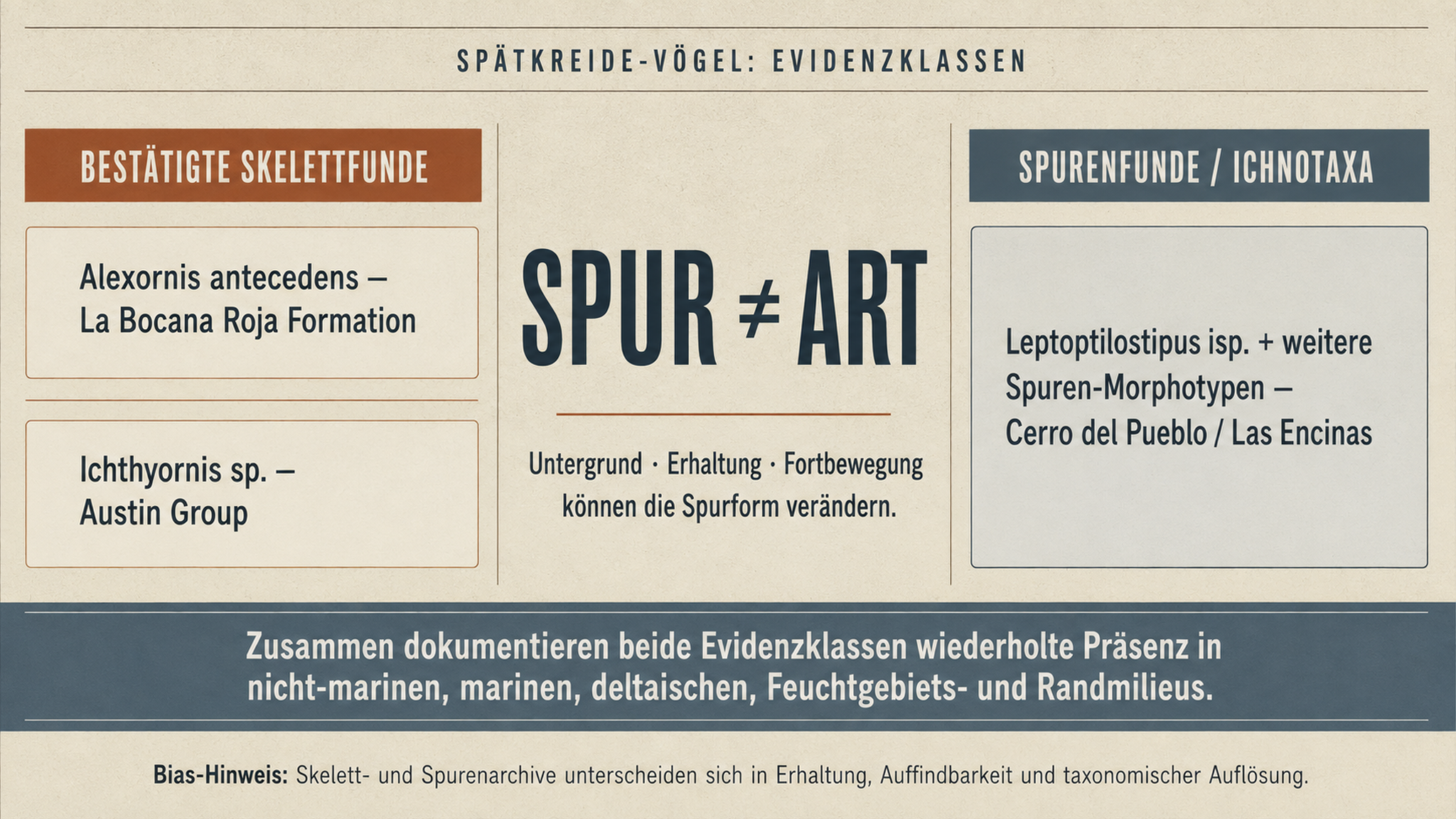
This is the heart of the problem. The researchers now make it clear: a footprint is not a biological calling card. The substrate can alter the shape of a print so severely that it no longer reveals the animal’s true anatomy unambiguously. Substrate properties — the consistency and moisture of the ground — manipulate the result.
The speed at which a bird ran, or its particular pattern of movement, also changes the print. A single bird can therefore leave utterly different tracks depending on whether it strides across hard sand or trudges through sticky mud. Anyone who directly equates these morphotypes — mere variations in form — with biological species is making a fundamental mistake.
The Hard Evidence in the Rock
To uncover the truth about the fauna, bones are essential. Genuine skeletal remains of *Alexornis antecedens* have been confirmed from the Campanian La Bocana Roja Formation. This representative of the Enantiornithes — an extinct group of “opposite birds” from the Campanian — provides indisputable evidence that these animals were present.
Finds from the Austin Group also confirm the existence of *Ichthyornis sp.* These remains date from the Coniacian to the Campanian and plant a firm anchor in Mexico’s Cretaceous history. While tracks permit only an inference, these bone-bearing sites establish a fixed point in Mexico’s deep past.
North-eastern Mexico also contains several occurrences of bird-like ichnofossils from the Cerro del Pueblo and Las Encinas formations. They include the recognised ichnotaxon *Leptoptilostipus isp.* An ichnotaxon is not a biological species, but a scientific name for one particular type of track.
An Empire of Mud and Salt
Together, the genuine bones and varied tracks now draw a precise picture. Mexico’s Cretaceous birds were not a solitary footnote; they appear repeatedly across several environments. They occupied an astonishingly broad range of habitats in what was then southern North America.
Their tracks and bones lead into marine settings and the delta landscapes of the Cretaceous. They lived in wet marshlands as well as non-marine environments in the continental interior. This broad distribution makes Mexico an important window onto the Cretaceous birds of southern North America.
The reconstruction is clear: where water and food were available, these animals were present. Between coasts, deltas, wetlands and non-marine landscapes, bird-like dinosaurs apparently occupied different niches. The chain of evidence from osteology (the study of bones) and ichnology (the study of traces) documents their recurring presence in non-marine, marine, deltaic, wetland and marginal environments.
The Gap in the Archive
Despite these findings, one problem remains: compared with other vertebrates, Mexico’s fossil record is extremely patchy. Much of what we know rests on a very small sample. Preservation and sampling are massively distorted.
The preservation of small vertebrate remains is an enormous source of uncertainty in Mexico’s fossil record. Many small bird bones apparently never enter the fossil archive permanently at all. This probably means that today we see only a fraction of the diversity that once existed.
Scientists recognise that many animals simply never endured in stone. To complete the picture, existing collections must be re-examined and targeted searches made for tiny bone fragments. Systematic reanalyses of historical sites could decisively sharpen the incomplete picture of Mexico’s Cretaceous birds.
The importance of this work lies in its methodological rigour. By separating track shape from biological taxon, researchers pull the ground from beneath potential phantom species. Mexico therefore supplies an important piece of the puzzle surrounding bird distribution in the Late Mesozoic and exposes just how treacherous the interpretation of footprints can be.
***
**Primary source:** Review of Cretaceous Avian Dinosaurs from Mexico: Current Knowledge and Future Perspectives DOI: 10.3390/fossils4030024
*Discover more insights into the prehistoric world on Tiefenzeit’s YouTube channel.*