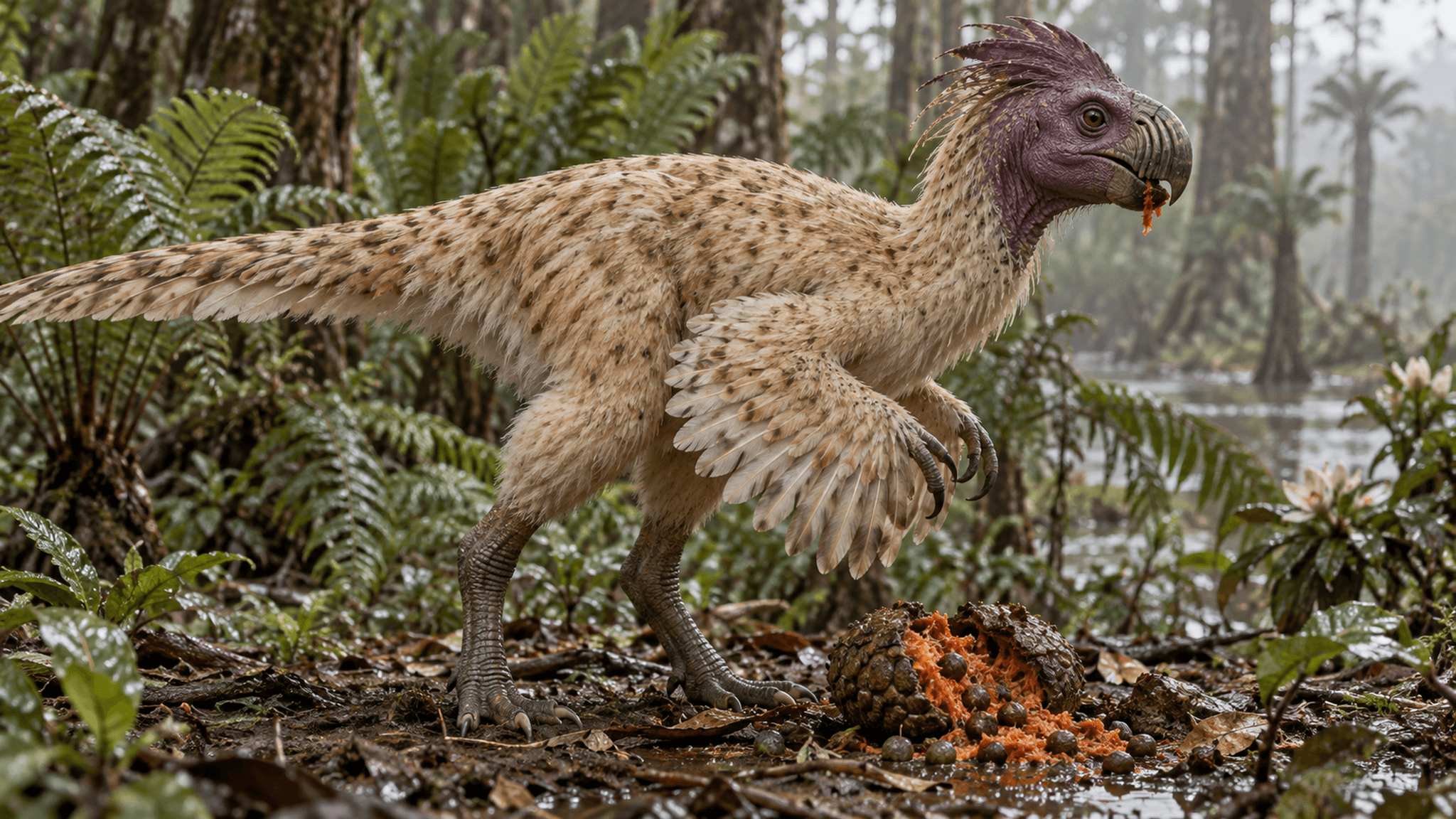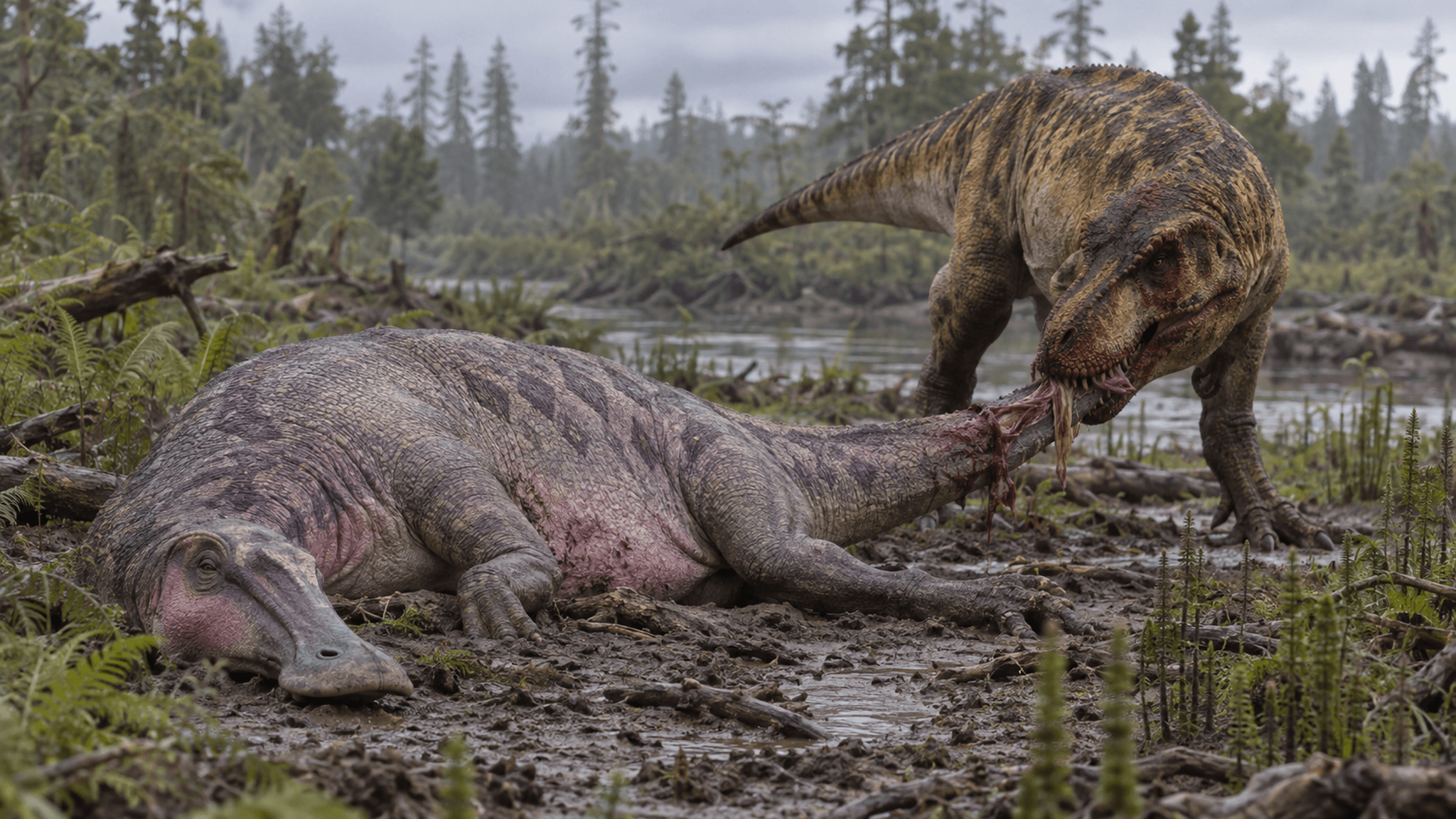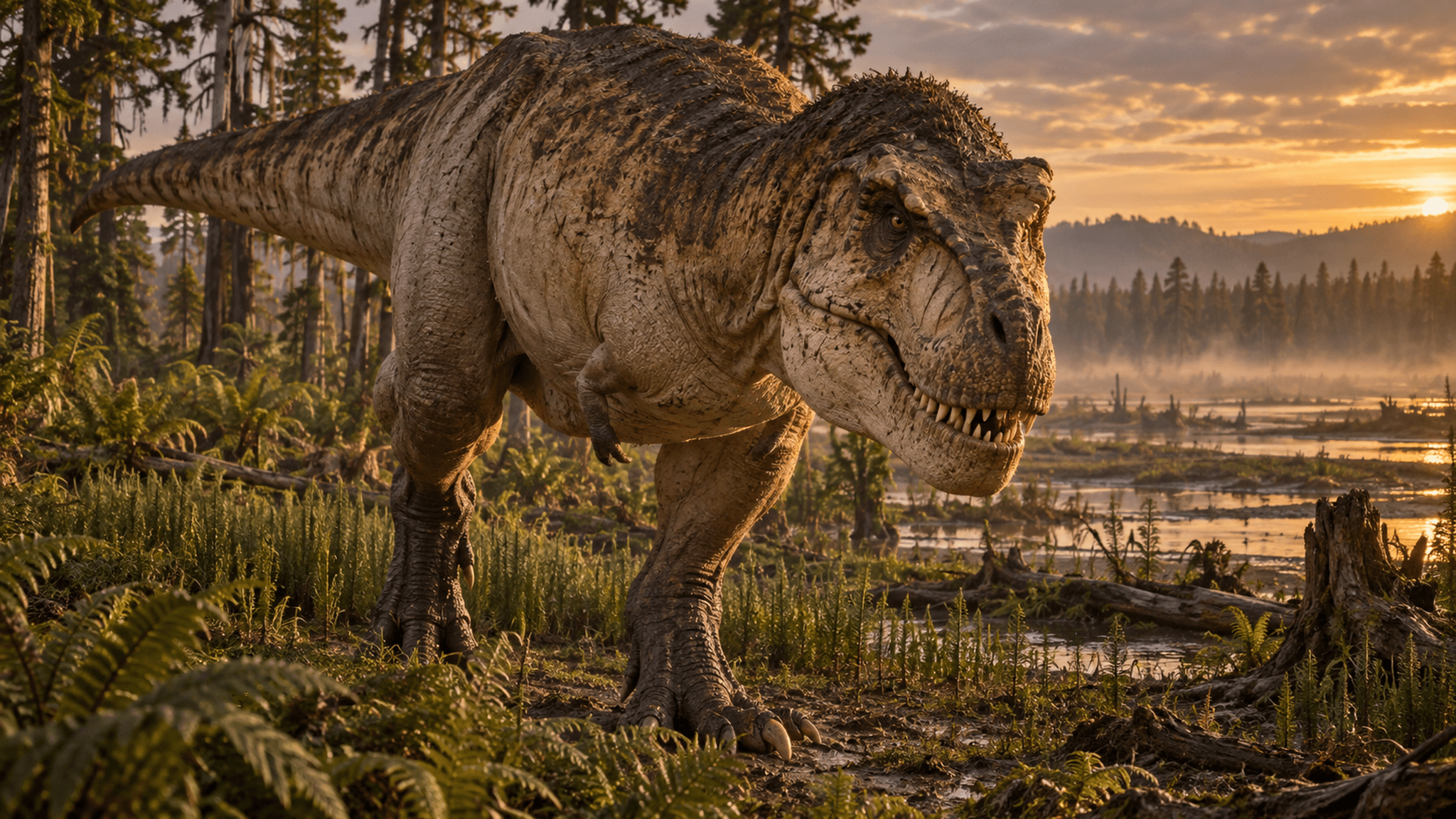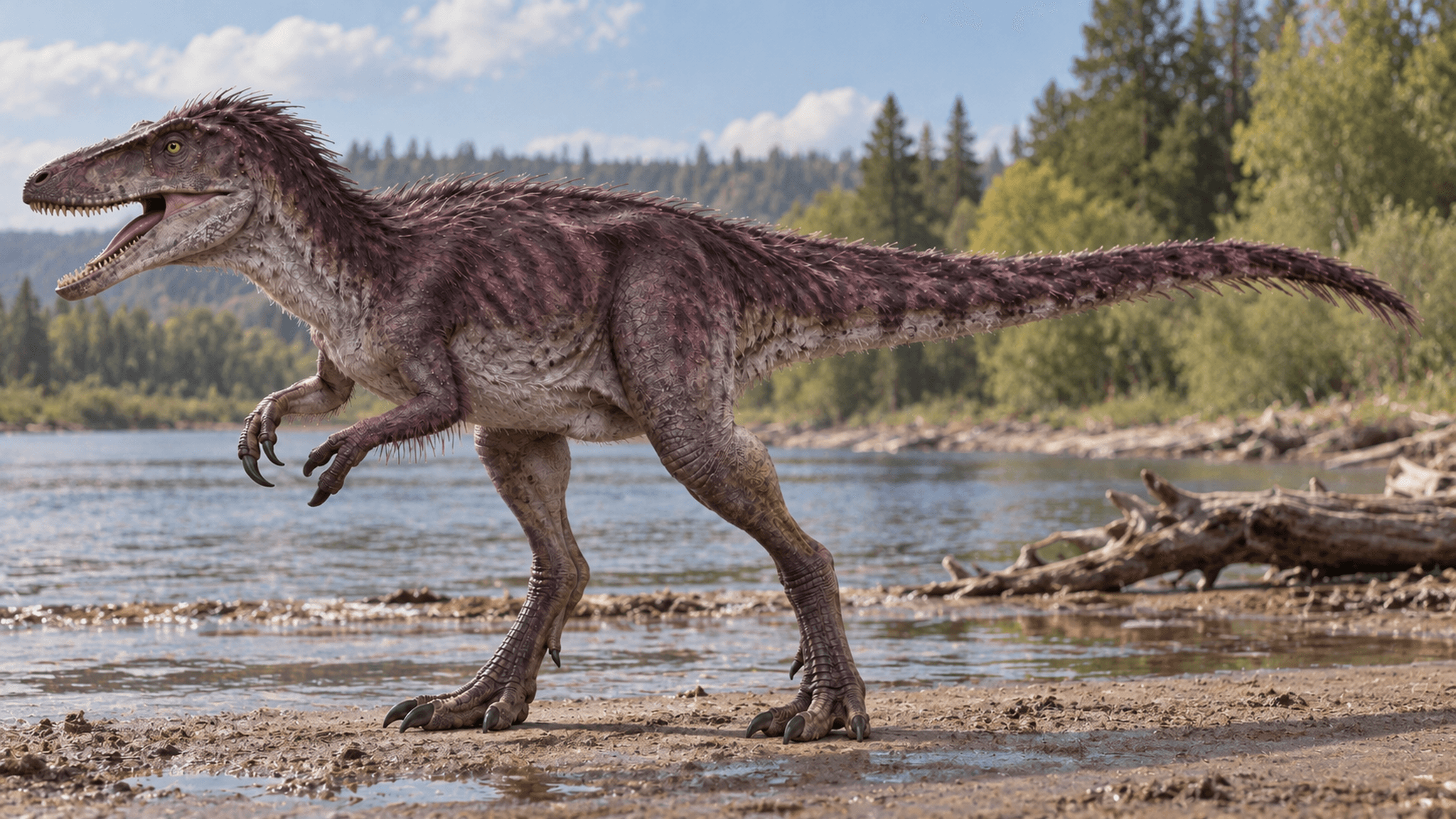
The new name rests on research published in 2025. A team led by Lindsay E. Zanno of North Carolina State University reported on another skeleton, known as the “Dueling Dinosaurs”, in the journal Nature. Since then, the little predator has had a strong case for recognition as a separate genus.
From Montana’s Rock to a New York Stage
In 2019, Jodi Pierson discovered the bones on her own land. That is what the catalogue’s provenance states. The site lies near Jordan in Garfield County, within the Hell Creek Formation, a layer of rock from the Late Cretaceous.
The lot description lists about 191 fossilised bone elements from a single animal. The skull is almost complete. Printed and modelled replacement parts fill the gaps in the mounted skeleton.
Jodi has been on public display in New York since 13 October. On stage, the animal looks complete; it was not found like that in the rock. The catalogue describes a seller’s offering and does not replace an independent assessment of this specimen.
A 60-Year Dispute: Child or Separate Genus?
In 1942, David Hosbrook Dunkle recovered a single skull. It started the dispute. Charles Gilmore named the specimen as the new species Gorgosaurus lancensis in 1946.
Anatoly Rozhdestvensky challenged that view in 1965. He proposed that such small predators were merely juvenile Tyrannosaurus rex. Yet in 1988, Robert Bakker, Michael Williams and Philip Currie placed the skull in a separate genus: Nanotyrannus.
The juvenile theory survived for around 60 years. Few questions in dinosaur research remained unresolved for so long. Jodi’s own story reflects the entire dispute: a young T. rex in 2023, Nanotyrannus today.
The Bones Reveal Its Age
Small does not mean young. A slender predatory dinosaur could be an adolescent or a fully grown animal. Size alone cannot settle the question.
Zanno and her colleague James G. Napoli therefore questioned the bones of the Dueling Dinosaurs skeleton. They examined, for example, whether the vertebrae had already fused firmly together. That happens only once an animal is well developed.
The result: an almost fully grown animal, clearly distinguishable from a young T. rex. The pair then compared it with numerous fossils from other relatives of T. rex. Their conclusion: Nanotyrannus is a separate genus alongside Tyrannosaurus.
Tiny Throat Bones Provide the Second Piece of Evidence
In December 2025, the Natural History Museum in Los Angeles followed up. It announced a second, independent study in the journal Science. Researchers had placed the hyoid bones of the original Nanotyrannus skull under the microscope—the delicate throat bones that support the tongue.
First, they tested the method on T. rex. The museum displays several T. rex individuals of different ages in its dinosaur hall, and their bones had already been examined under the microscope. Their hyoid bones carried the same growth rings as the long bones in their skeletons, rather like the annual rings of a tree.
Then came the Nanotyrannus skull. Its growth rings revealed an animal that was already well advanced towards maturity.
The Catch: Other Skeletons Were Tested
For the auction, there is a catch. Neither study examined Jodi. Both strengthen the case for Nanotyrannus as a separate genus.
They do not prove that Jodi belongs to the species lancensis. That is precisely why the cautious “cf.” appears in the catalogue name Nanotyrannus cf. lancensis. It means “comparable with”: the species has not been securely identified.
A Slender Rival to T. rex
Around 67 million years ago, Montana was a forested river plain with deltas along the edge of an inland sea. It was warm, with no severe winter. In this reconstruction, a slender biped stalks through riverside woodland while horned dinosaurs feed beside the water.
Prey was plentiful. According to a 2011 count by Horner and colleagues, around 40 per cent of dinosaur finds from the Hell Creek Formation belong to horned dinosaurs. Tyrannosaurids—the family containing T. rex—account for only about 24 per cent.
According to her university, Zanno sees T. rex competing for prey with the slimmer, faster Nanotyrannus at the end of the Cretaceous. On that view, T. rex did not rule alone. No fossil, however, has captured a hunt.
The Price Will Be Decided on 27 October
Whether anyone will actually bid six to nine million dollars will become clear only on auction day. Science has already transformed Jodi’s world. The little predator that many regarded as a child for 60 years now stands beside T. rex in a genus of its own.
---