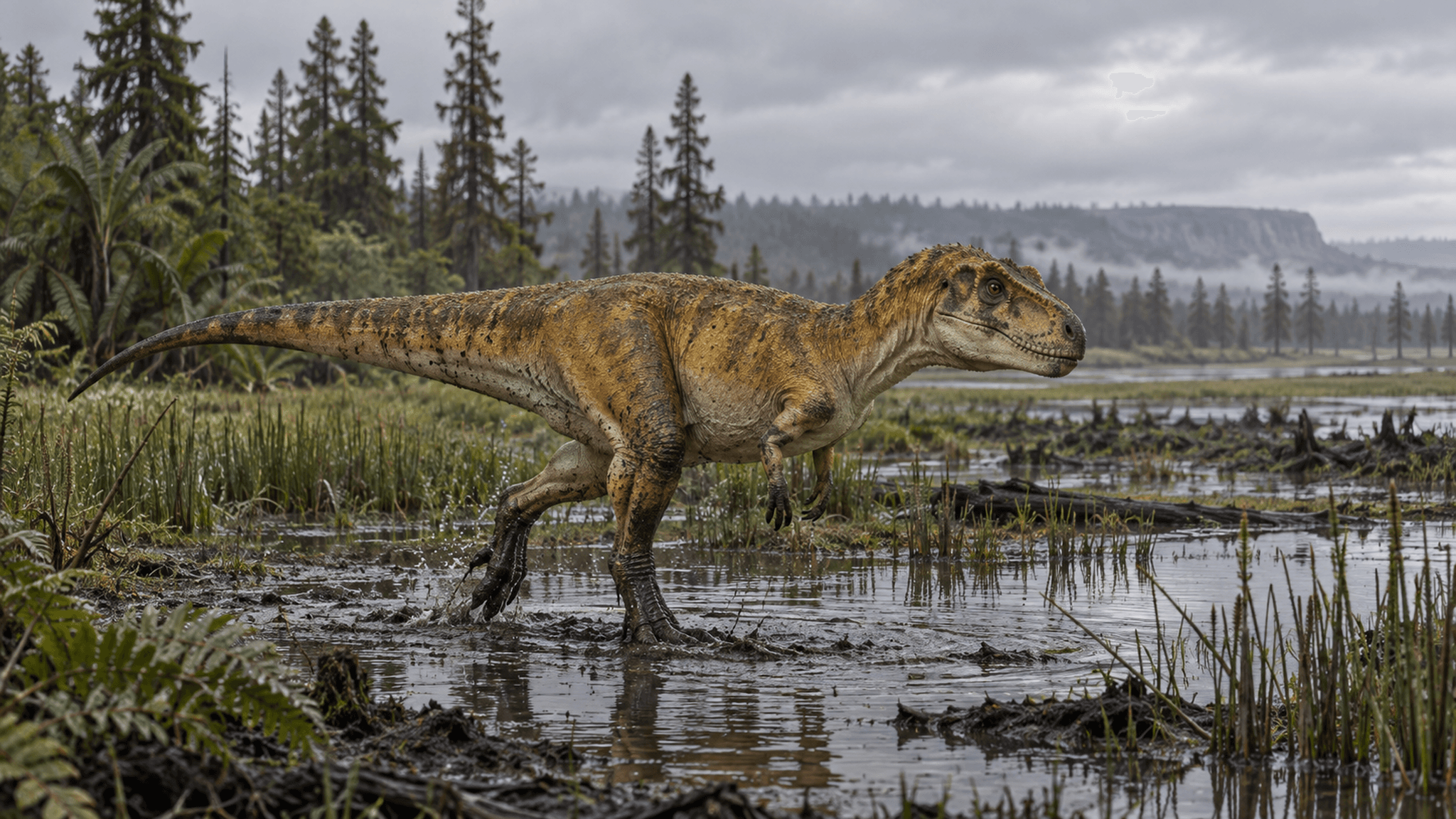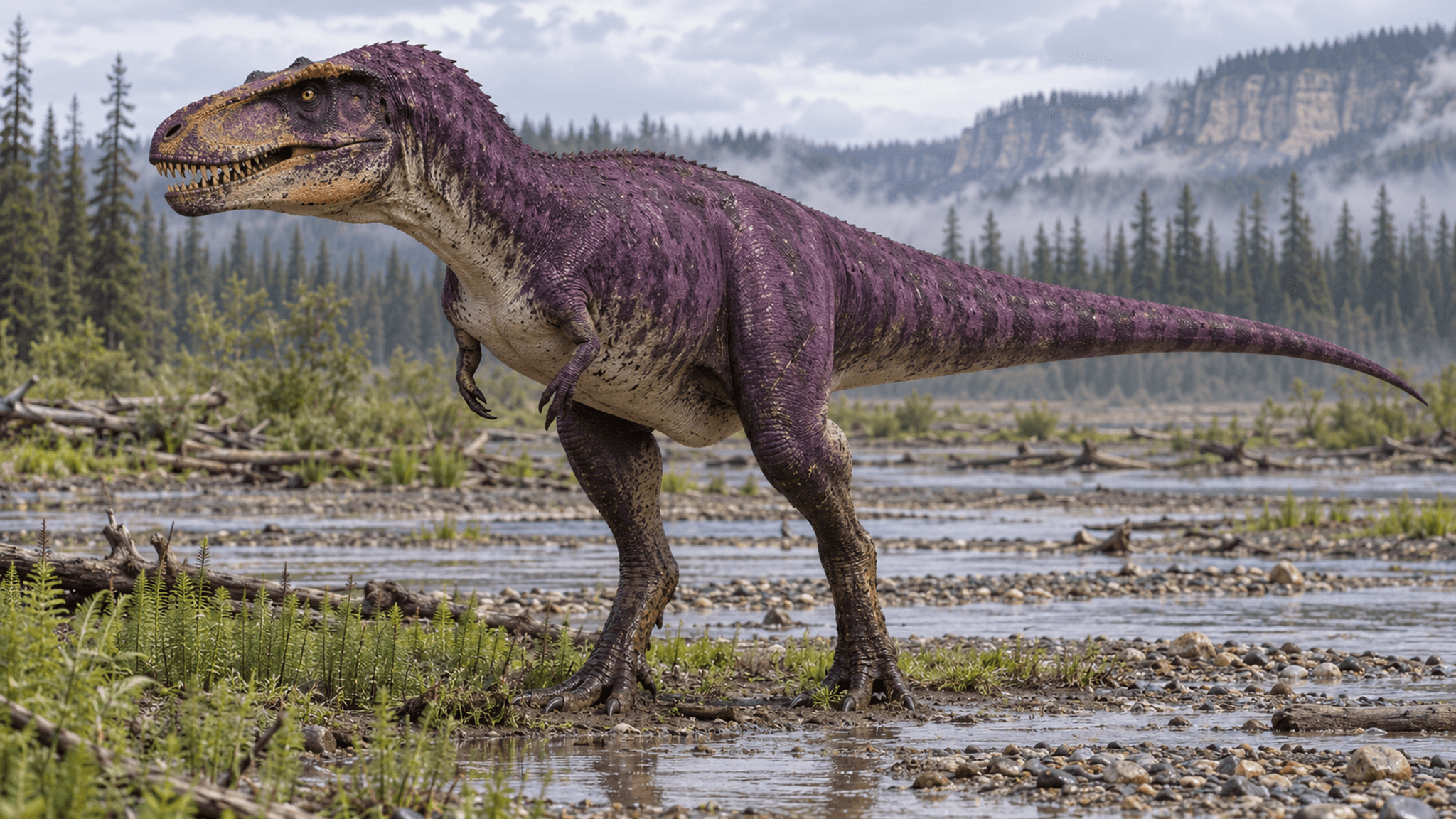
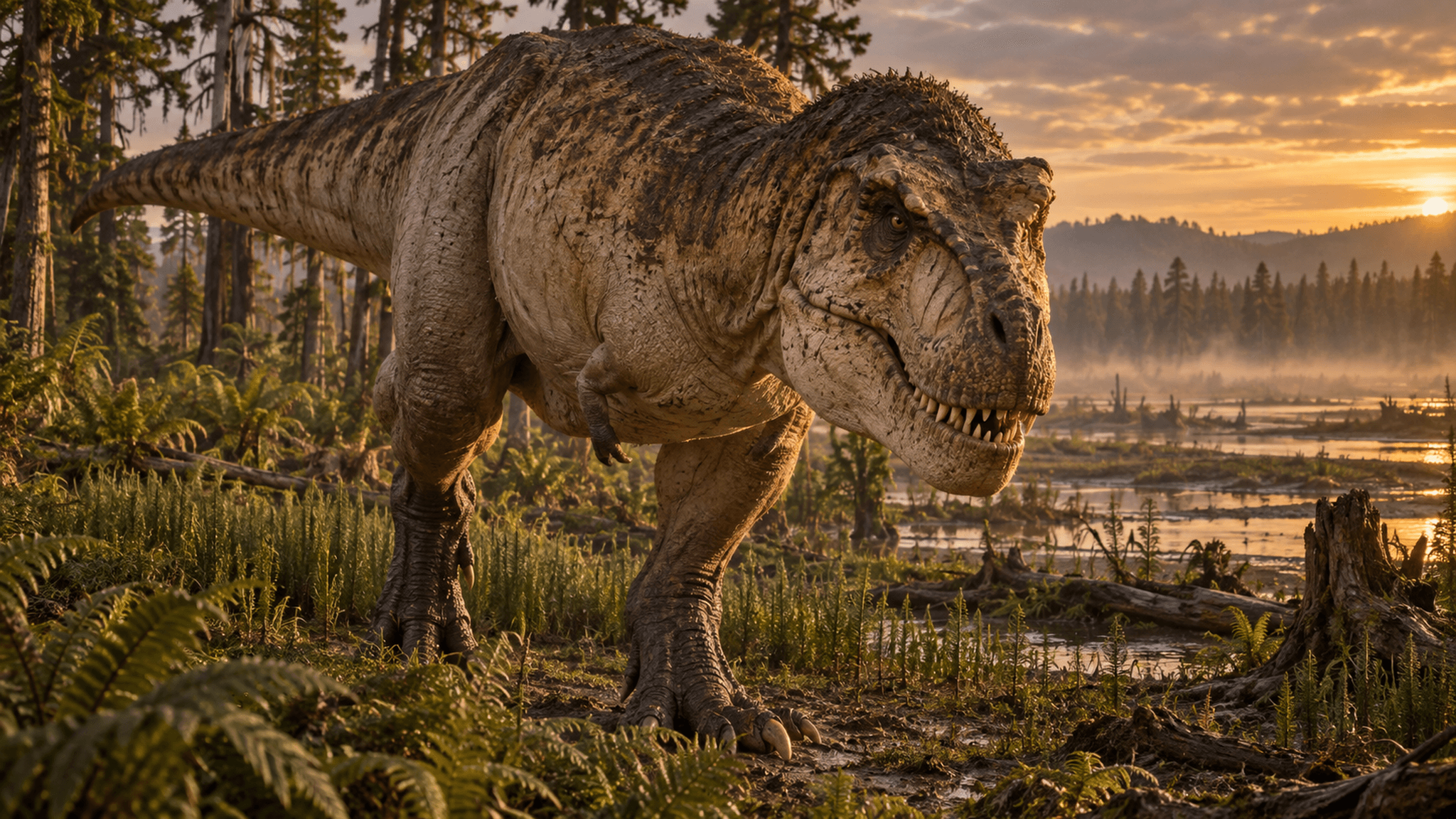
A team led by Matías Reolid of the University of Jaén reports the findings in the journal Estudios Geológicos. Facing the tyrannosaur are Giganotosaurus carolinii, a giant predator from what is now Argentina, and Allosaurus fragilis, a hunter with a narrow head. Representing T. rex in the ring is ‘Stan’, a famous museum specimen numbered BHI 3033.
The Longer Head Loses the Trial of Strength
Giganotosaurus leads on length: its skull is longer. Yet T. rex wins the trial of strength. Its head is broader and more compactly built.
The researchers demonstrate this with a simple calculation. They divide skull length by skull width. T. rex scores 2.42, while Giganotosaurus reaches 2.98. The lower the number, the broader the head.
A second measurement confirms the result. The team compares skull volume with lower-jaw volume and obtains a figure of 3.68 for Giganotosaurus and 3.31 for T. rex. This value also points to the tyrannosaur having the more robust head.
T. rex Held On and Broke Bones
The lower jaw makes the decisive difference. In T. rex, it is deeper than in other large predatory dinosaurs. Then there are the teeth, which specialists call pachydont: thick and sturdy like pegs.
These teeth were probably adapted for high bite force. With its deep jaw, T. rex held large prey fast and bit through flesh and bone alike.
In the reconstruction, the tyrannosaur lunges from close range. Its jaws snap shut, its teeth smash through muscle and rib, and the prey cannot break free.
Its eyes also faced forwards. The authors interpret this as an indication of binocular vision. Allosaurus and Giganotosaurus, by contrast, carried their eyes farther round the sides of the head.
Giganotosaurus Struck with Saw Blades
Giganotosaurus relied on a different weapon. Its teeth were ziphodont: flat, blade-shaped and serrated along the edges like a bread knife. The tallest measured tooth crown rises 92 millimetres, roughly the width of a hand.
From this, the researchers infer powerful slicing bites. They interpret the shallow lower jaw as a sign that the predator tended to seize and toss prey smaller than the victims of T. rex. In the reconstruction, it tears deep wounds into flank and neck with rapid slashes.
The giant lived around 100 to 95 million years ago in what is now Patagonia. Fossil collector Rubén Carolini discovered it in 1993, and the species was named two years later. No complete skeleton is known even today, so every estimate of its size remains uncertain.
Fresh help arrived in 2022 from a close relative. Meraxes gigas from Patagonia preserves an almost complete skull. It allowed specialists to produce a new estimate of the skull length of Giganotosaurus.
Allosaurus Was Narrow but Still Tough
The third hunter is around 150 million years old. The specimen examined, MOR-693, comes from the Morrison Formation, a rock layer dating to the Late Jurassic. Its skull is the narrowest in the comparison, with length divided by width producing a figure of 3.24.
Its teeth were straight and thick, while its lower jaw was suited to slicing, catching and holding small prey. As early as 2005, Therrien and colleagues suggested that Allosaurus could seize prey animals and hold them fast.
Then comes the twist. Its ratio of skull volume to lower-jaw volume is 3.53, lower than that of Giganotosaurus. Allosaurus was therefore probably also built to withstand powerful twisting forces when it attacked larger animals.
In the reconstruction, an Allosaurus locks its jaws onto a large plant-eater. The prey hurls itself sideways and wrenches at the predator’s head. The narrow skull holds firm.
Even a Mobile Phone Can Produce Useful 3D Models
The skulls were recreated using photogrammetry, a method in which software assembles numerous photographs into a 3D model. The researchers also used laser scans and programs including Agisoft Metashape Pro and the free software CloudCompare. This allowed the team to determine the bones’ size, volume and surface area.
According to the authors, the process is becoming easier all the time, even with a mobile phone or tablet. The team tested that for themselves. A basic smartphone app produced the largest errors in volume, missing the figure for Giganotosaurus by as much as five per cent.
Hunter or Scavenger? The Authors Choose a Side
The skull comparison touches on a long-running debate. Palaeontologists still dispute whether T. rex mainly hunted or scavenged. Jack Horner championed the scavenger theory, while the opposing camp considers active hunting more likely.
The authors side with the hunters. As evidence, they cite puncture wounds in the bones of possible prey animals such as Edmontosaurus and Triceratops. Their comparison does not settle the question once and for all, but a head that could hold large prey and bite through bone fits a hunter.
Head Shape Reveals the Hunting Method
In comparing these predatory dinosaurs, the study puts function before size. T. rex held on and broke bones, Giganotosaurus sliced, and Allosaurus probably withstood twisting forces. The shape of these giants’ skulls reveals more about how they hunted than skull length alone.
---