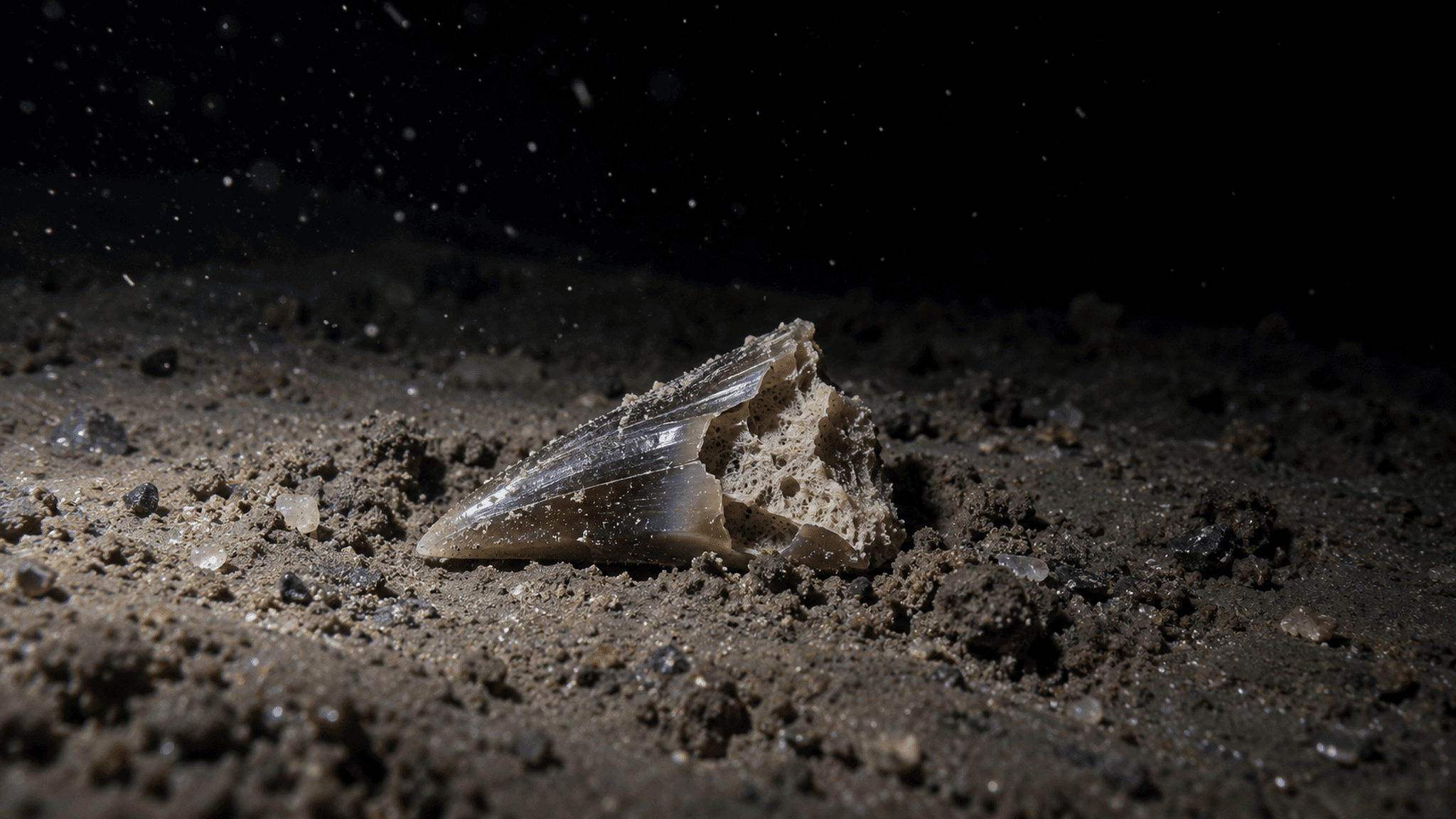
A team led by Zongqi Zou of the Southern Marine Science and Engineering Guangdong Laboratory in Guangzhou reports the discovery in the journal Science Advances. The researchers extracted tiny grains of dental mineral from deep-sea mud and measured them directly within the grain. The mud accumulated during the millions of years following a major cooling of the Earth, precisely where the Antarctic deep current crosses the North Pacific.
Nine Parts in Ten Are Inside the Tooth
The measurements reveal a clear distribution. Around 90 per cent of the rare metals — the so-called rare-earth elements and the related element yttrium — sit in the inner dentine. This is the layer directly beneath the hard outer coating.
A 2025 study had already shown that fish teeth absorb metals after death. When the protein collagen in a tooth breaks down, it leaves tiny pores. Through them, the dental mineral soaks up rare-earth elements from the mud until fossil teeth contain three to six times as much as the teeth of living fish.
One Tooth Holds Two Seas
The breakthrough came from the metal neodymium. It occurs in several subtly different forms, and every sea mixes them in its own way. That blend acts like a fingerprint of the water, which researchers express as a single value.
In the dentine, this value is about minus 5. Tiny mineral grains that grew directly within the mud show almost exactly the same value, and both match North Pacific water. By contrast, the dense outer layer of the same teeth jumps to about minus 10, matching seawater from the South Pacific.
Each tooth therefore becomes a double archive. The outer layer preserves the fingerprint of the water in which the fish swam. The dentine records the place where the tooth landed in the mud.
A Current on the Seabed Becomes a Conveyor Belt
The route could be reconstructed like this: a fish moves through water whose chemistry resembles that of the South Pacific. It dies, its body decays and its teeth sink through the darkness to the seabed.
That is where, according to the researchers’ proposal, the real journey begins. The Antarctic deep current seizes the teeth, drags them northwards along its path and sorts them as it goes. Eventually, they settle in basins farther downstream, enriching the mud there with rare-earth elements.
The timing had been known for some time. Such mud deposits appeared worldwide only after the major cooling, precisely where the Antarctic deep current was spreading at the same time. Why the two events coincided had remained an open question until now.
A Snail’s Pace Creates the Treasure
Less than half a metre in a million years: that is how slowly the mud enriched with rare-earth elements grows. A group led by Yasuhiro Kato of the University of Tokyo first described such deposits in the Pacific in 2011. A follow-up study analysed a total of 3,968 samples from the Pacific and Indian oceans in 2016 and identified this snail’s pace as the key.
The EU project VISE had already tested how reliably dental mineral records its environment. Researchers compared fossil teeth with shark teeth shed by living animals in aquariums containing precisely controlled water.
The values in the teeth are measured. The journey with the deep current, however, is the explanation proposed by the team. The method also has pitfalls: the 2025 study found neodymium values in fossil fish teeth that did not match the expected sea and therefore urged caution in their interpretation.
If the separation between the two layers is confirmed, a single fish tooth could be read like a journey recorder. It captures where the animal lived and where the deep sea finally deposited it.
---