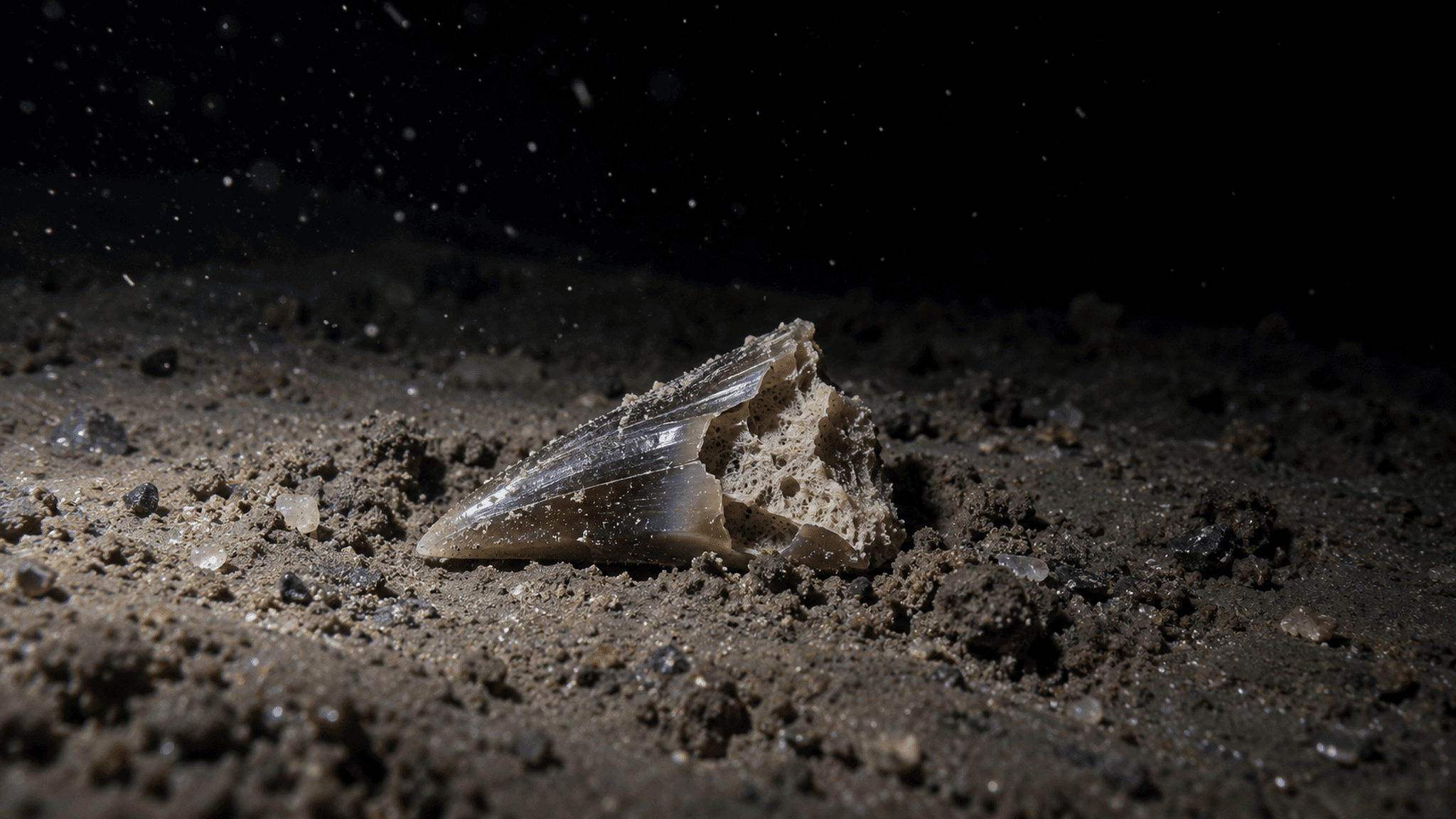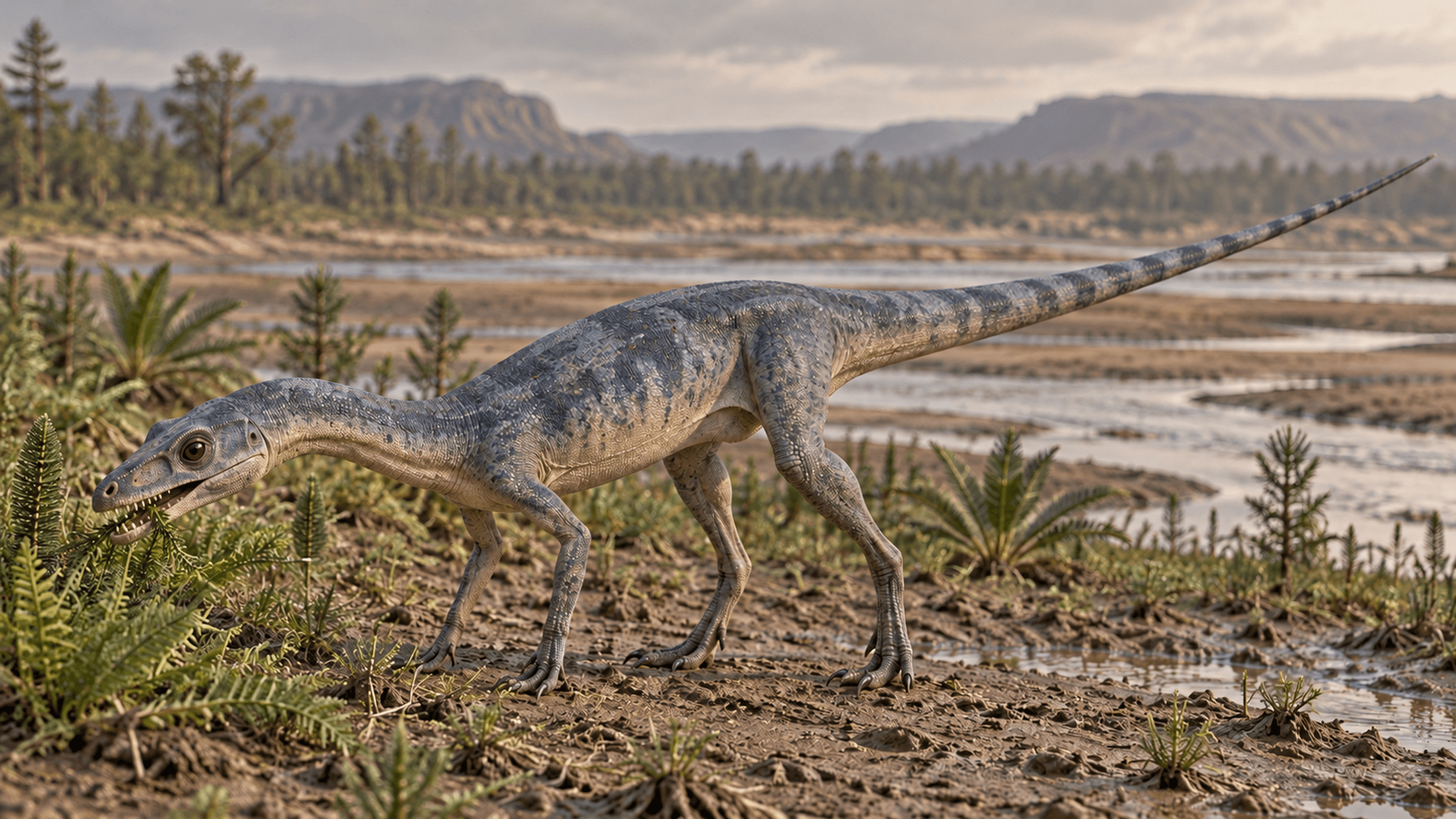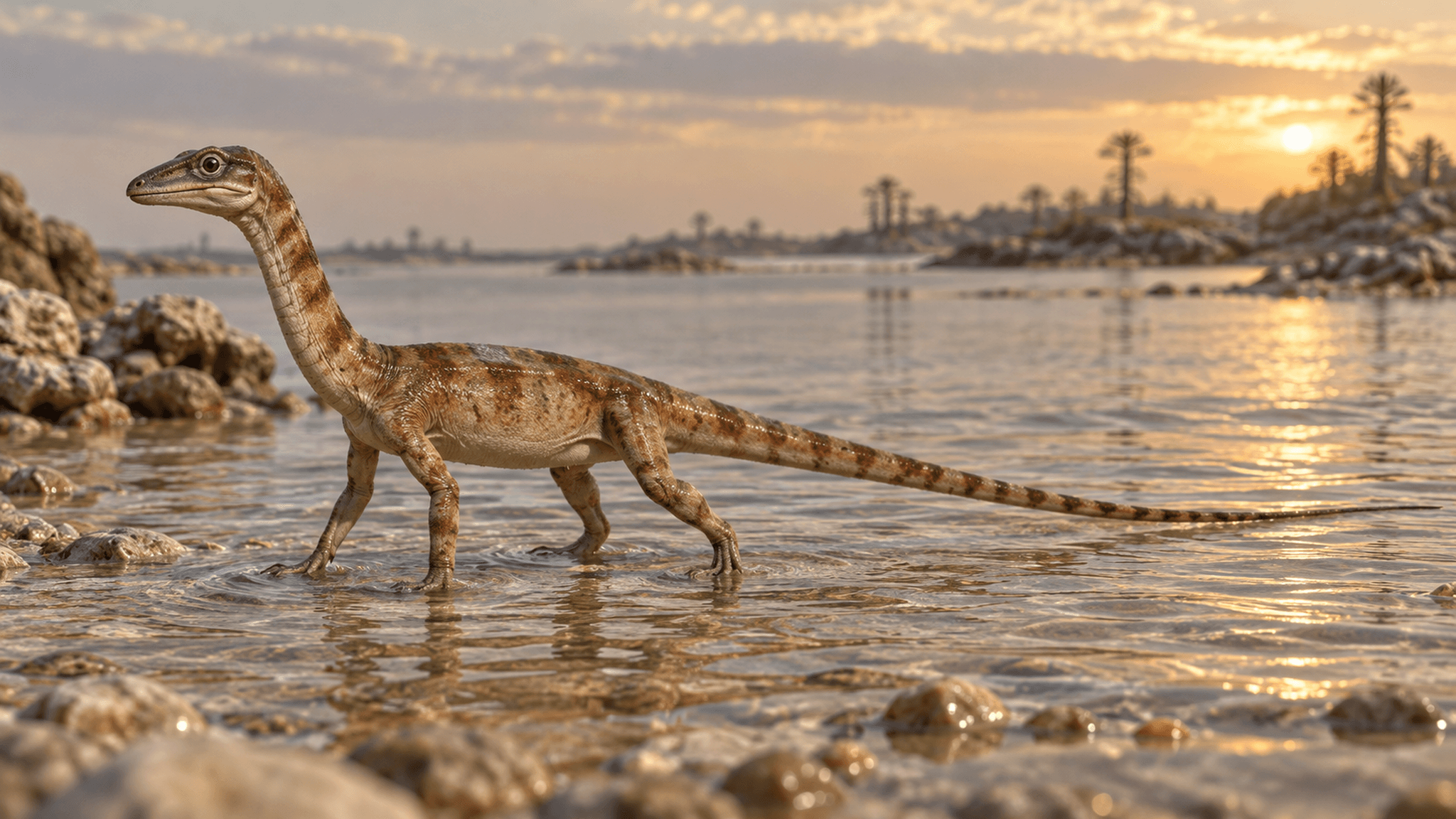
Silvio Renesto and his team have now introduced the species: Simonettoia tilaventina, as it is known scientifically. R. Rigo found the skeleton in the Forchiàr stream, shortly before it flows into the Tagliamento.
This is how the authors picture the small hunter: it stalks through shallow water, walks along the bottom or paddles slowly, barely pushing any water ahead of it. Once the prey is close enough, it surges forwards, driven by its hind legs, with its neck stretched out stiffly. This hunting scene is the researchers’ interpretation, not observed behaviour; they infer it from the stiffened neck region.
Displaced Thigh Bone? The Suspect Falls Apart
The most striking bone in the rock is long and straight. That is precisely what made it suspicious, because a displaced and reversed thigh bone would look similar. The researchers examined this possibility in detail.
Then they did the sums. If the bone were a thigh bone, the animal would have had two very unequal legs: one thigh bone would have been no more than 83 per cent as long as the other. The articular trochlea is also missing—the rounded end that allows a thigh bone to sit in the knee.
That makes the bone an enormously elongated neck vertebra. Behind it lie at least four more neck vertebrae, the bones of the neck, which are far less stretched. Because the bones still lie together much as they did in the living animal, their sequence can be read directly.
Counting Exposes the Lookalike
At first glance, the new species resembles a familiar face: Langobardisaurus pandolfii, a small reptile with a short, triangular head and large eye sockets. It remained less than half a metre long. Its fossils come from the same rock layer, as well as from Lombardy and Tyrol.
Renesto himself described this lookalike in 1994. The fossils behind that description had surfaced in a quarry near Cene in 1974.
Then the researchers counted. They identified at least nine vertebrae in the neck, with ribs shaped like a plough blade attached to the final two. The trunk contains 14 vertebrae, only three of them in the lower back.
The legs do not match the lookalike either. The thigh bone is longer, while the metatarsus—the bones between the ankle and toes—is more slender. In the forearm, the radius is shorter in relation to the upper arm.
The twist: the number of neck vertebrae in this very lookalike had already been disputed. Renesto counted nine in 1994; a review by Saller and colleagues reached eight in 2013.
The Long Neck Matches No Known Species
That leaves Tanystropheus, a relative with an exceptionally long neck. Its rear neck vertebrae are also extremely elongated, while in Simonettoia at least four remain normal in length. The new species also has two more dorsal vertebrae and one more lumbar vertebra.
Comparisons with two other relatives produce no match either. One reptile of the same age from Lombardy has decisive identifying features that are absent from the new skeleton.
In the other, the ploughshare-shaped ribs occur on more neck bones. It also has one fewer dorsal vertebra. The find from Friuli does not fit that picture either.
No single feature solves the case. Only the combination of the giant vertebra, normal neck vertebrae, rib shape and leg proportions turns the skeletal remains into a distinct species.
A Stiff Neck Like Its Famous Relative
A widely discussed study from the University of Zurich had painted a similar picture for Tanystropheus. Its nostrils sat on top of its snout, as in modern crocodiles, fitting an aquatic hunter. However, the Zurich researchers found no adaptations for swimming in its limbs.
The only known animal of the new species was probably not fully grown. Its small size and weak ossification point in that direction: tissue in the wrists and ankles, limb ends and shoulder girdle had not yet hardened into solid bone.
A Lagoon Full of Pterosaurs
The animal lay in the Dolomia di Forni, a layer of dolomite rock in the Friuli-Venezia Giulia region. It formed around 216 to 212 million years ago. At the time, a shallow, oxygen-poor marine basin covered this place—a lagoon cut off from the open sea at the edge of a limestone platform.
The same rock contains several pterosaurs and a climbing reptile belonging to an entirely different group of animals. The layer therefore preserves very different creatures from the same period of Earth’s history.
An older find from the site also gains a new interpretation. In 1989, fossil MFSN 1891 was considered a regurgitated mass of pterosaur bones. The authors of the new study instead see it as the remains of a relative of the long-necked reptiles.
Undescribed for Twenty Years, Now a Species of Its Own
The striking neck bone could easily have led to the wrong name. Only its connection with the remaining bones reveals that the old find conceals a species never described before.
---