A team led by William J. Freimuth of North Carolina State University reports the reassessment in the journal PLoS ONE. The finding overturns an identification made in 2010, when Phil Senter and colleagues described the fossil as a new genus and species of troodontid. Their evidence rested on a single upper jawbone from the Suarez Site, a bone bed in the lower Cedar Mountain Formation of Utah.
A Troodontid in the Wrong Bone Bed
The label never fitted the site well. The Suarez Site is packed almost exclusively with therizinosaur bones, while the quarry that produced Falcarius utahensis lies only about 800 metres away. A lone troodontid jaw in the middle of this bone bed remained an outsider.
Even so, the jaw carried enormous weight. As a troodontid, Geminiraptor suarezarum would have ranked among the geologically oldest and largest members of the group on the continent. Anyone trying to understand how these bird-like dinosaurs evolved, lived and spread could hardly ignore it.
The 2010 misidentification had a simple cause. At the time, researchers knew only one well-described therizinosaur skull, that of Erlikosaurus andrewsi. This highly modified form offered little basis for comparison with the plain jaw from Utah, the authors explain.
An Asian Group Appears in Utah
Researchers know therizinosaurs almost entirely from Asia. When Falcarius utahensis emerged in Utah, it came as a major surprise: for the first time, the group had appeared in North America too.
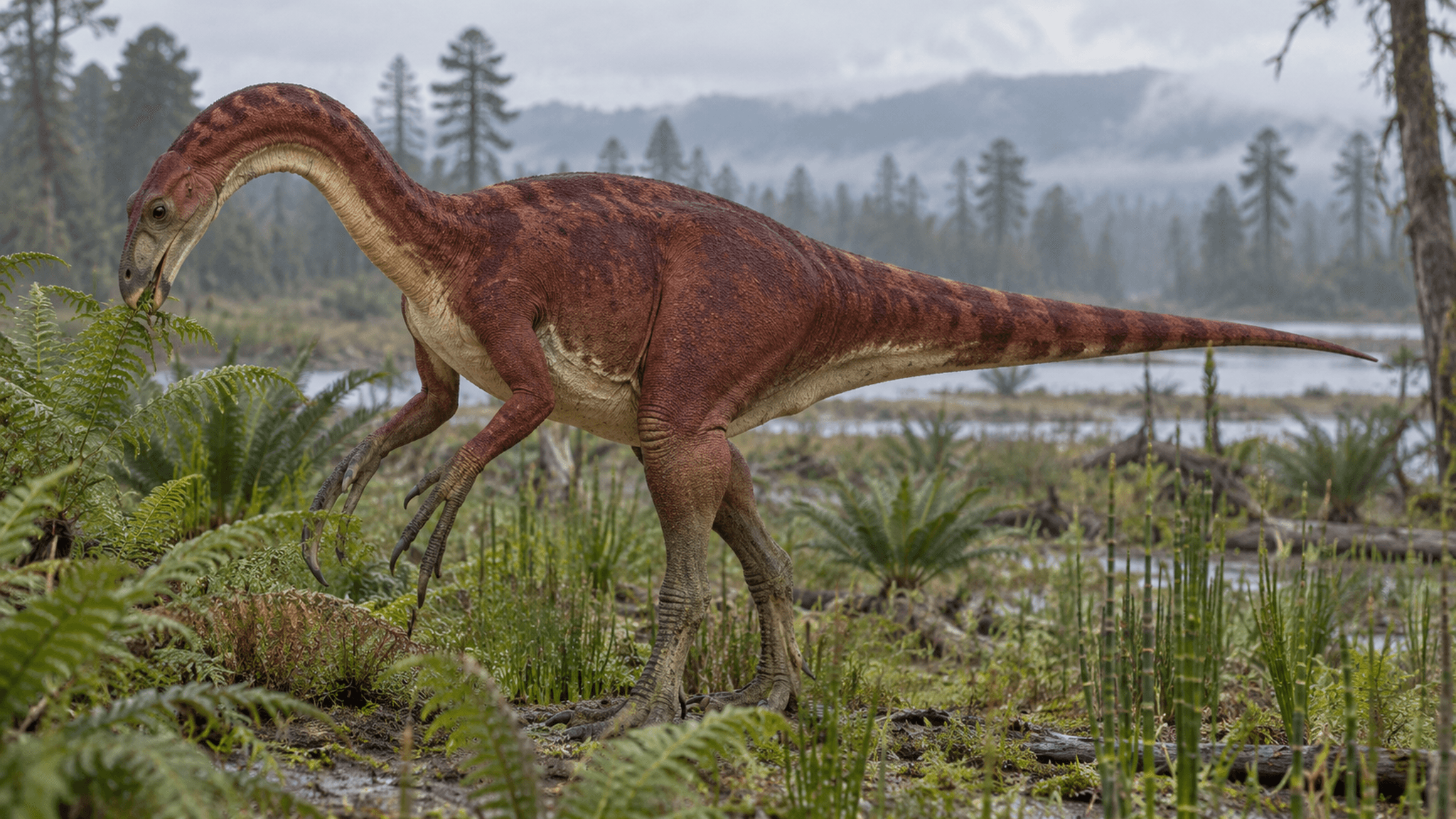
Around 125 million years ago, this animal walked across the landscape south-east of present-day Green River in Grand County. Its leaf-shaped teeth mark it as one of the earliest theropods to switch to plants. Most species in this dinosaur group otherwise ate meat.
The Scan Finds the Incriminating Replacement Teeth
Then the team shone light through the bone. Computed tomography, a series of layered X-ray images, exposed growing replacement teeth missed in the original description. They are robust, lance-shaped and curved towards the lip side.
Each tooth carries a distinct central ridge on its inner face, swells at the base and bears tiny serrations along its edges. Researchers know precisely this dental pattern from early therizinosaurs such as Falcarius utahensis. It does not fit troodontids.
The other skull bones from the layer also had to return to the examination table, from the frontal bone and pieces of lower jaw to a fragment of the braincase. Several of their features are now considered typical of early therizinosaurs. Others occur across theropods more generally.
Jaw Shape Alone Reveals Little
Then came the catch. The team compared the jaw proportions of numerous coelurosaurs, the broad dinosaur group that also includes birds. Early therizinosaurs, troodontids and the Utah fossil overlapped substantially.
An angle of 22 to 23 degrees moved the case forward. That is how steeply the upper edge of the jaw rises above the tooth row, almost exactly matching Falcarius utahensis. The short, deep jaw of the early coelurosaur Ornitholestes hermanni looks very different.
The final verdict came from the family-tree analysis, a computational method that determines relationships from many features at once. It places the fossil as the sister species directly beside Falcarius utahensis, at the root of the therizinosaurs. Only the teeth, bone comparisons and family tree together toppled the old classification.
Geminiraptor Becomes a Falcarius
The team follows the evidence and moves the species into the genus Falcarius. An hourglass in the bone nevertheless keeps it distinct. The bar between two openings in the jaw narrows in the middle, whereas in Falcarius utahensis it runs thin and straight.
In the reconstruction, a two-legged dinosaur stands amid the greenery of a Cretaceous plain, tearing at plants with powerful teeth. Researchers also know swift hunters from the same rock interval, the lower Yellow Cat Member, including the dromaeosaur Yurgovuchia doellingi. This interval is considered one of North America’s two oldest dinosaur faunas.
The site’s exact age remains unresolved. Mineral grains from a higher layer produced an age of about 122.6 million years. The authors themselves consider that figure uncertain because it rests on few samples and conflicting rock sequences.
North America’s Large Troodontids Arrive Later
The new name removes a cornerstone. Researchers now count four therizinosaurs in North America’s earliest Cretaceous. After this study, unambiguous large-bodied troodontids remain restricted to the Late Cretaceous.
The team offers an explanation for the startling similarity between the jaws. The shared proportions of early coelurosaurs may reflect structural limits and a meat-free diet, traits that later troodontids independently reached again.
The rest of the bone bed remains an open question. Thousands of additional bones from the Suarez Site are also provisionally assigned to Falcarius suarezarum, but a final assessment of the entire assemblage is still pending.
A single jaw has thus changed its place in the dinosaur family tree. With it shifts the picture of which groups inhabited North America at the dawn of the Cretaceous.
---