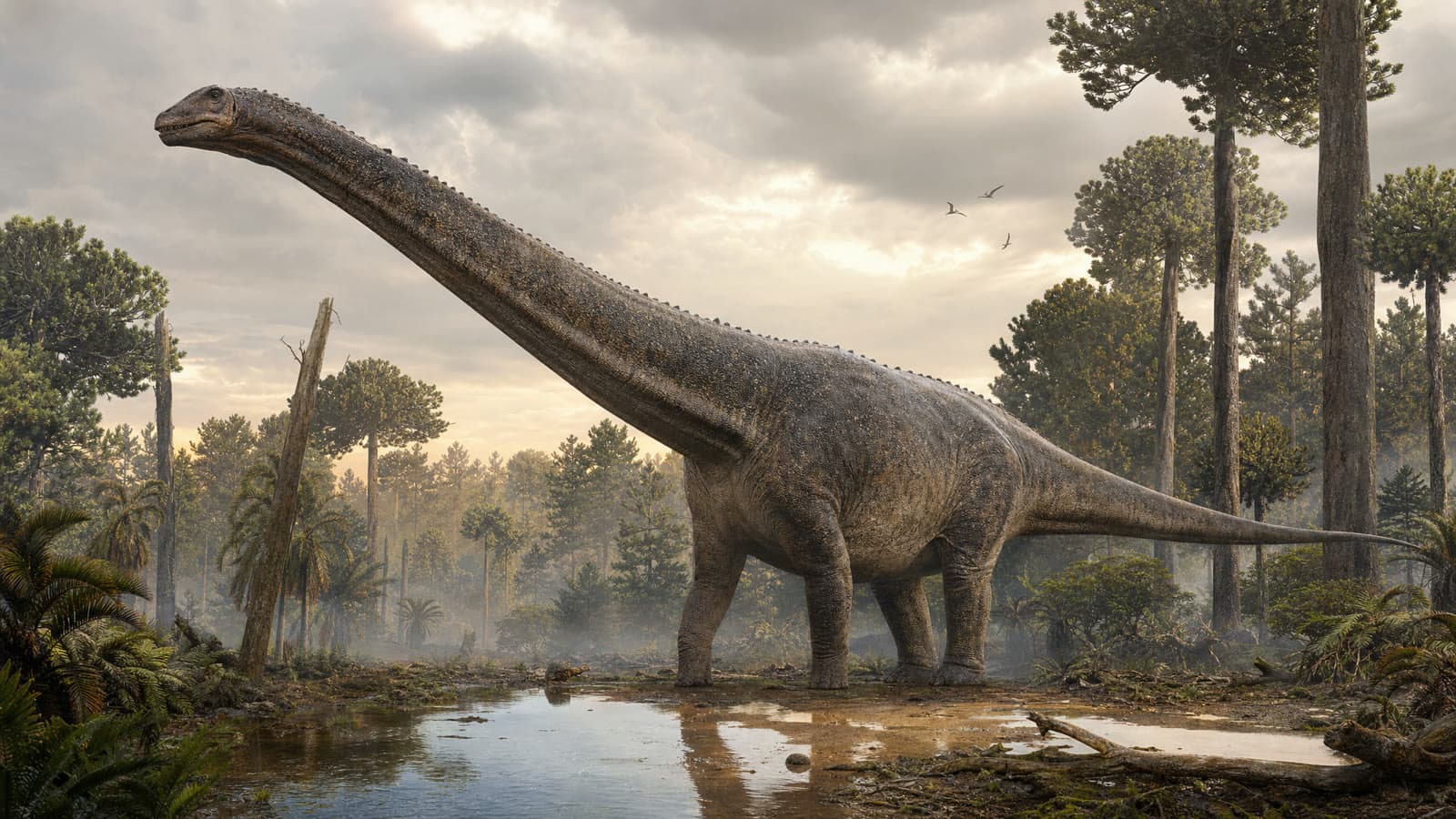
The name sounds as if it came from a prehistoric epic—and behind it stands a scientifically well-described giant: Nagatitan chaiyaphumensis. In Scientific Reports, researchers present a new sauropod from Thailand, based on a partially preserved postcranial skeleton. The find comes from the Khok Kruat Formation, a Lower Cretaceous unit in which sauropod remains are important but often rare and fragmentary.
The paper’s central finding is cautious but significant: Nagatitan is the first diagnostic sauropod find from this formation. Here, diagnostic means that the bones provide enough characteristics to identify the animal scientifically as a new genus and species—not merely as “some large sauropod”. The authors classify Nagatitan as a somphospondylan titanosauriform, placing it within a group of long-necked dinosaurs that reached enormous body sizes during the Mesozoic.
The anatomical details are particularly interesting. The paper identifies two autapomorphies—unique derived characteristics—and a distinctive combination of features, including some found in the middle to rear dorsal vertebrae. In palaeontology, precisely such details determine whether a few bones remain only a vague trace or receive a genuine new name.
For Tiefenzeit’s big question, however, body size provides the click-worthy moment: the team estimates Nagatitan’s mass at around 25 to 28 tonnes—a model estimate based on preserved bones, not a direct measurement. This does not automatically make it the largest dinosaur of all time, but that size is remarkable for Southeast Asia. The paper also links the find to a possible increase in the size of Asian titanosauriforms during the mid-Cretaceous—perhaps encouraged by warmer temperatures and larger suitable habitats.
Caution is still necessary. The find is not based on a complete skeleton, but on selected preserved bones. Body mass, relationships and ecology are therefore models derived from the fossil material, not direct observations. That is precisely what makes the article fascinating: it shows how vertebrae, comparisons and phylogenetic analyses create a new piece of Earth’s history.
Tiefenzeit context: Nagatitan is not a monster of the imagination, but a good example of how regionally incomplete our picture of the dinosaur world remains. Southeast Asia was not a sideshow during the Cretaceous. Each new find makes it clearer that distinct lineages, body sizes and evolutionary histories emerged there. Thailand’s “last titan” is therefore less an isolated wonder than an indication of how much remains missing beneath tropical soils.
Source: Sethapanichsakul, T. et al. (2026): The first sauropod dinosaur from the Lower Cretaceous Khok Kruat Formation of Thailand enriches the diversity of somphospondylan titanosauriforms in southeast Asia. Scientific Reports 16, 12467. DOI: 10.1038/s41598-026-47482-x. Lead image: AI-generated artistic approximation of Nagatitan chaiyaphumensis. The depiction is based on the scientific description of a partial skeleton and is neither an original image from the study nor an exact reconstruction of the described individual.