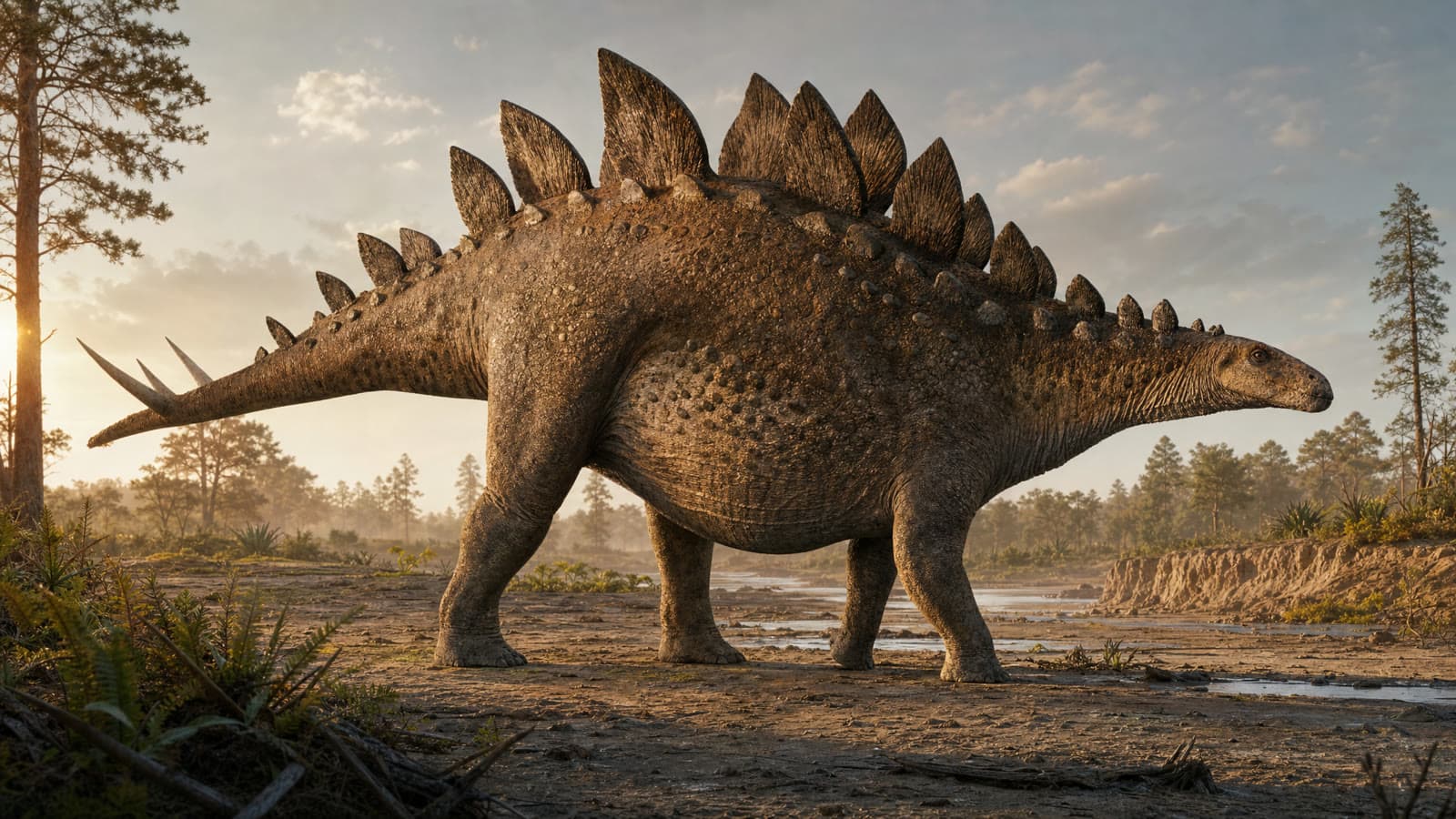
When many people think of stegosaurs, they immediately picture back plates, spikes and a small head. Yet that very head is often the scientific problem: stegosaur skull material is remarkably rare in the fossil record. A study in Vertebrate Zoology now describes an exceptional skull from Spain’s Late Jurassic—and assigns it to Dacentrurus armatus.
The find comes from the Villar del Arzobispo Formation in Teruel. According to the authors, it is the most complete stegosaur skull yet known from Europe. That may sound like a museum headline, but its main importance is taxonomic: skull features help researchers diagnose species more accurately, examine relationships and correct old family trees.
Researchers Sergio Sánchez-Fenollosa and Alberto Cobos use the new material to define the anatomy of Dacentrurus armatus more precisely. The paper updates the species diagnosis and describes a new autapomorphy—a feature that distinguishes Dacentrurus in this particular form. For a dinosaur group whose fossil record is often dominated by back plates and vertebrae, a well-preserved skull is therefore a rare anchor point.
The broader context is equally intriguing. The study uses a new stegosaur data matrix, and its phylogenetic analysis produces family trees that divide Stegosauria into two major lineages: Huayangosauridae and Stegosauridae. Such results are not final truths, but hypotheses to be tested against new finds. Yet they change which animals are considered closely related—and where researchers will need to look more carefully in future.
To put it particularly cautiously, the paper also calls for several Early Cretaceous Chinese stegosaurs to be reassessed taxonomically. It also questions previous taxonomic classifications of individual stegosaurs. This is typical palaeontology: a single good skull can not only make one animal easier to understand, but also unsettle old classification systems.
For Tiefenzeit, the find provides a welcome counterpart to the usual “new species discovered” stories. This is not about a spectacular new name, but better anatomy. Dacentrurus armatus was already known—but the new skull makes it more tangible. It quite literally gives Europe’s stegosaurs a clearer face.
What remains unresolved? Even an exceptional skull is only one part of the overall picture. Phylogenies can shift as new data emerge, and the precise diversity of European stegosaurs remains an active field of research. What is certain, however, is that this find provides a robust building block because it is based on specific, described fossil material and a peer-reviewed analysis.
Source: Sánchez-Fenollosa, S. & Cobos, A. (2025): “New insights into the phylogeny and skull evolution of stegosaurian dinosaurs: An extraordinary cranium from the European Late Jurassic (Dinosauria: Stegosauria)”. Vertebrate Zoology. DOI: 10.3897/vz.75.e146618. Header image: AI reconstruction / artistic approximation of Dacentrurus armatus in Late Jurassic Europe. The depiction is based on the primary source cited in the article and comparative stegosaur anatomy; it is not an image from the paper or an exact reconstruction of the skull described.