A team led by Julian C. G. Silva Junior reports the findings in the journal Royal Society Open Science. The researchers built 3D models of thigh bones from across the family tree: early representatives, narrow-legged relatives of Diplodocus, forms with an intermediate stance and titanosaurs with their particularly wide stance. An African elephant was also put to the test for comparison.
The bone enters the virtual press
Each thigh bone had to bear a load twice. In the first run, it was solid like a block of wood. In the second, it was built as it would have been in the living animal: a hollow marrow cavity inside and, at each end, a cap of articular cartilage, the smooth cushioning material in a joint.
The computer broke each bone into tiny components and tested how strongly every one of them was compressed and bent. What mattered in the end was how severe the forces became at the most heavily stressed points and how much bending the material had to withstand. The researchers also measured how stiff the entire bone remained.
Wide stance, less stress
Extra weight did not bring the same extra strain for every giant. In the two narrow-legged animals, Diplodocus and Amargasaurus, stress shot up steeply with body mass. Among the wide-legged titanosaurs, the curve was usually flatter, the values were lower, and several large species had particularly stiff bones.
However, the narrow-legged side of the test includes only two species. All the values described here come from computer models.
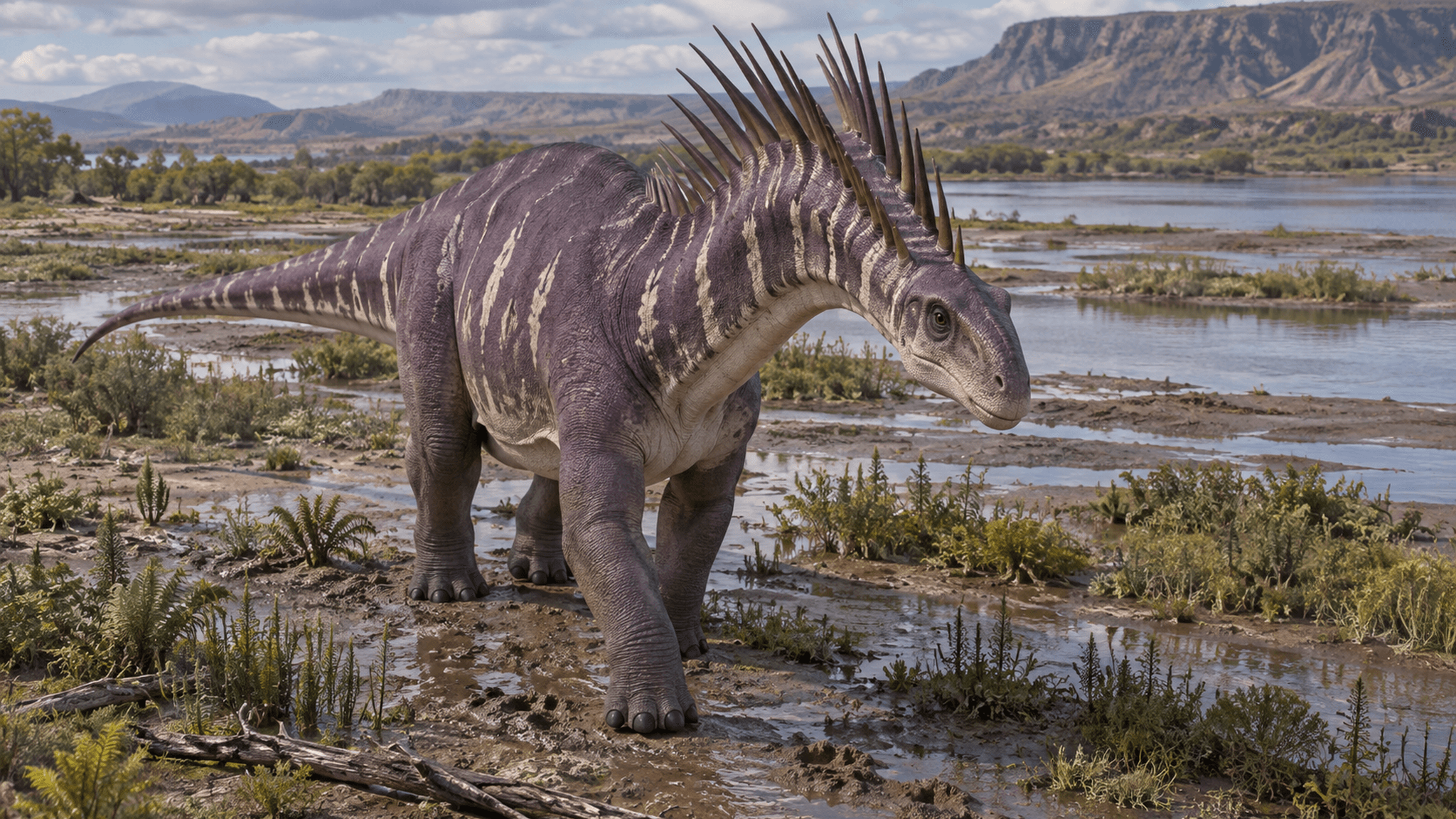
Around 130 to 120 million years ago, Amargasaurus trudged through what is now Argentina, crossing river channels, lakeshores and floodplains in the Neuquén Basin. The same rock layers have yielded other long-necked dinosaurs such as Zapalasaurus bonapartei and the small predatory dinosaur Ligabueino andesi. With every step, the weight of Amargasaurus bore down on the very bone that belongs to the steep curve in the model.
The same hollow cavity did not help every giant
Hollow tubular bones and thick articular cartilage had long been regarded as building blocks of gigantism. In additional tests, the researchers deliberately adjusted these two features. Their effect depended each time on the shape of the particular thigh bone.
The same hollow cavity and the same cartilage therefore produced no universal recipe. Only in combination with each bone’s individual shape did their effects become clear.
Wide legs alone did not make giants
Researchers long assumed a clear trend: the larger sauropods became, the wider and more stable their stance grew. A biomechanical analysis made the wide stance a hallmark of titanosaurs and linked it to outwardly rotated thigh bones and an unevenly shaped bone shaft.
Then a study examined 17 hind limbs from titanosaurs and their close relatives. In that sample, stance width did not increase directly with body size. It appears to have evolved for another purpose and only benefited the giants later. What it was originally good for remains unknown.
Every giant lineage built its own leg
The new models suggest that every sauropod lineage supported its weight through its own mixture of bone shape, internal structure and articular cartilage. There was apparently never a single blueprint for becoming a giant.
The largest animals ever to walk on land therefore solved the problem of their weight a little differently in every thigh bone.
---