How does an armoured animal suffer damage in this particular spot? The answer lies in a moment no fossil shows directly: the escape from its own shell.
To Grow, the Animal Must Shed Its Armour
Trilobites belong to the moulting animals. This group includes some of the most abundant and diverse animals on Earth. All its members grow in the same risky way: they shed the rigid outer skeleton that protected them until then.
This step often goes wrong. Deformities or even death can follow.
Trilobites wore armour made of calcite, a calcium carbonate mineral. Injuries in it are well documented. Researchers have already traced some of them to moulting mishaps in which long spines became deformed.
Right on the Head: Here the Usual Pattern Flips
Usually, the trunk takes the damage. Injuries to the head shield are exceptional among trilobites, and deformed cheek spines appear only rarely in the scientific literature.
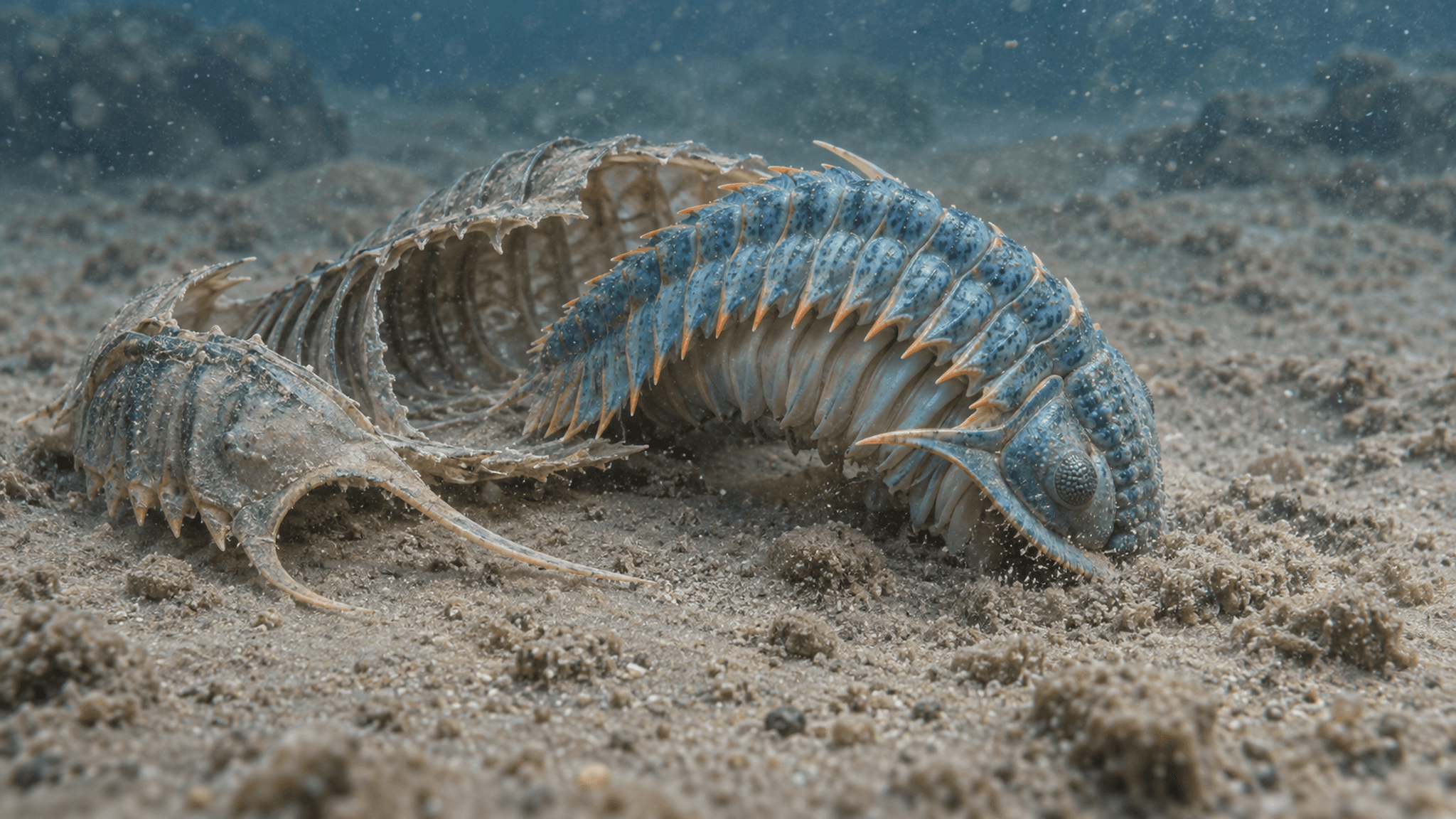
Cheek spines are the long points that project backwards from the rear corners of the head shield. In Olenoides serratus, they are long and delicate.
The team examined injuries in eleven specimens of this species from the Burgess Shale, specifically from the Wuliuan Stage of the Cambrian. The result reverses the usual distribution: here, the cheek spines are deformed more often than in other trilobites.
The authors’ explanation does not begin with the armour itself. It begins with a movement by the animal.
Head First into the Seabed: How Moulting May Have Bent the Spines
The scene can be reconstructed on the Cambrian seabed. A trilobite curls its body towards its underside and drives the front edge of its head shield into the soft sediment. Fine mud billows up.
The pressure serves a purpose. It opens the facial sutures, pre-formed separation lines in the head armour where the old shell splits apart.
This puts force on the free cheeks. These are the side plates of the head shield that carry the cheek spines.
Then space runs tight. The old cheek plates tip downwards at the front while the animal pulls itself from the discarded shell. That movement forces the cheek spines to bend.
For long, delicate spines, this does not pass without consequences. The fossils of Olenoides serratus bear precisely these injuries.
The Trail May Lead to Other Early Arthropods
The study goes one step further. A similar moulting sequence, with similar injuries, may also be recognisable in other early arthropods. Today, this vast group includes insects, crustaceans and spiders.
A collection of damaged shells thus becomes a study of movement. The fossils show how an animal left its old body behind.
A kinked spine is therefore more than damage. It captures a Cambrian moment that could never itself become fossilised. Only its scars survived.
---