How did one fossil become a much more diverse genus? The answer lies in the minute details of the teeth, which work like a biological code and rewrite the animal’s entire ecological story.
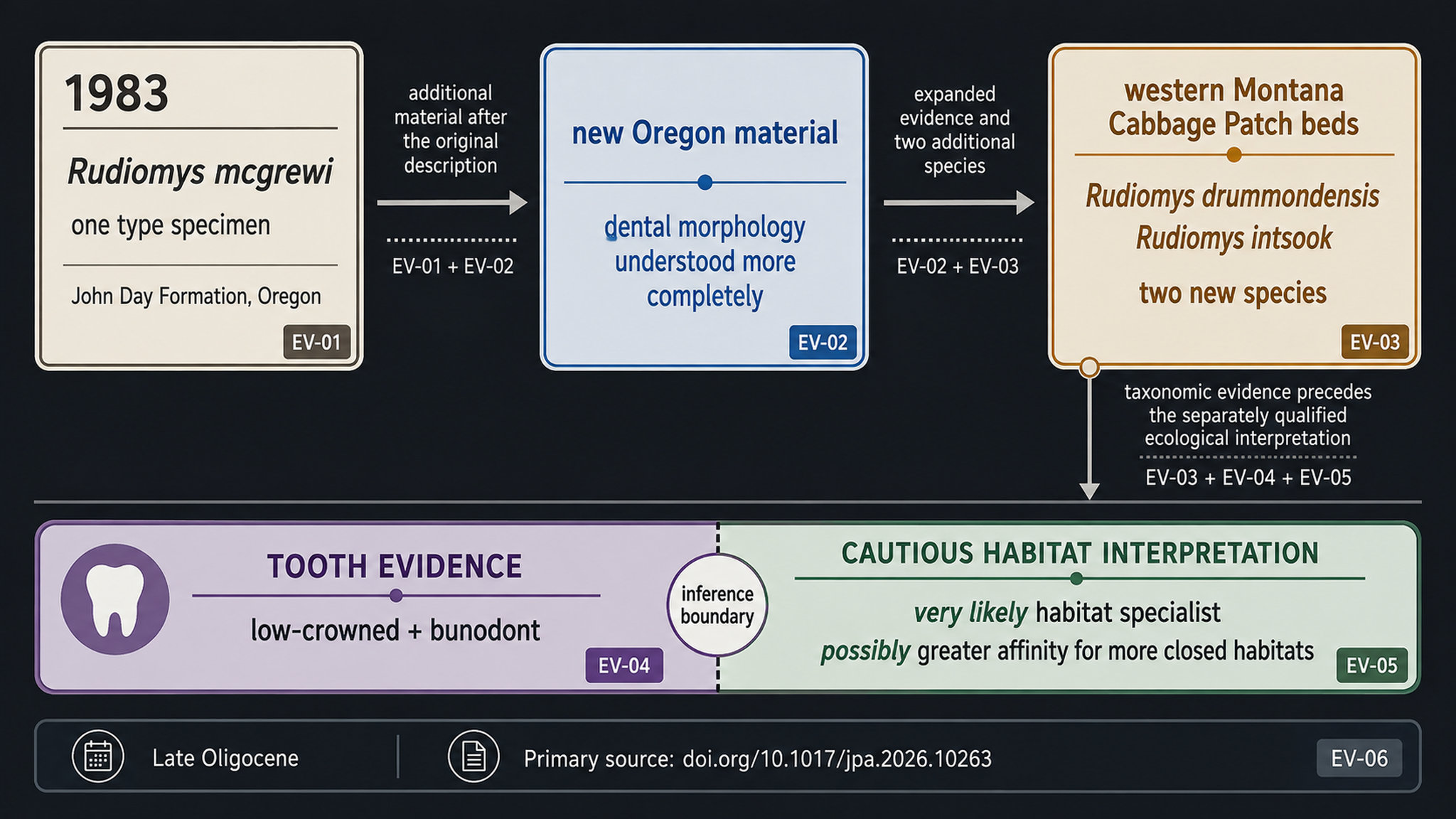
For more than four decades, Rudiomys was little more than a name in the dusty files of palaeontology. In 1983, the researcher Rensberger described the species *Rudiomys mcgrewi* from a single specimen found in Oregon’s John Day Formation. One fossil is an extremely weak foundation on which to reconstruct an entire way of life.
Rensberger ventured some initial ideas about the animal’s ecology, but without comparative material, these propositions remained pure hypotheses. The genus looked like an isolated error in the fossil record of an otherwise diverse group of rodents. There was no evidence showing whether this animal was a regional oddity or part of a broader strategy.
Then the decisive evidence broke from the ground of the north-west. Remains suddenly appeared in Montana’s so-called Cabbage Patch Beds and radically corrected the established picture. The researchers identified two additional species: *Rudiomys drummondensis* and *Rudiomys intsook*.
This discovery proves that Rudiomys spread beyond Oregon and possessed genuine evolutionary breadth. The focus was no longer an isolated outsider, but a lineage with its own consistent survival strategy. The genus was more diverse than the lone fossil discovered in the 1980s could ever have suggested.
Dental Gold Topples Old Theories
The Montana finds fired the starting gun for a comprehensive revision. At the same time, new material from Oregon delivered a far more complete picture of the original species, *Rudiomys mcgrewi*. Only now could experts properly analyse and directly compare the morphology — the precise anatomical structure — of the teeth.
They encountered one striking feature: the teeth of Rudiomys are low-crowned and bunodont. This means that the tooth crowns are shallow and bear a characteristic pattern of rounded cusps. This dental form provides a strong indication of the ecological ties that shaped Rudiomys.
This anatomical insight became the lever that transformed old suspicions into a strongly supported interpretation. The new finds and the unusual dental structure show that Rudiomys was very probably a habitat specialist. Compared with other meniscomyines — a related group of rodents — this genus was tied to very particular environmental conditions.
The reconstruction of the dental material now shows that the genus possessed considerably greater biological breadth in the late Oligocene than previously thought. The two new species demonstrate diversity within the genus, while the new occurrences and unusual dental structure also support a highly specific ecological niche.
Imagine the world of the late Oligocene: across the Northern Great Plains and Northern Rockies, a fierce race for the best resources is under way. While other rodent groups responded flexibly to different environments, Rudiomys chose the path of extreme adaptation. The animal occupied an opening that remained closed to others.
The Price of Perfection: Life in a Niche
Why has Rudiomys appeared at so few sites in the fossil record? The answer lies in its own biological direction. An animal closely bound to a particular habitat gains an advantage there, but pays for it with reduced flexibility.
The low-crowned teeth suggest that the animal was strongly associated with more enclosed habitats. Here lies the crucial scientific limit: although the dental form powerfully supports specialisation, the exact nature of the habitat — a very particular type of woodland, for example — remains a plausible reconstruction rather than an absolutely proven fact.
This dependence explains its geographically restricted distribution compared with other genera of the Meniscomyinae. While other relatives roamed widely across the continent, Rudiomys remained tied to its green islands. Specialisation was its evolutionary trump card, but also its greatest strategic weakness.
The Aplodontiidae as a whole experienced a golden age of immense diversity during the late Oligocene. But a dramatic collapse followed in the later Miocene. The entire group shrank so severely that only a single living species survives today. By the late Miocene, aplodontiid diversity had collapsed dramatically until just one species living today remained.
The discovery of the two new species reveals the former splendour of this group and finally gives Rudiomys a tangible ecological role. The reconstruction of the dental material has pulled the animal out of the shadows of speculation. It was probably not an evolutionary accident, but a highly specialised inhabitant of distinctive environments.
Overall, the discovery demonstrates how just a few additional fossils can transform the classification of an entire genus. Rudiomys stands as a prime example of the biological dynamism of the late Oligocene. Its unusual teeth were probably the ticket into a narrow niche, but the genus’s later fate remains unknown.
Primary source: https://doi.org/10.1017/jpa.2026.10263 DOI: 10.1017/jpa.2026.10263
You can find further insights into the fascinating world of prehistoric life on the Tiefenzeit YouTube channel.