How can one inconspicuous component turn two fossils from two countries into members of the same genus? The answer lies in the body plan of an animal from the very first chapter of echinoderm history.
The First Echinoderms Were Everywhere at Once
Today’s echinoderms include starfish and sea urchins. Their Cambrian debut was anything but timid. As soon as they appeared in the fossil record, three different classes were already living side by side across the world of that time.
Until now, researchers knew of no older representative from Africa. The new fossil comes from Morocco’s Issafen Formation. This layer of rock belongs to precisely the interval of the Cambrian in which echinoderms first appear.
Mosaic Armour Studded with Breathing Pores
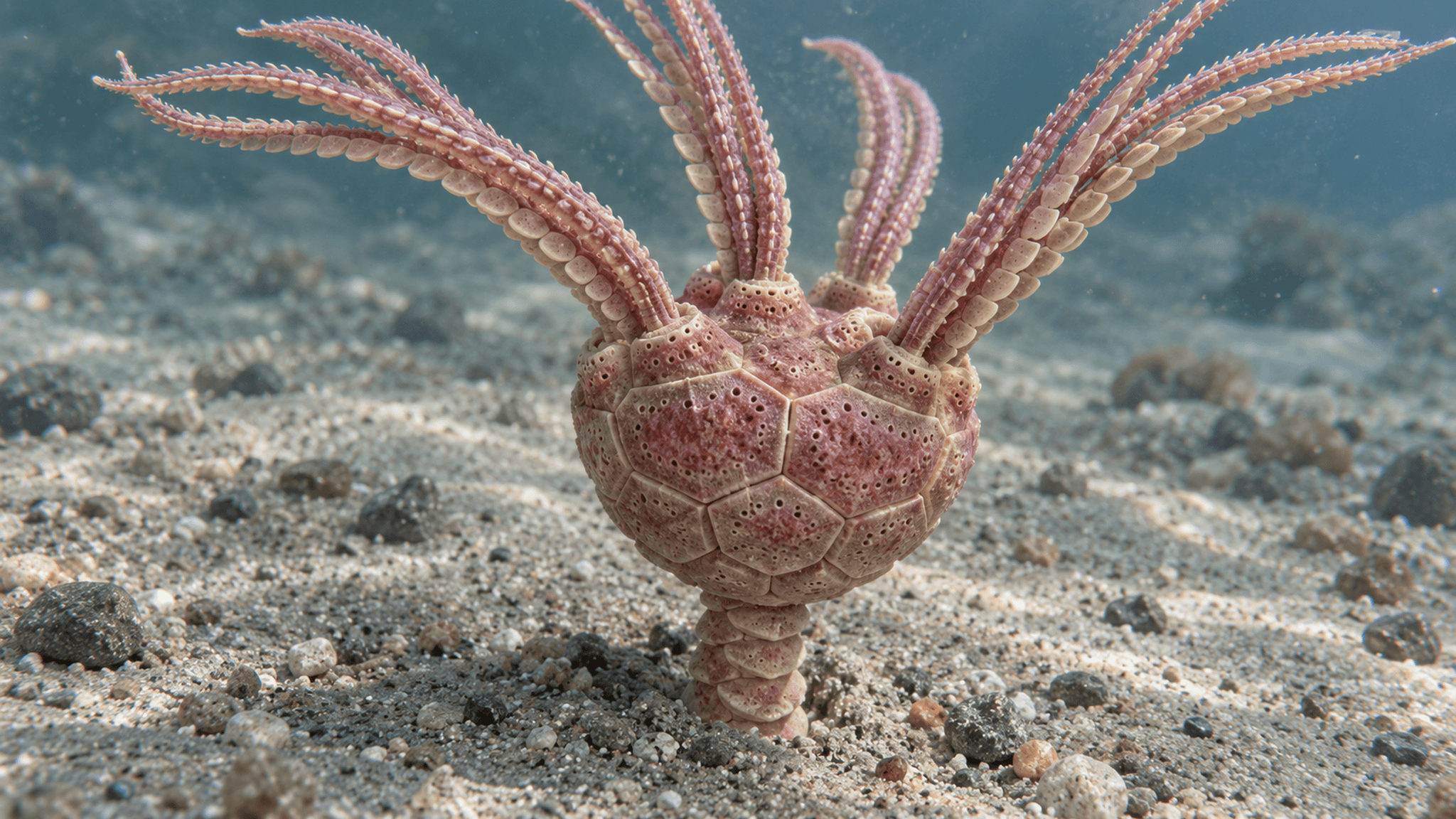
The Moroccan animal is a gogiid, an early echinoderm. It has been placed in its own new genus. At the bottom sits a simply built stalk made from small, rounded plates arranged haphazardly against one another.
Above it rises the body capsule, known to specialists as the theca. Irregular polygons lock together into a mosaic, yet still form five neat rings stacked one above another. Each plate has a finely granular surface and is pierced by numerous epispires, structures used for breathing.
Long arms called brachioles project into the water at the top. They usually grow in clusters of three from raised mounts around the mouth. Two staggered rows of floor plates support each arm, while two equally staggered rows of cover plates seal it from above.
The scene may have looked like this: in the Cambrian sea, clusters of arms sway in the current while the stalk anchors the animal to the seabed. All around it, the story of an animal group that survives to this day is just beginning.
The Basal Plate Points to a Relative in Spain
Then comes the detail that turns the whole story around. At the base of its capsule, Atlaseocrinus issafenensis has only one basal plate. According to the study, no other gogiid has this feature.
The same identifying mark reappears in Spain. The region’s oldest articulated specimens came to light in the Iberian Chains in the north-east of the country. They belong to a species described in 2004 as “Rhopalocystis” mesonesensis, whose place in the family tree had remained unresolved.
The Spanish animals also carry a single cup-shaped basal plate. One channel runs through it from the body capsule into the stalk. Because of this cup plate, the species moves to a different genus and is now called Atlaseocrinus mesonesensis.
Morocco and Spain Share a Genus
The study places these earliest echinoderms in western Gondwana, part of the southern supercontinent of the time. An animal from Morocco and one from Spain now stand in the same genus. The abstract published so far does not reveal exactly what conclusions the authors draw from this about their early distribution.
Neither the long arms nor the patterned armour settled the question. The decisive clue was an inconspicuous component at the bottom of the capsule.
For more than 500 million years, this plate lay inside the rock. Today, it links fossil sites in two countries and shows how a single feature can rewrite a family tree.
---