A team led by Ralf Werneburg reports the new fossils in the journal “Fossil Imprint”. They come from the Zbýšov Horizon, a rock layer within the Padochov Formation. They match the material that the researcher Augusta described from the same site in 1947.
Named in 1947, Lost Today
Augusta described two forms at the time: Moraverpeton remesi and an unidentified Branchiosaurus. He assigned both to the branchiosaurids, a family of early amphibians. Today, these bones are considered very probably lost.
Without the original, a species name can scarcely be checked. The team has therefore designated a neotype: a new reference fossil that takes the place of the lost original. At the same time, the study shows that Moraverpeton remesi clearly belongs to the branchiosaurids and moves into the genus Branchiosaurus, established by Fritsch in 1876.
20 Teeth and a Dimpled Skull Give the Species Away
About 20 teeth sit in the upper jaw. This detail is one of eleven features that, in this combination, occur only in Branchiosaurus remesi. They include a broad, almost square bone at the rear of the skull roof and an early-developed pattern of dimples and ridges across the central skull bones.
This genus urgently needs clear features. After its first description, an allegedly unusual vertebral structure even landed Branchiosaurus in an order of its own. Later, some finds turned out to be larvae of larger amphibians such as Eryops, while others proved to be animals that kept their gills throughout life.
Even today, it remains uncertain whether many described species are valid. A fixed reference fossil brings order to the confusion.
Amphibians Sometimes Ruled the Lake at Zbýšov
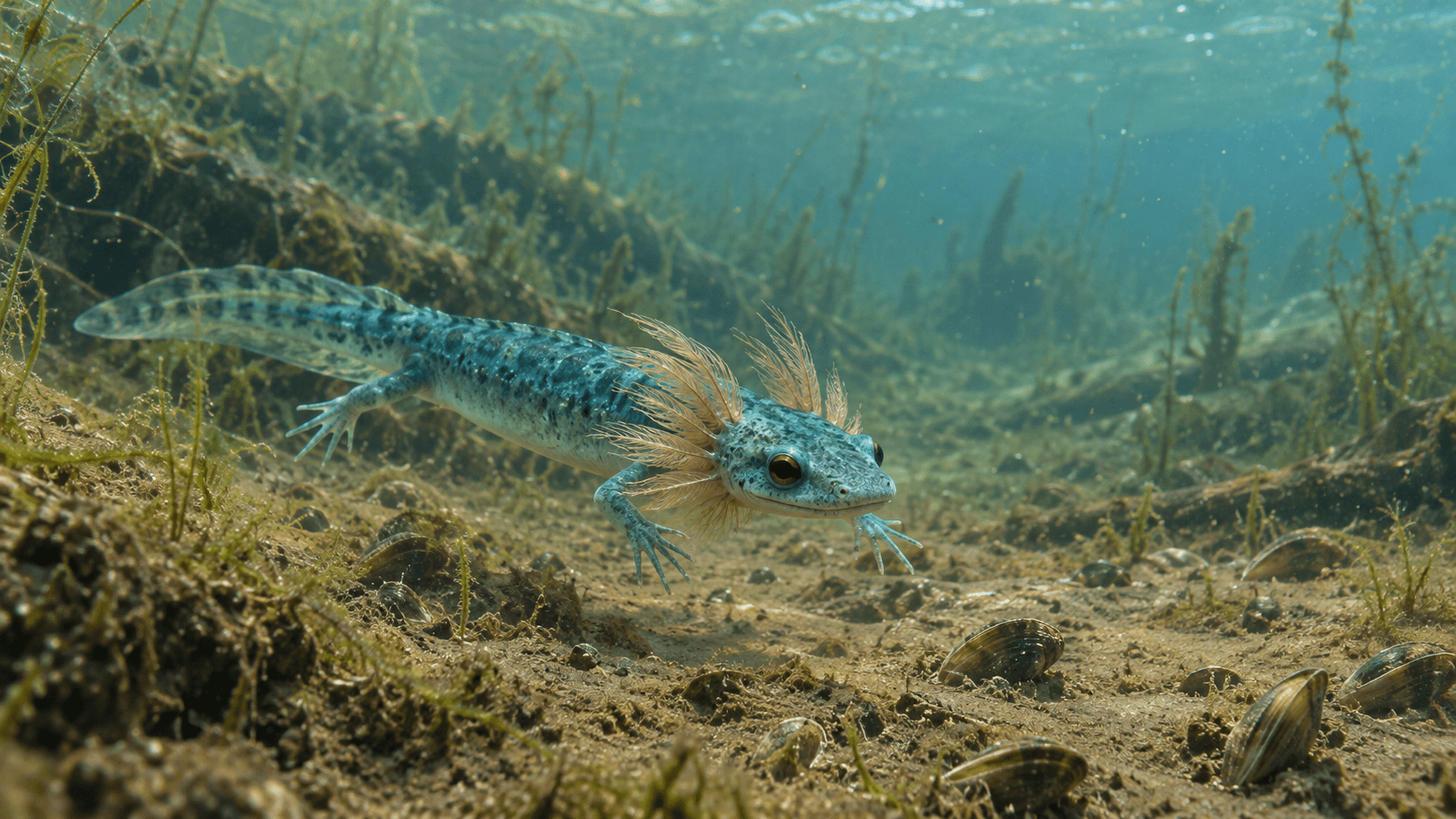
Young mussels cover the lake bed. Small fish pass by, joined more rarely by spiny sharks of the genus Acanthodes, freshwater sharks and clam shrimps (conchostracans), with algae drifting between them. Amphibians of the genus Branchiosaurus swim through the middle of it all.
According to the study, amphibians dominated this lake at times. The population belongs to the so-called stream type, which points to high oxygen levels in the water. A river may have fed the lake.
The lake lay in the equatorial part of Pangaea, the supercontinent of its day. The Boskovice Basin is a sunken trough on the eastern edge of the Bohemian Massif, around 100 kilometres long and 3 to 10 kilometres wide. Rivers mostly filled it with red sediment; only isolated grey lake layers are packed with fossils.
Life also moved across the land. Zbýšov preserves tracks made by diadectomorphs, a group of early four-limbed vertebrates. The track species is called Ichniotherium sphaerodactylum.
Fish Ruled the Neighbouring Lake
Moravský Krumlov looked completely different. Ray-finned fish—the group containing most living fish—and xenacanthids, a group of early freshwater sharks, dominated there. Only a single amphibian specimen was found, and it very probably belongs to Branchiosaurus remesi.
Two ways of life are documented among closely related branchiosaurids with gills. Some transformed completely into land animals. Others followed neoteny, remaining in the water with gills throughout their lives.
The axolotl still follows this second path today. It becomes sexually mature without ever moving onto land and retains its external gills. How these two life strategies arose and what controls them remain open questions in research.
A Firm Benchmark Again, Almost 80 Years Later
Almost 80 years after their description, the original bones of Branchiosaurus remesi are considered very probably lost. With the new reference fossil, the species once again has a firm anchor against which every future find can be measured.
---