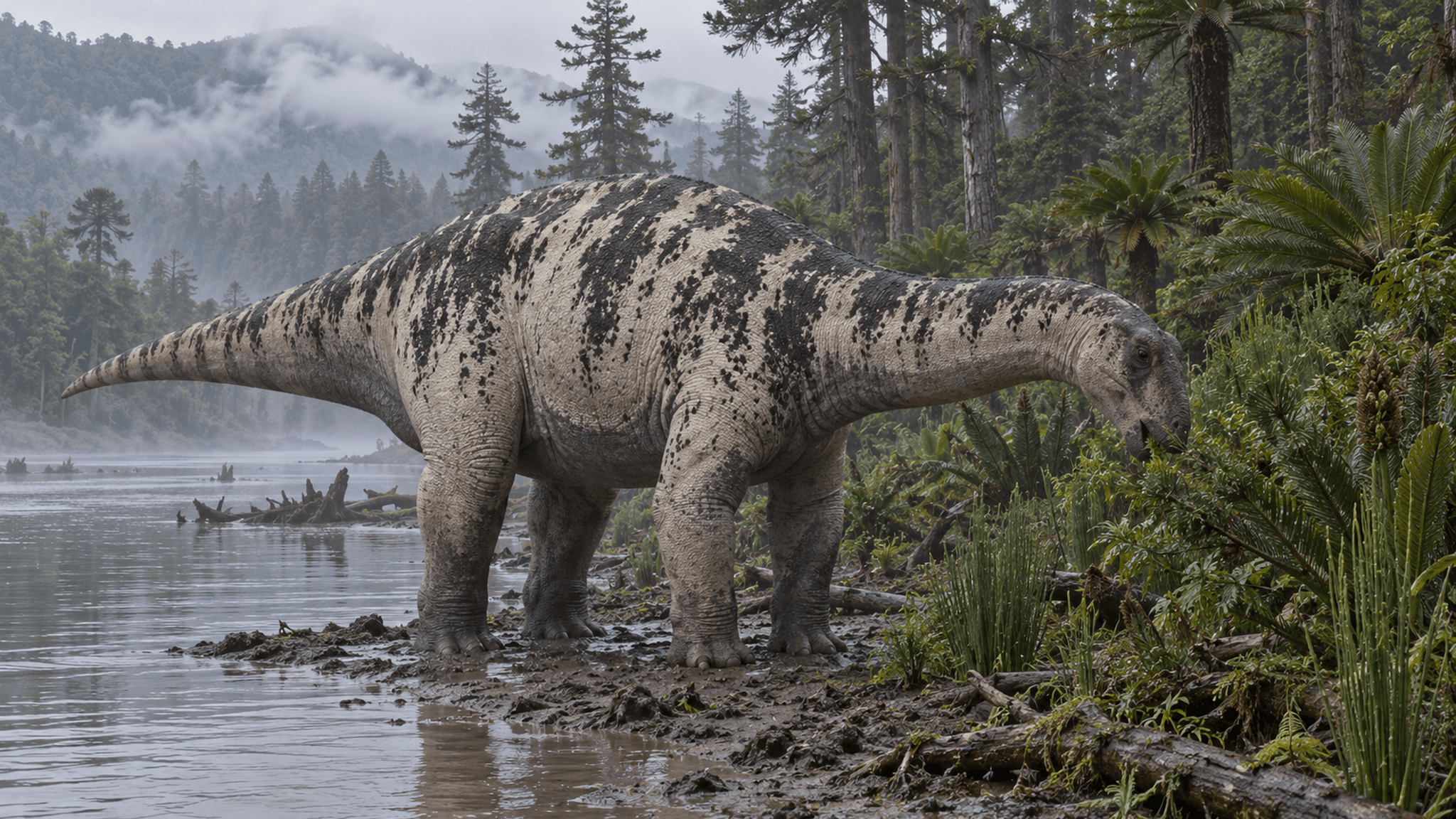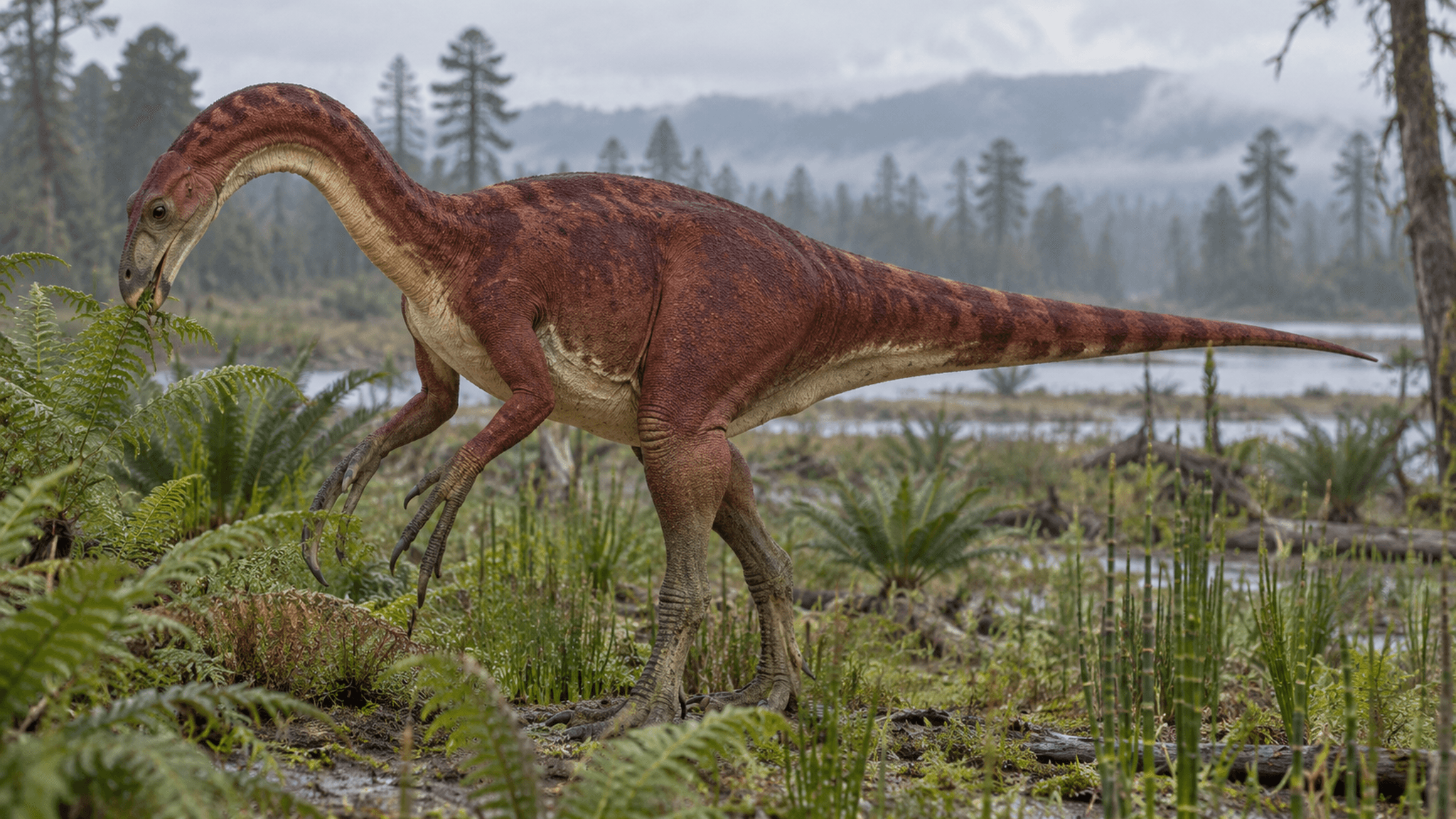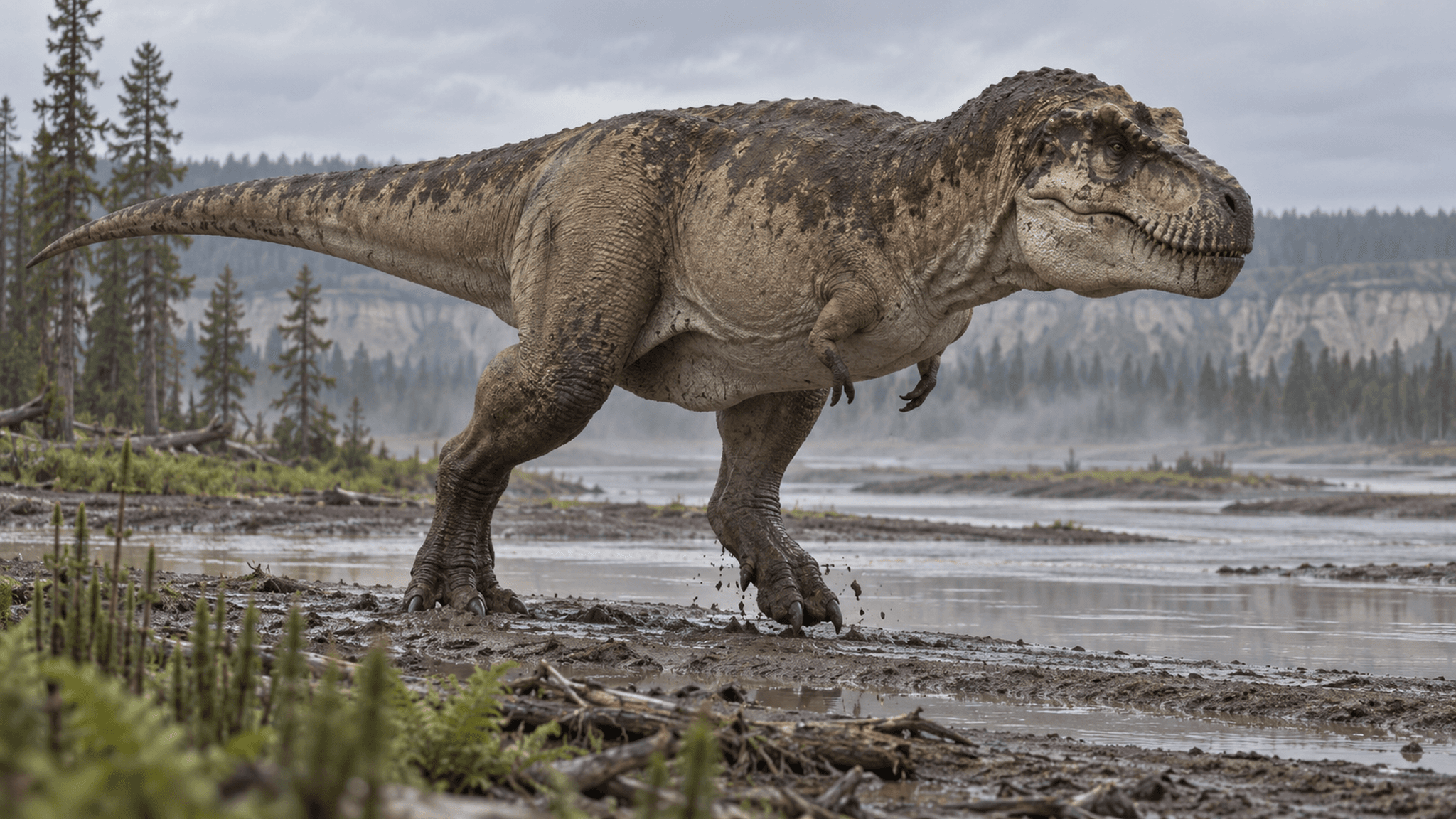
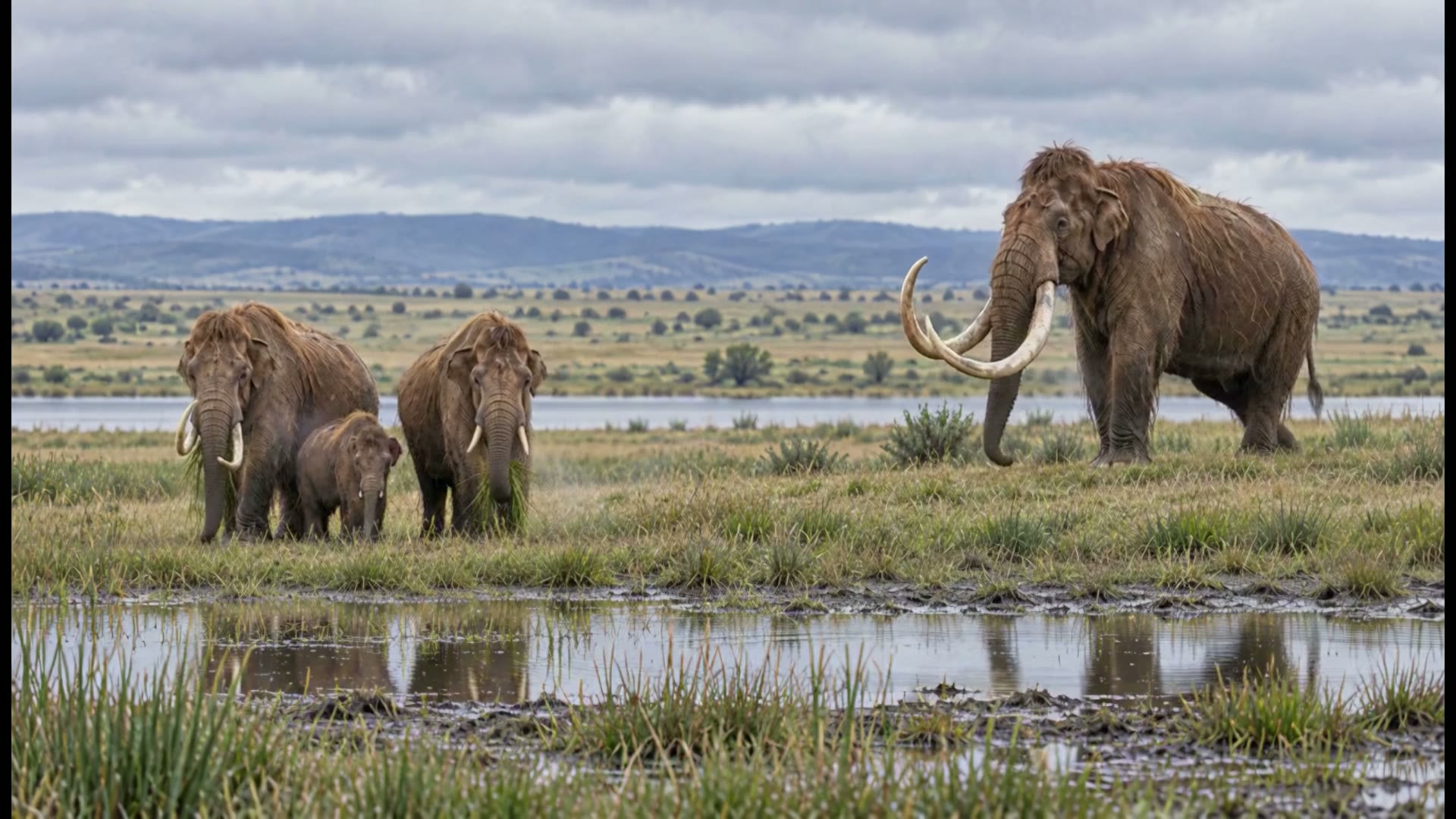
About 13,000 years ago, where dry farmland now lies near Clovis, New Mexico, there was a spring-fed lake in the middle of a wide grassland. The water drew in the great animals of the Ice Age, and with them the hunters of the Clovis culture. Our time-travel episode shows one day at this lake. This page explains what is backed by evidence, what remains reconstruction, and where the knowledge comes from.
Blackwater Draw: where the mammoth hunt was proven
The site is called Blackwater Draw. It is the type site of the Clovis culture, the place that gives its name to the oldest clearly defined culture in North America. When excavations began there in 1932, Clovis points lay directly among mammoth bones. That was the first unambiguous evidence that people in the Americas hunted mammoths. Over more than 80 years of excavation, at least 28 mammoths have been recovered at this one site.
The Clovis culture dates to roughly 13,050 to 12,750 calibrated years before present. It lasted only a few centuries.
Which animals lived at the lake
The fauna list from Blackwater Draw reads like a complete late Ice Age ecosystem: Columbian mammoths, bison, horses, camels, ground sloths, sabre-toothed cats and dire wolves. American lions are not directly recorded at this site, but they lived in the region at the same time. Not every species necessarily comes from the same layer as the Clovis points, but all of them belong to this region and this period.
- *Columbian mammoth (Mammuthus columbi): a full-grown bull stood almost four metres tall and weighed almost ten tonnes, larger than any living elephant. The weights are calculated from bone measurements. It was not the shaggy woolly mammoth of the north; it lived on warmer plains and carried less hair. Its coat colour is unknown; the colour in the film is an assumption of the reconstruction. - Bison antiquus: about a quarter more massive than today's bison, over two metres tall, with horns spanning almost a metre. - Camelops: a true camel native to North America. Whether it had a hump is still unknown. - American lion: about a quarter larger and heavier than a modern lion. It died out only after the Clovis people. - Harlan's ground sloth (Paramylodon harlani): well over two metres tall when upright and more than a tonne in weight, about as heavy as a small car. - Sabre-toothed cat (Smilodon fatalis): not a tiger but its own lineage of cats, about as heavy as a lion but stockier. Its long upper canines were finely serrated, made for a precise bite rather than for cracking bones. Its coat pattern and how it reacted to humans are unknown. - Dire wolf (Aenocyon dirus):* about as large as the largest grey wolves, but more heavily built.
How the Clovis people lived
The Clovis people lived in small groups and moved constantly; permanent villages are not known. Bone needles show that they sewed hides into clothing. What that clothing looked like is not known, because only the tools survived.
Their best-known tool is the Clovis point: lanceolate, worked on both faces, with a lengthwise groove at the base. The groove is not decoration; it helps fix the point into a wooden shaft. The stone often came from far away, sometimes from more than 900 kilometres. Whether the people travelled that far themselves or the material was passed along cannot be told apart with certainty.
How the mammoth hunt worked and what remains open
No spear-thrower has been found for the Clovis period; it appears only thousands of years later. Clovis hunters therefore had to get close and thrust or throw their spears from a short distance. A lack of finds does not entirely rule out its use, however.
How such a hunt unfolded in detail, alone or in groups, as a drive or an ambush, nobody knows. The scene in our film in which the hunters pick out an animal that lags behind is a cinematic reconstruction. What is documented is the link between point and prey in the ground.
A 2024 study shows that mammoths were no rare prey for these people: isotope values in the bone of a Clovis child from Montana suggest that almost half of its mother's diet came from mammoth. The study rests on a single individual; other Clovis groups may have eaten differently. At Murray Springs in Arizona, five hunting layers lie on top of one another: hunters returned to the same spot again and again.
Were the Clovis people the first Americans?
No. At White Sands in New Mexico, just under 500 kilometres from Blackwater Draw, people left footprints about 21,000 to 23,000 years ago. Independent dating confirmed this age in 2023, although the debate is not fully closed. Who these early people were, and whether they were ancestors of the Clovis people, remains open.
The Anzick child and its descendants
In Montana, people of the Clovis culture buried a small child almost 13,000 years ago. They laid it beneath more than 115 tools and sprinkled it with red ochre. The Anzick child is still the only human directly linked to the Clovis culture. Its genome was sequenced in 2014. It shows a close relationship with many Indigenous peoples of the Americas, closest of all with peoples in Central and South America.
Why the mammoths disappeared
Shortly after the Clovis period, the Columbian mammoth and almost all of North America's large animals disappeared. Whether human hunting, climate change at the end of the Ice Age or both together tipped the balance is still debated. Only the difference with which our episode ends is certain: the mammoths of the lake are gone, the people of that time are not. Their descendants live on today.
The episode in chapters
- 0:00 Time travel: 13,000 years back - 0:39 Arrival at the mammoth lake - 2:24 Camels, horses and lions at the water - 4:03 The ground sloth - 5:02 The sabre-toothed cat - 5:50 In the camp of the Clovis hunters - 7:15 The mammoth hunt - 9:09 The wolves arrive - 9:44 Night by the fire - 10:41 What remains today
Note: the episode has German audio. Animals, people and landscape in the video are AI-generated reconstructions based on current research. Colours, clothing and behaviour are partly not documented. The facts in this text have been scientifically reviewed.