A team led by Yuyan Zhu of the Chinese Academy of Sciences presents the discovery in the Journal of Paleontology. The researchers establish a new species for the animal — and a new genus with it, meaning a distinct group of closely related species.
The X-ray scan pulls the legs from the rock
The legs were invisible to the naked eye. Only micro-computed tomography revealed them, using extremely fine X-rays to scan a fossil layer by layer.
The researchers examined two specimens. Both came from a yellowish layer of mudstone — finely stratified rock formed from mud — in the Maotianshan Shale near Chengjiang.
The scan exposed two antennae, followed by leg after leg. Three pairs sit beneath the head, seven beneath the trunk and three beneath the tail shield. All 13 pairs share the same biramous structure, meaning that each leg forks into two branches.
Dianhaia belongs to the helmetiids, an extinct group of flat arthropods whose armour was not hardened by calcium. Yet their undersides are precisely the parts researchers know least about.
The first species described from the group, Helmetia expansa from Canada’s Burgess Shale, remains barely understood from below. Chengjiang fossils such as Dianhaia are therefore supplying the missing body plan piece by piece.
A 23-millimetre spiny miniature
The fossil on which the new species is based measures about 23 millimetres including its tail spine. That is slightly less than the width of a two-euro coin.
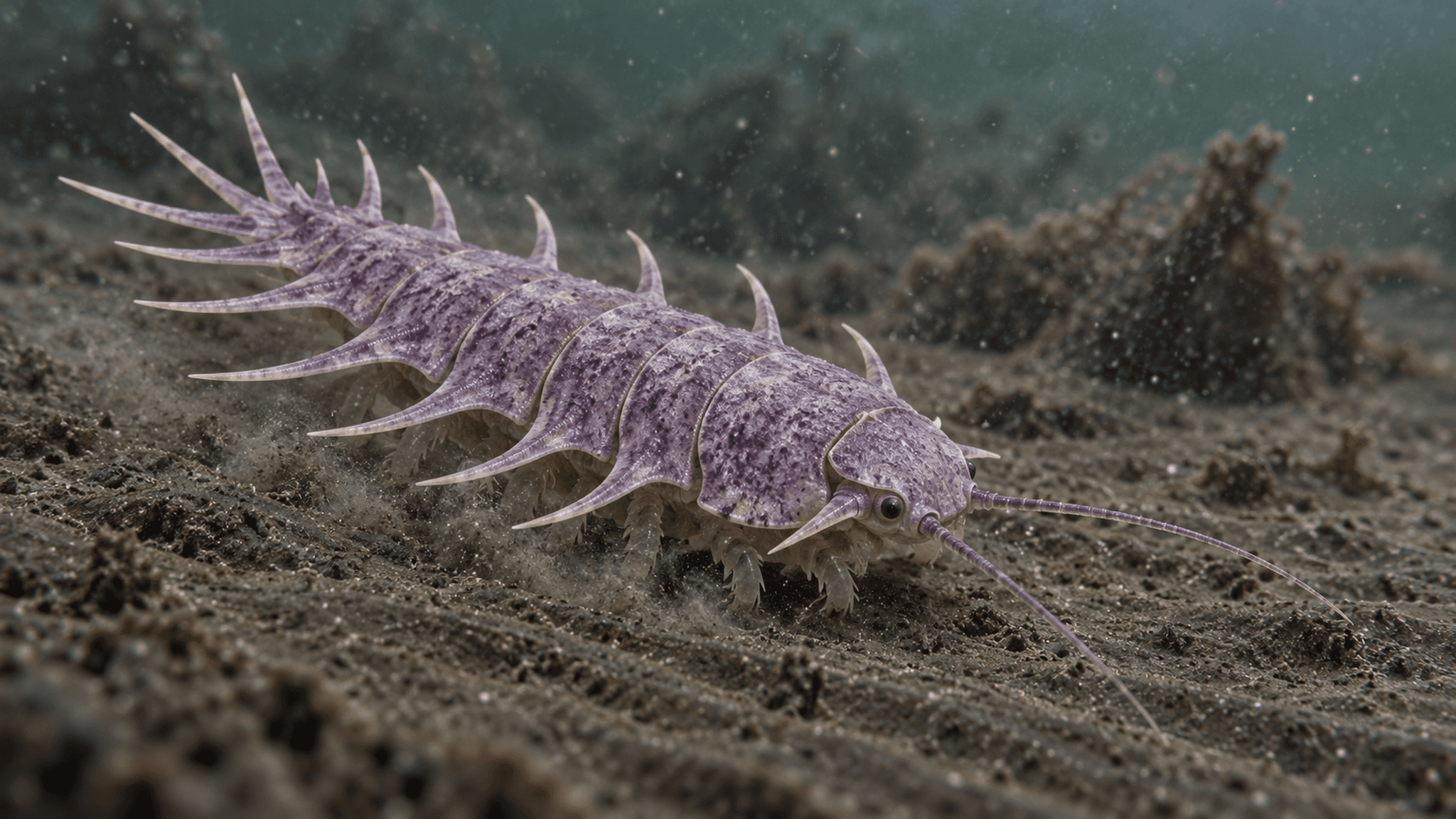
In the reconstruction, a flat, spiny body pushes across the muddy seabed. A small plate sits at the front, followed by a semicircular head with two short spines, then seven trunk segments armed with long lateral spines. At the rear, the tail shield ends in a short central spine flanked by three pairs of long spines.
Two long antennae reach far forwards into the murky water. The authors leave their purpose open because direct evidence for their function is still lacking.
Life swarmed around this tiny animal. Researchers know around 185 described species from at least 15 animal phyla in the Chengjiang Biota, the animal community preserved at this site. Alongside the Burgess Shale, it is regarded as the most important window into the Cambrian explosion, when animal life diversified enormously over a geologically short period.
One segment more than its neighbour
The long spines on the trunk and tail shield distinguish Dianhaia from the related genera Helmetia and Kuamaia. Its short cheek spines, by contrast, resemble those of Kuamaia lata more closely than the long spines of Haifengella.
Haifengella corona was described from the same fossil site in 2014. It bears six trunk segments, each with one pair of spines, and a crown-shaped tail shield with two pairs of spines. Dianhaia adds one to both counts: one more segment and one more pair of spines at the rear.
Its closest relative lived next door
To resolve these relationships, the researchers ran a phylogenetic analysis, which uses anatomical features to infer where evolutionary lineages branch apart. The result places Dianhaia and Haifengella as sister groups, each the other’s closest relative.
Together, they form the latest-branching lineage within the helmetiids. Kuamaia lata, by contrast, branches off first. That result applies to this single analysis and does not yet constitute a definitive family tree for the group.
The trail leads to the trilobites
Behind this small fossil lies a large question. Trilobites are the famous marine arthropods with three-part armour. Some earlier phylogenetic studies placed the helmetiids directly beside them — sometimes as close relatives, sometimes even as their sister group.
The issue remains unresolved. Dorsal plates that meet edge to edge while remaining mobile support a close relationship, but do not prove it.
The Maotianshan Shale in Chengjiang County is no more than 518 million years old and has been a UNESCO World Heritage Site since 2012. Even the delicate legs of a 23-millimetre animal survived there. Every fully counted pair of legs brings the helmetiid body plan into sharper focus — and that body plan holds the key to how closely they were really related to trilobites.
---