A team led by Ekaterina V. Tselikh described the new genus and species in the scientific journal Zootaxa. According to the study, the fossil dates from the late Eocene, a period in Earth's history.
Five clues expose the amber wasp
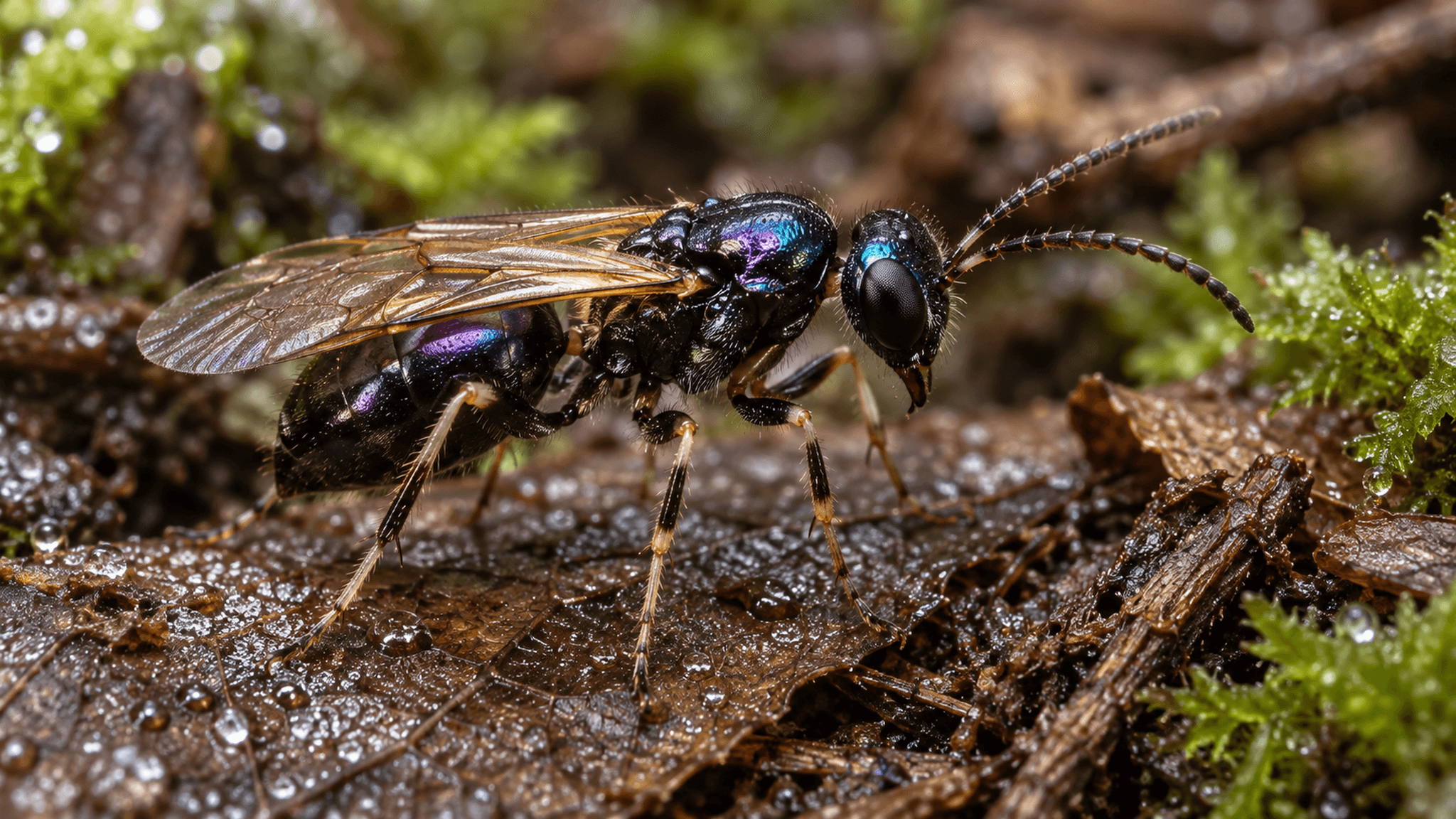
The hunt for clues begins at the mouth. The wasp's upper lip is concealed, with a row of fine bristles lining its edge like the teeth of a comb.
The trail continues across its back. Between the wings, one area stands out clearly from the rest. Directly behind it, a plate on the back lies lower, as though someone had pressed it in.
The hind legs reveal the next clue: their uppermost segments, the hips, are wrinkled crosswise like a furrowed brow. At the very rear of the body sit two tiny appendages, each with a conspicuous brush of bristles in front of it.
None of these clues would be enough on its own. Only all five together identify the animal as a member of the Diparidae.
Young family, ancient find
The family itself is a newcomer to insect classification. For many years, specialists treated the Diparidae merely as a subfamily of the Pteromalidae, another chalcidoid wasp family. Only the reclassification of chalcidoid wasps in 2022 made it a family in its own right.
An angular tooth places the wasp between two genera
The greatest surprise lies in its face. A single angular tooth projects from the centre of the clypeus, the plate above the mouth. It also has a comparatively short antennal segment: the first segment in the middle section of the antenna is only 1.10 to 1.14 times as long as the second, making the two almost equal in length.
This combination places Paleolelaps anatomically between two genera in the family that were described as early as 1833 and 1843: Dipara and Lelaps. The amber wasp does not fit either one completely. The finding says nothing about direct ancestry.
Living relatives thrive at the expense of weevils
Leaves rustle across a damp forest floor: that is where researchers find most Diparidae today. A reconstruction could also picture Paleolelaps draco among decaying leaves, beneath trees whose resin would one day become amber.
Its living relatives are parasites. Their young develop mainly at the expense of weevils, although the wasps occasionally emerge from mantis egg cases or fly pupae. Such hosts would be plausible for the amber wasp, but there is no evidence for them.
Today, the family lives across almost the entire world, with most genera found in South Africa and Australia. Its roots probably lie in Gondwana, the former southern supercontinent. Its oldest known representative, however, comes from amber found in the Baltic region.
The amber guards a mystery of age
More than 90 per cent of Baltic amber comes from the Sambia Peninsula in what is now the Kaliningrad region. Ice Age glaciers carried further chunks into Poland, the Baltic states and the North German Plain.
The age of this amber remains disputed: estimates range from about 56 to 34 million years. Usually, researchers can date only the layer into which it was later redeposited. When the resin flowed therefore remains an open question.
The study assigns Paleolelaps draco to the late Eocene. The Diparidae have been recognised as a separate family only since 2022, and this first fossil now traces their history back into prehistory through physical evidence.
---