A team led by Gaël E. Spicher of the University of Fribourg reports the discovery in the Zoological Journal of the Linnean Society. The researchers re-examined all four turtle fossils from Canjuers because most studies of them are more than three decades old. Modern imaging exposed fine details of their skulls and shells.
The Mud Sealed Entire Skeletons
Dead animals in the lagoon were quickly buried by mud. According to the authors, thin films of microbes — tiny living organisms — slowed decomposition. That is why many skeletons still lie bone against bone today.
The lagoon has since become rock in the French département of Var. The Canjuers limestones date from the Tithonian, the final stage of the Jurassic, and rank among Europe’s most important fossil sites from this period. They have yielded an extraordinary fauna of invertebrates and vertebrates, with turtles forming only a small group.
First One Species, Then Three — Now the Answer
In 1982, a study tentatively and cautiously placed one specimen close to the genus Solnhofia. A 1994 paper went much further. It saw three different turtles in the same material: one new species each of the genera Eurysternum and Solnhofia, plus a third form that could not be identified more precisely.
The new study now sorts out these finds piece by piece. In the end, every fossil gets its own answer.
One Bone Above the Tail Decides the Case
The shell of the type specimen measures 224 millimetres along its midline. The type specimen is the individual fossil to which a new species name is officially tied. At its widest point, the shell measures 213 millimetres, making it slightly longer than an A5 exercise book and almost as wide as it is long.
The decisive clue lies at the rear of the shell. Caesaria templaria carries a robust pygal bone there — the central bony plate directly above the tail — without any notch at all. Eurysternum wagleri lacks this bone; in its place, a distinct notch cuts into the shell margin.
Other features bring the animal into sharper focus. The skull is medium-sized and the snout is short. From the seventh marginal plate onwards, the rear plates around the edge of the shell are wider than they are long. Broad horny scutes cover the back, divided by wavy grooves.
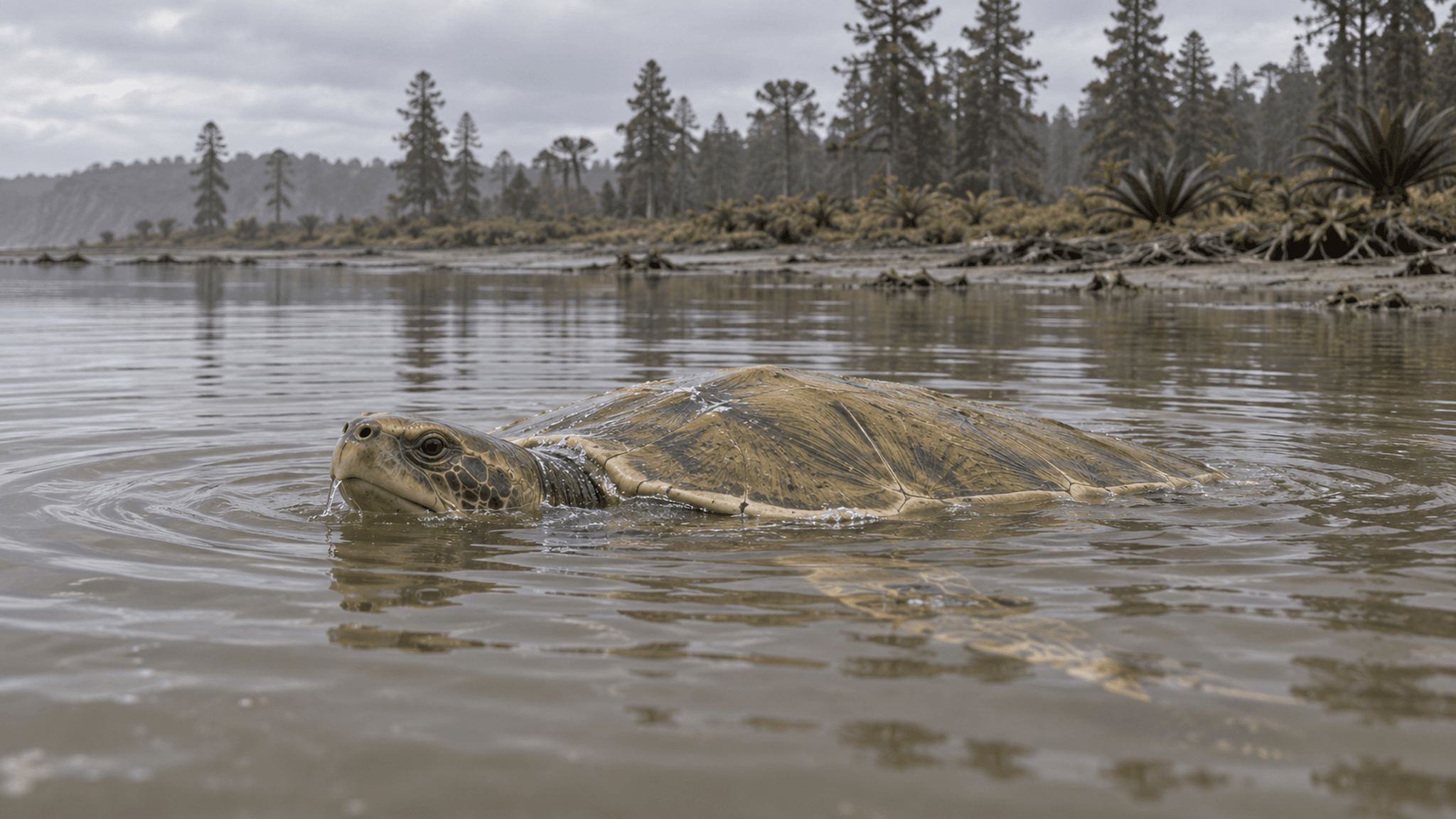
The new species belongs to the thalassochelydians. This was a group of Jurassic marine turtles that lived along the coasts. The team also establishes a separate genus for Caesaria templaria.
The Third Find Is an Old Acquaintance with a Giant Skull
The third fossil belongs to a species known for decades: Solnhofia parsonsi. Its identification rests on the outline and size of the skull, the elongated snout and small gaps between the rib and marginal plates of the shell. In the researchers’ assessment, minor differences from previously described specimens do not affect the species identification.
This is precisely where the two turtles part company. In Solnhofia parsonsi, the snout projects far beyond the external nasal opening, and the bones of its shell are thick throughout. Caesaria templaria has a short snout and thin shell bones.
Solnhofia parsonsi is known from the Late Jurassic of Germany and Switzerland. Its head is so large that, in a complete skeleton, it measures about 40 per cent of the shell’s length. The genus received its name only in 1975, based on two skulls, although a specimen from Solothurn had already been briefly mentioned in 1965.
The Juvenile Keeps Its Name Secret
The fourth fossil came from a young animal and was found during an excavation led by S. Wenz. It is so poorly preserved that its species cannot be identified with precision. The team therefore leaves it unnamed.
Turtles Colonised Europe’s Jurassic Coasts
As early as the Kimmeridgian, the stage before the Tithonian, related turtles swam through Europe’s coastal waters. Fossils of the genus Thalassemys come from the Swiss Jura Mountains and southern England. This turtle group was therefore widespread across the islands and coasts of the European archipelago of the time.
How the animals spread through this island world is still considered largely unexplored by specialists. The scientific literature contains more than 60 named species that still need to be reassessed worldwide.
A New Genus at the End of the Jurassic
With Caesaria templaria, the known diversity of Late Jurassic marine turtles gains one genus and one species. The researchers found it in fossils that had already been studied decades ago.
---