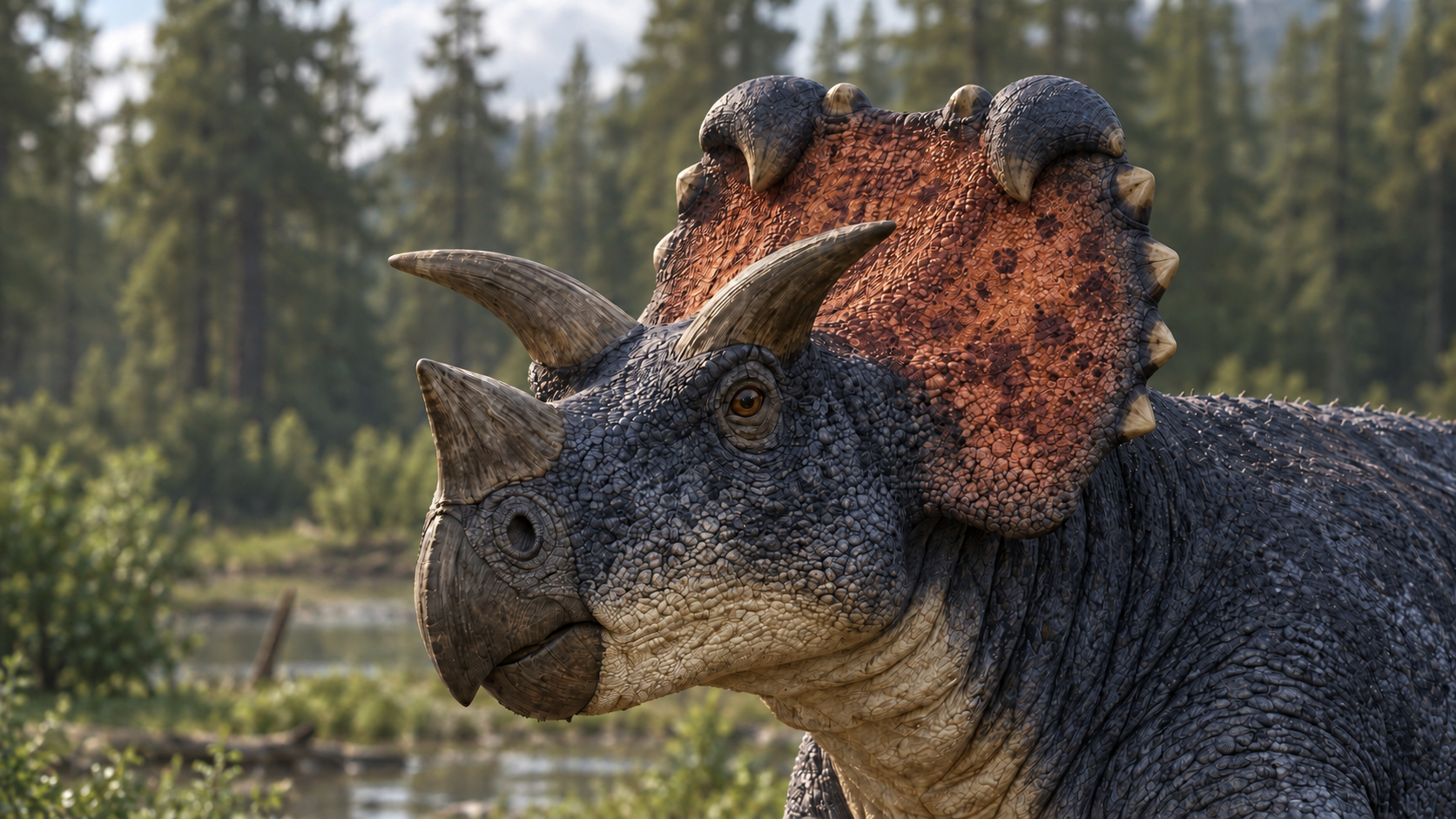
Disease had left its mark across the tail bone. Its sideways-projecting processes were destroyed, while cavities and cracks opened inside. Growths covered the outside, one almost six centimetres high.
And running through it was a channel that drained pus to the outside. This small passage through the bone reveals a great deal about what Medusaceratops lokii went through. It leads straight to the deep-seated infection.
Number seven stands out
The diseased vertebra comes from a nearly complete skeleton. Of its tail vertebrae, only the seventh shows this pathology. One bone stands out from the entire series.
The animal was found in pale sandstones of the Judith River Formation near Joplin, Montana. These rocks date to the Late Cretaceous. Today, the skeleton is housed at the Grandview Museum of Natural Science in Guangzhou, China, under the number HS0385.
The damage struck at the base of the dinosaur's tail. Its seventh vertebra sits in this forward section. Researchers examined the bone and uncovered a medical history that had left traces both outside and within.
Newly formed bone covers the sides and one joint surface with a honeycomb-like texture. Smooth bone gives way to rough, broken surfaces. Much of the vertebra looks extensively remodelled.
Cauliflower outside, cavities inside
Two large growths on the underside are especially conspicuous. One resembles cauliflower. The other projects like a beak and measures 57.3 millimetres in height.
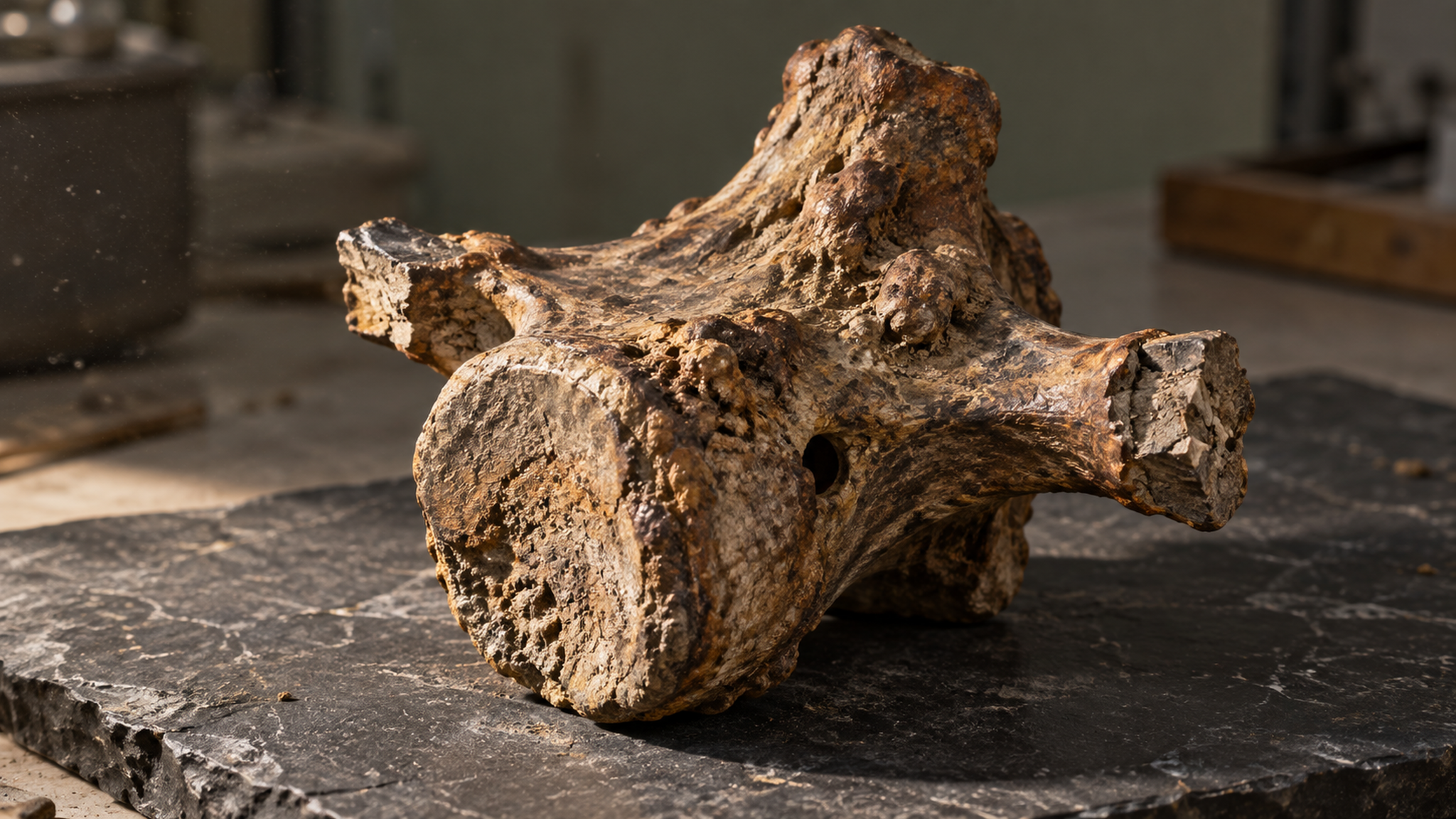
Both are part of the vertebra: their outer bone layer and spongy interior are continuous with its bone. Further, smaller growths sit on the right-hand side. The animal had built this new bone itself.
But this mass was far from uniformly solid and dense. Images from computed tomography, or CT, reveal cavities and cracks in the growths and the vertebral body. In places, the bone looks moth-eaten.
Around these damaged areas are regions of markedly increased density. Bone destruction and bone formation sit side by side in the same vertebra. Their combination lets the researchers trace the course of the disease.
The pus found a way out
On the right-hand side, the team found the crucial channel. It passes through the outer bone layer, connecting the diseased area within to the outside world. Pus could drain through it.
Such a draining channel is a characteristic feature of chronic bone infection, known as osteomyelitis. The disease was deep inside the bone. Together with the growths, destruction and dense regions, it establishes the diagnosis.
For Medusaceratops lokii, this is the first documented case of this chronic infection with a draining channel. The fossil preserves particularly clear evidence. It even shows where the infection found a route to the outside.
Fractures reveal the beginning
The infection followed an injury. On the left, the sideways-projecting bony process survives as a broken remnant with new bone at its end. On the right, an oval, rough bony trace sits in the corresponding position.
There are also fracture lines that become visible in CT images. The researchers identify evidence of old injuries with incomplete or faulty healing. What originally injured the horned dinosaur remains unknown.
The damage therefore had a history. It affected a living body that responded at the fracture sites. Later, the chronic infection left its own distinct marks in that same vertebra.
Its body built a sheath of bone
Then comes the surprising turn: a massive sheath of new bone developed around the diseased area. This sheath is called an involucrum. Together with the considerable increase in bone density inside, it confirms that Medusaceratops survived for a long time after its severe injury.
The dinosaur had time to develop this substantial response. The researchers interpret it as evidence of strong immune resilience in horned dinosaurs. Prolonged survival, however, does not establish a full recovery.
A striking pattern in 81 infected dinosaurs
The case sits within a larger collection: the researchers reviewed 81 reported dinosaur infections. Of these, 68 were bone infections. In 48 cases, there was evidence of an earlier injury.
Infections following trauma therefore dominate this collection. Openings caused by injury appear to have been an important route for pathogens to enter. The 81 findings describe the makeup of documented cases, not the proportion of all dinosaurs that became ill.
In Medusaceratops, that pattern takes a tangible form: broken bony processes, hidden fractures and a channel for pus. And a massive sheath of bone that still bears witness to its prolonged survival.