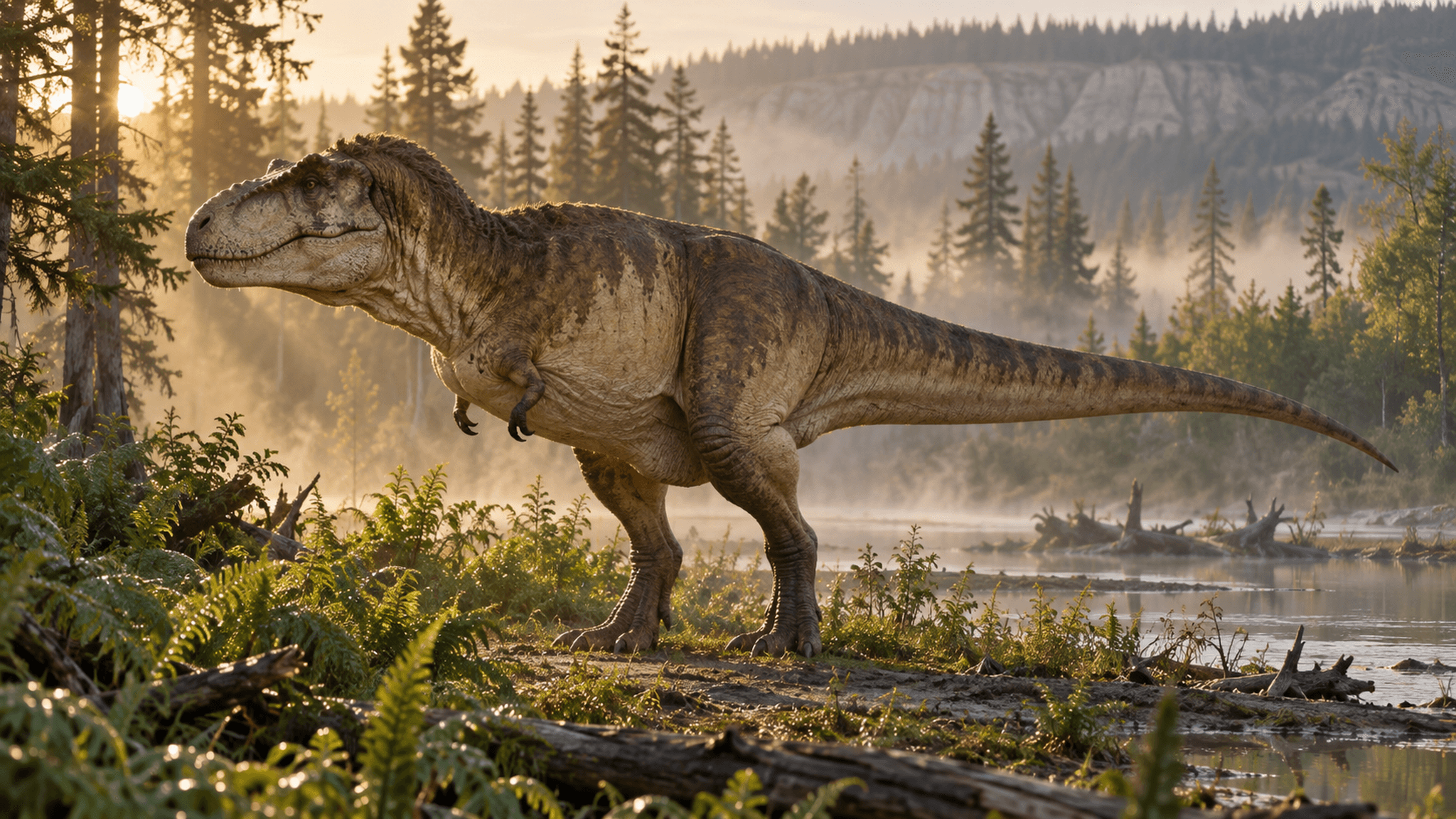
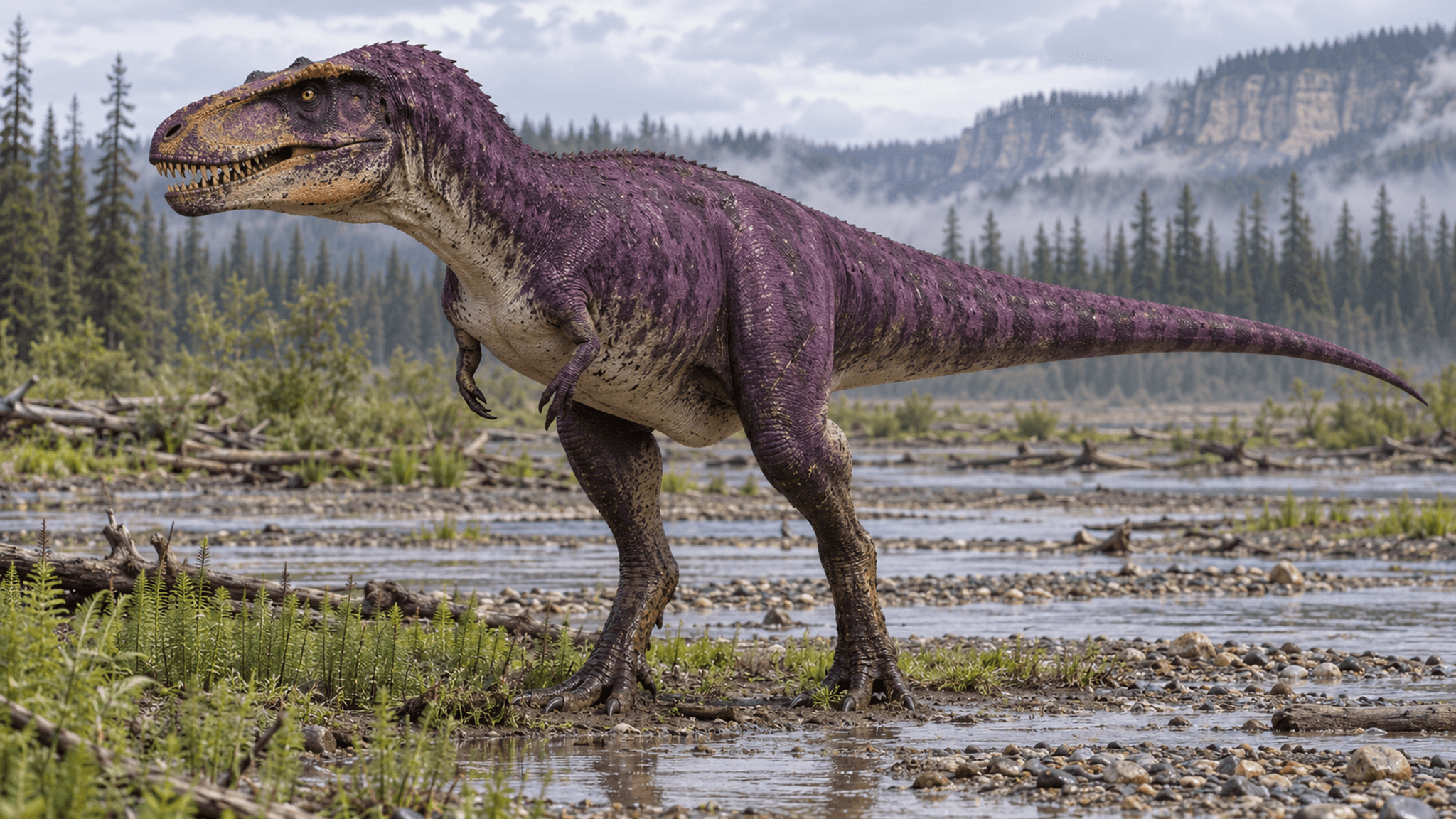
A team led by Mark J. Powers of the University of Alberta presents the predator in the “Journal of Vertebrate Paleontology”. Several fossils previously assigned to Gorgosaurus now change hands: they belong to the new species.
A powerfully built neighbour already lived in the river country
River channels snake across the landscape as floods repeatedly wash over the plains. Tromerosaurus lived in this Late Cretaceous world. Researchers already know Daspletosaurus, a far more heavily built tyrannosaur, from the same rock layers.
The slender albertosaurine group reached lengths of eight to nine metres. That is roughly the length of two small cars parked nose to tail. Their skulls were flatter and their shin bones longer than those of the robust relatives around Tyrannosaurus, but the study’s abstract does not reveal how large Tromerosaurus itself grew.
A hole in the jaw gives away the newcomer
The upper jaw cracks the case. It contains a fenestra, a natural opening in the bone, which extends farther from front to back in Tromerosaurus. A bony strut in the same area is narrower than in Gorgosaurus libratus.
The measurements tell a clear story: the jaw shape falls exactly between Gorgosaurus and Daspletosaurus. The rock record also supports the new genus, because Tromerosaurus and Gorgosaurus appear together in only a few layers.
Mistaken identities have a long history among these predators. A juvenile skull from the Dinosaur Park Formation was initially identified as Daspletosaurus, but since 2019 it has been assigned to Gorgosaurus libratus. Even the first tyrannosaur finds of 1856 were merely isolated teeth, which Joseph Leidy named “Deinodon”.
Different calculations send the predator to different camps
Then comes the shock in the family tree. The team fed a revised character matrix into two widely used analytical methods. The parsimony method, which favours the fewest possible character changes, places Tromerosaurus at the base of the slender albertosaurines.
Bayesian statistics, a probability-based method, pushes it into the other camp: the tyrannosaurines, the lineage of Tyrannosaurus itself. Lythronax, Teratophoneus and Bistahieversor also lose statistical support. Which of the two lineages they belong to is once again unresolved.
The tyrants changed at breakneck speed
Tyrannosaur species were long considered enduring and relatively lacking in diversity compared with the great herbivores of their age. Some studies even proposed species that split from one another in sequence within a single lineage. Whether that applies to the three species of Daspletosaurus remains unresolved.
Tromerosaurus scratches at that picture. The team reads the blurred family tree as a clue: the two main lineages may have separated later and rapidly acquired their typical features during the final stages of the Cretaceous, from the Santonian to the Maastrichtian.
The boundary between slender hunters and massive powerhouses therefore blurs exactly where it began. When the family divided, the early predators of both lineages apparently looked strikingly alike.
---