A team led by Paul M. J. Burke of University College London reports the discovery in the journal Royal Society Open Science. Tomistoma cairense becomes Herugavialis cairensis: the animal receives its own genus and a new place in the crocodilian family tree. The study is based on the original skull used to describe the species and several other fossils from Gebel Mokattam, a range of hills east of Cairo.
Like the Sphinx, the skull is missing the tip of its nose
The new name bows to ancient Egypt. Heru is the Egyptian name for the god Horus, while the name also alludes to the Great Sphinx of Giza. Both come from the same rock layer, and both have lost the tip of their nose.
The rock also reveals where the crocodile hunted. It consists of the lime-rich shells of tiny marine single-celled organisms that sank to the floor of a warm, shallow sea on the eastern edge of the Mediterranean region. The Giza Plateau, on which the pyramids stand, was also carved from this limestone.
The stone reveals the age as well. According to the conventional estimate, the entire rock sequence formed around 48 to 37 million years ago. The study assigns the skull to the older part of that span, a period geologists call the Lutetian.
Almost two-thirds of the head was snout
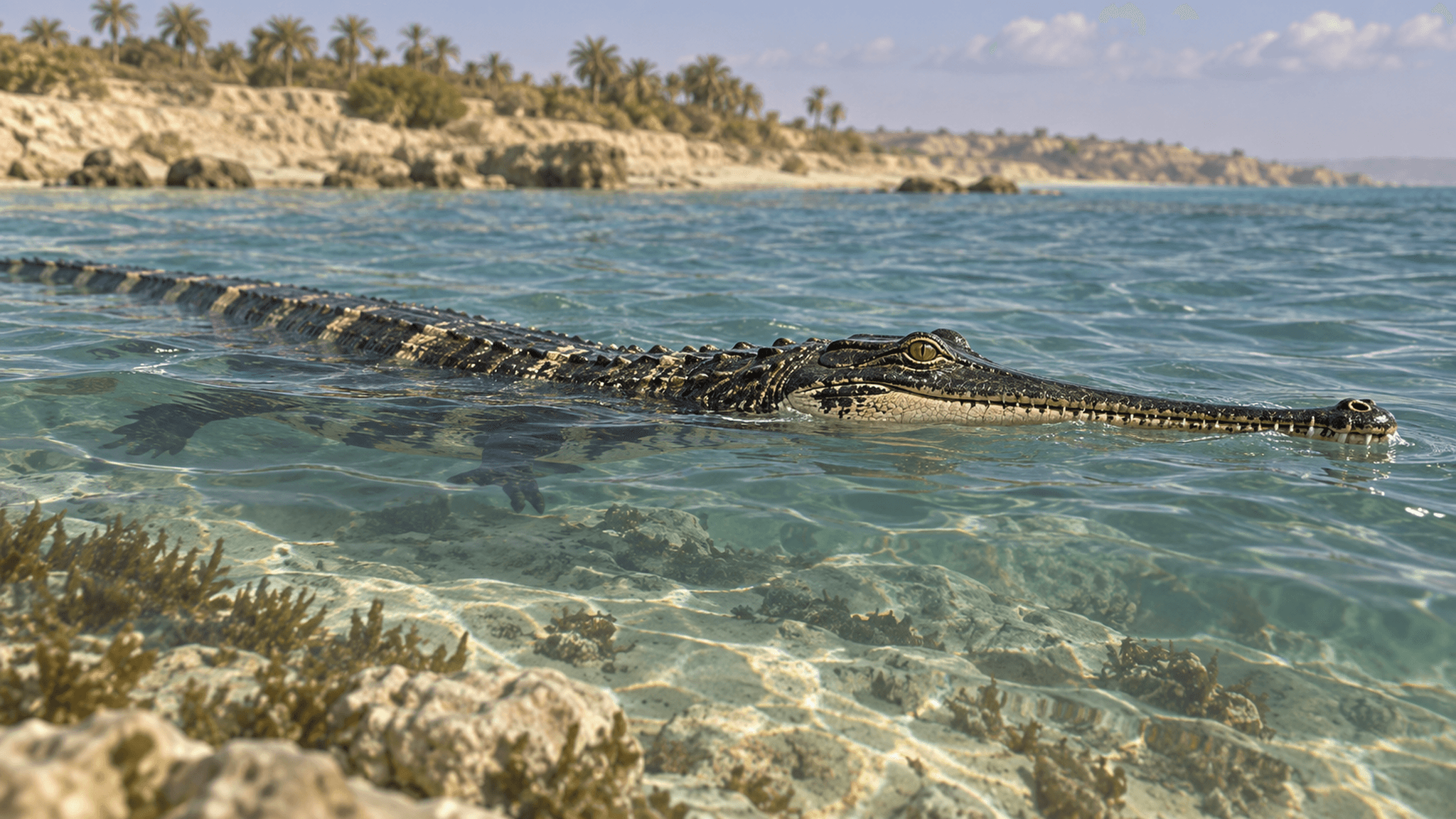
The animal was built like a pair of forceps fitted with teeth. Around 64 per cent of its skull length consisted of the snout. Because the original skull is missing its tip, the researchers combined it with a second piece of snout to make this estimate.
This body plan is the hallmark of gharials, a group of crocodilians with extremely narrow snouts. The team estimates that each half of the upper jaw held at least 15 tooth sockets. Such a slender jaw cuts through water with little resistance, and today’s Ganges gharial in India catches fish with a similarly thin mouth.
Its extinct Mediterranean relatives, however, did not hunt in rivers. According to the study, these gharials stayed around coasts and in shallow seas, unlike the living species. Some evidence even suggests that they could venture into the open sea.
A look inside the brain exposes an outsider
The researchers then scanned the skull with a computed tomography scanner, an X-ray machine that looks into the rock layer by layer. From the images, they created a digital cast of the cavity that once held the brain. At the top, this cast ends bluntly — a shape unknown in any other gharial.
Elsewhere, such a blunt end appears only in crocodilians from entirely different lineages, including an extinct crocodilian from Australia. The nose holds another surprise: the region the animal used for smelling was large and swollen. It resembles those of crocodilian relatives that lived entirely at sea.
The team found many more differences in the skull itself, both from the false gharial and from two crocodilians that lived in Egypt at roughly the same time. One feature now appears in the defining profile of the new genus: eye sockets that project above the skull roof like short telescopes.
It stands alone in the family tree
Only two gharial species survive today, both in South and Southeast Asia: the Ganges gharial Gavialis gangeticus and the false gharial Tomistoma schlegelii. The fossil record, by contrast, contains more than 40 species spread across almost the entire world. Many finds from around the Mediterranean were once filed under Tomistoma, the genus of the false gharial.
More recent family trees had already cast doubt on that classification. Burke and his colleagues ran their own analysis, searching for the family tree that required the fewest changes in anatomy. The Egyptian crocodilian grouped neither with the false gharial nor with the other Mediterranean forms examined.
Its living relative, the Ganges gharial, is itself fighting for survival today. It has been classed as critically endangered since 2007 and mainly hunts fish in the rivers and mountain streams of India and Nepal. Some individuals grow longer than six metres, and males carry a pot-like knob on the snout, called a “ghara” in Hindi.
First came the cold, then the salt
With the correct name, Herugavialis cairensis takes its place in a larger story: the rise and fall of crocodilians in the Mediterranean. After its time, gharial diversity there apparently collapsed. The authors consider it possible that the Earth cooled, sea levels fell and the coastal hunters lost their territory.
Not a single gharial is known from the Mediterranean during the following cool period, the Oligocene. The team leaves open whether they were truly absent or simply left no fossils. The group may have returned during the next warm phase, the Miocene.
In the late Miocene, crocodilians then vanished from the region altogether. The authors identify one possible culprit: an enormous salt crisis between 5.97 and 5.33 million years ago. The Atlantic supplied scarcely any water, and the Mediterranean became extremely salty. More than one million cubic kilometres of gypsum, salt and limestone were deposited at the time.
How far the sea level fell remains disputed. One estimate puts the plunge at more than a kilometre, while other experts question whether there was any major fall at all. The answer determines how severely the crisis could have struck the Mediterranean’s last crocodilians.
Every false name blurs the trail
A single newly named skull may sound like archive work. Yet only by knowing which crocodilians lived around the Mediterranean, and when and where they lived, can researchers explain their rise and disappearance. The authors therefore call for more Mediterranean species still listed under old names to be re-examined.
---