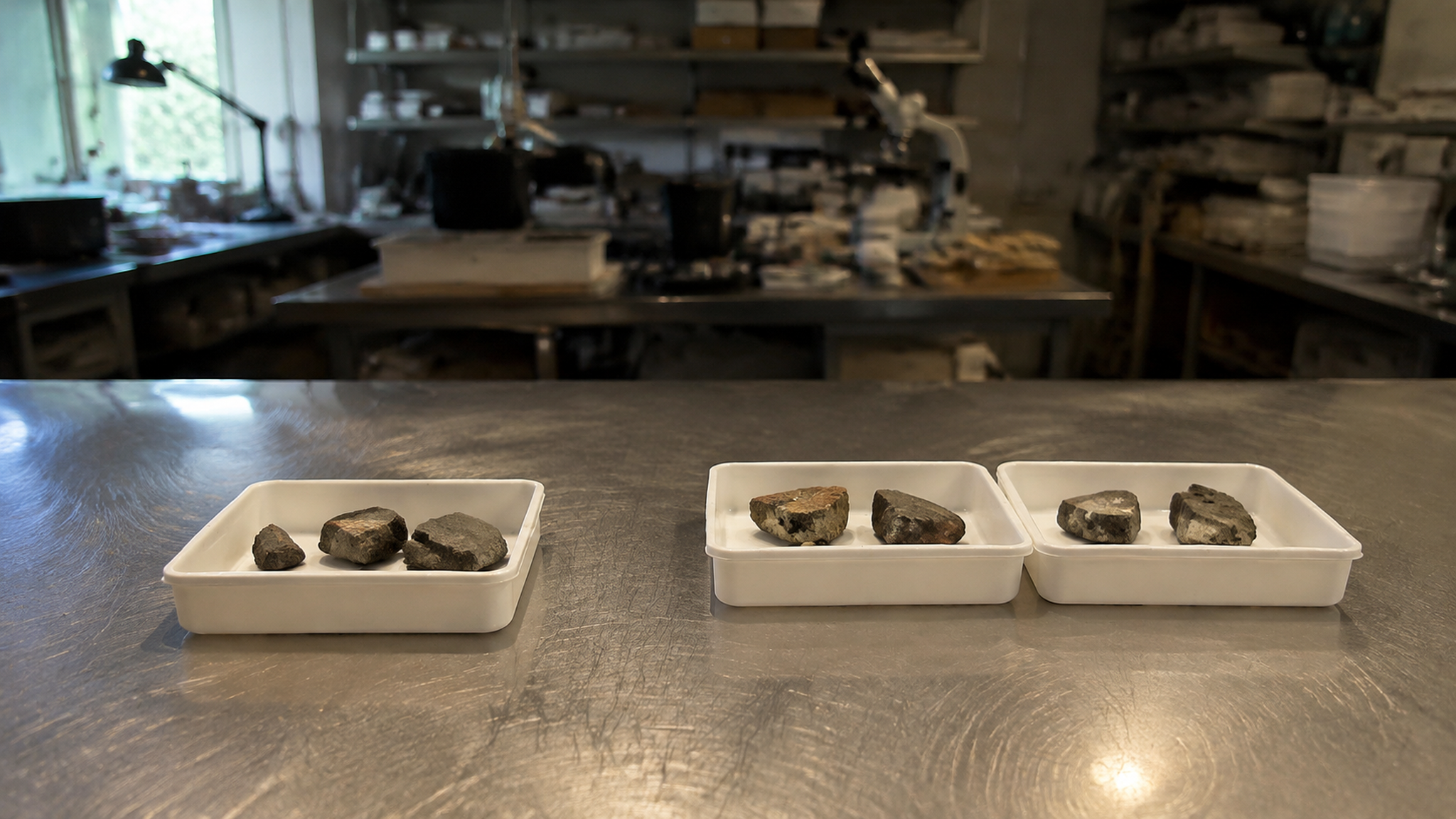
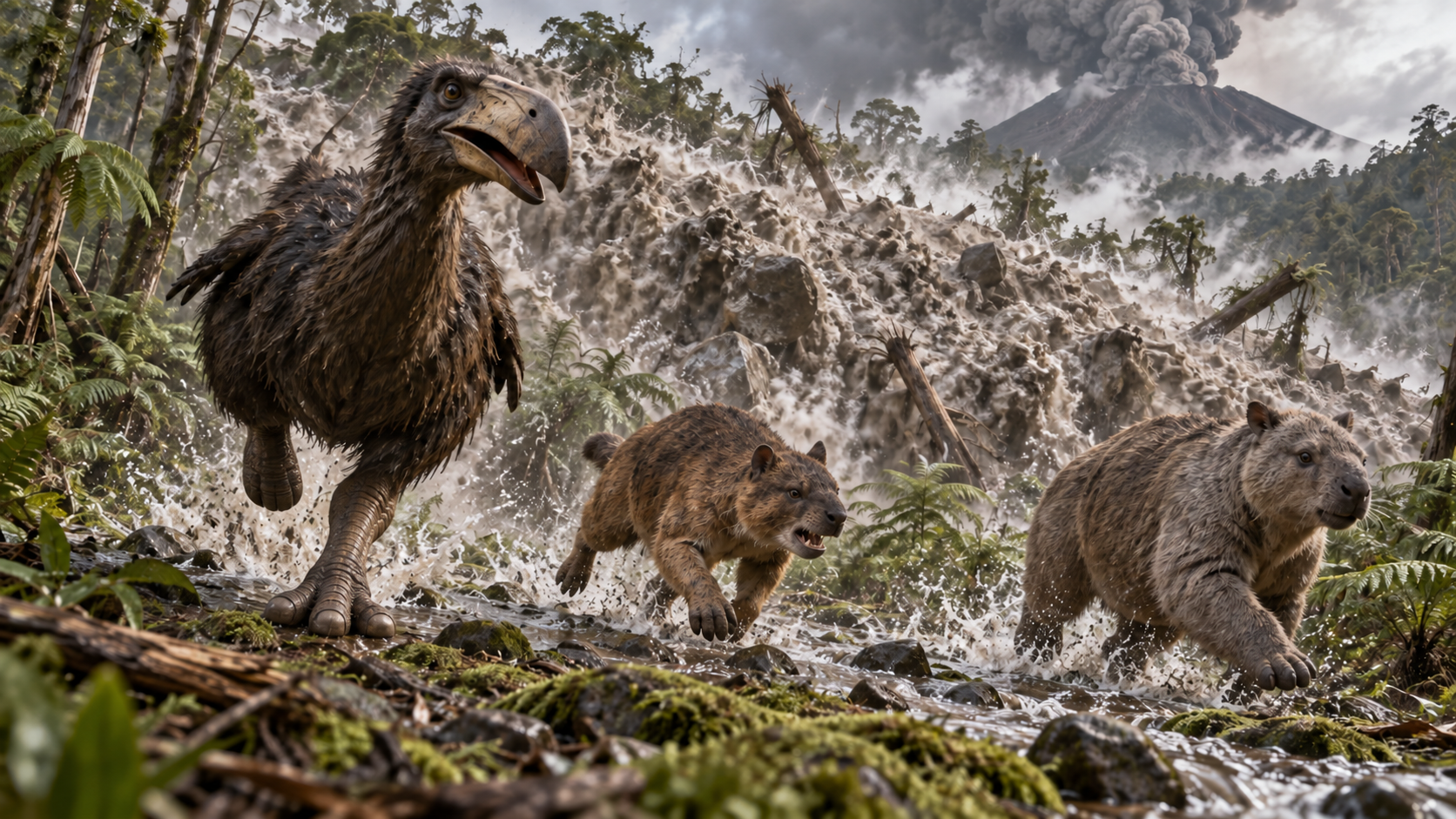
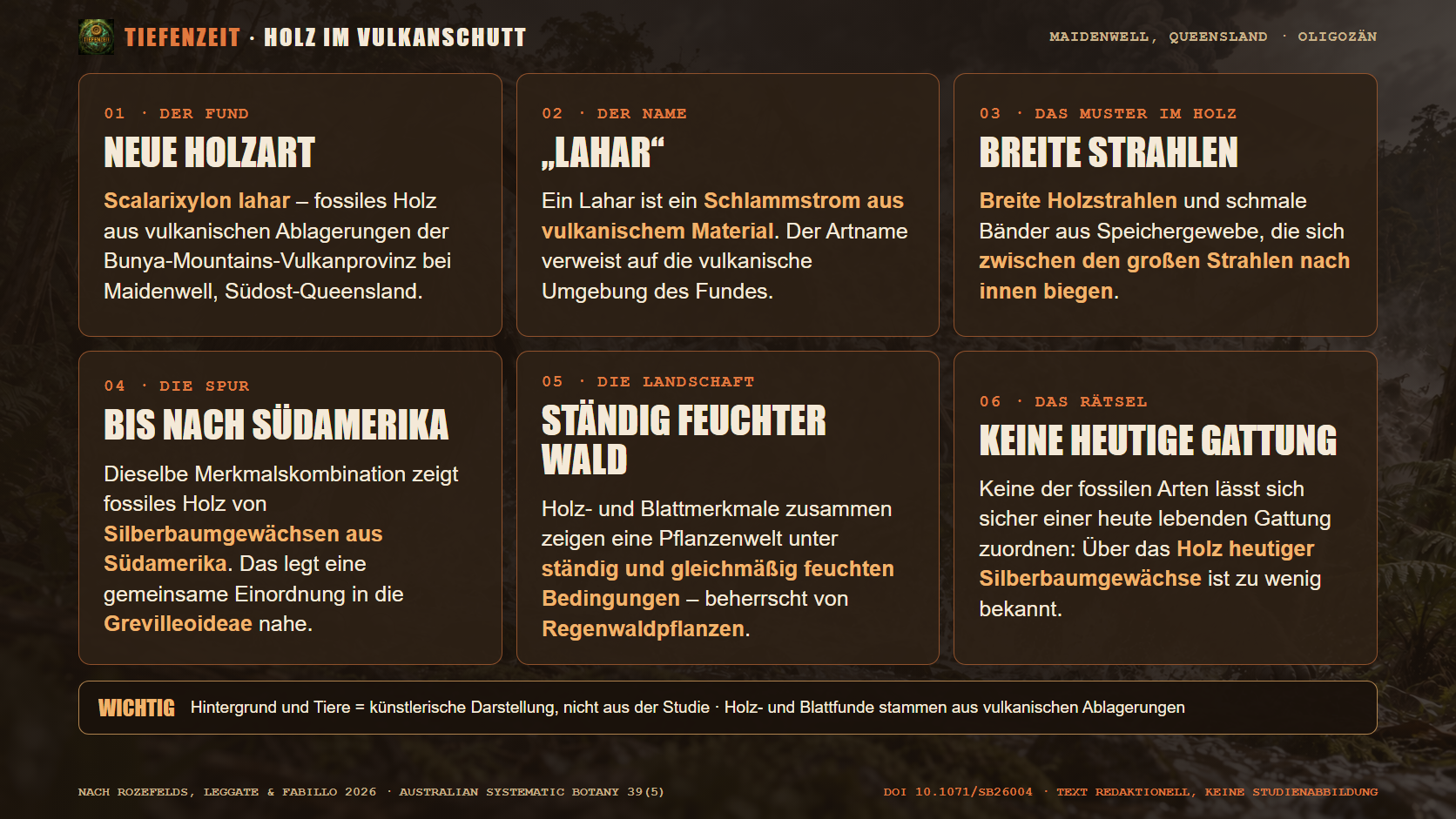
The name sounds like a warning. A lahar is a mudflow made of volcanic material. And the find really does come from a volcanic setting: the wood lies in volcaniclastic deposits, meaning rock formed from shattered volcanic material.
The fossil-bearing layers belong to the Bunya Mountains Volcanic Province, an ancient volcanic region in south-eastern Queensland.
Volcanic Debris Holds a Rainforest
The Oligocene is an epoch of the Cenozoic Era, long after the dinosaurs vanished. The Maidenwell vegetation dates from this time. Anyone who associates volcanic rock with ash and heat would hardly expect a moist forest there.
Yet that is exactly where the evidence points. The team relies on two trails: the internal structure of the fossil wood and the shapes of fossil leaves. Together, they reveal a flora that grew under permanently moist conditions.
The researchers also describe those conditions as mesic. This technical term means moderately moist, without extremes of drought or waterlogging. Rainforest plants dominated the plant community.
The Pattern in the Wood Connects Two Continents
The name *Scalarixylon lahar* rests on a close examination of the wood. William Leggate, Melodina Fabillo and Andrew Rozefelds formally described the new species. Two features of its internal anatomy proved decisive.
The first is its broad wood rays. Wood rays are bands of cells that run across the wood from the inside towards the outside. In this species, they are strikingly wide.
The second feature lies between them. Narrow bands of parenchyma, a living storage tissue, run lengthways through the wood. Between the large rays, these bands bend inwards.
This precise combination appears elsewhere too: in fossil Proteaceae wood from South America. Proteaceae, also known as the protea family, is a plant family. The Australian and South American fossil woods therefore share a distinctive architectural pattern.
The Trail Leads to a Subfamily
The team draws a conclusion from this shared pattern. The matching features suggest that these fossil species all belong to the Grevilleoideae. That is a subfamily within the Proteaceae.
It is a reasoned assignment supported by the wood anatomy — but not yet definitive proof of their position on the family tree.
Even so, the step is powerful. A piece of fossil wood from Queensland can be compared with finds on another continent through a fine cellular pattern. And that comparison is enough to indicate a particular subfamily.
Then the Trail Goes Cold
Now comes the real twist. The fossil species, especially those from South America, share certain features with genera alive today. That sounds as though the target is close.
But this is where the classification stops. None of the fossil species can be assigned securely to a living genus or tribe. A tribe is a group of closely related genera within a family.
The obstacle does not lie in the rock, but in modern plants. Too little is known about wood anatomy across the living Proteaceae. Without those comparative data, researchers lack the yardstick against which the fossil could be measured.
A second gap compounds the problem. Phylogenetic studies evaluating wood characters across the Proteaceae are missing. Until they exist, any more precise assignment remains uncertain.
A Lost Cold Case from Victoria
An older find shows why firm evidence matters. Wood from Bacchus Marsh in the state of Victoria was once described as *Banksia fossilis*. It too is grevilleoid wood, meaning wood linked to the same subfamily.
But the species’ status is unclear. R. T. Patton’s original description is incomplete. And nobody knows what happened to the type material. Type material is the reference specimen on which a species was originally established.
Without that specimen, the old find cannot be classified securely. An unresolved cold case — sitting directly beside Queensland’s new star.
What the Wood Really Reveals
The study places the new find within Australia’s record of fossil Proteaceae wood. *Scalarixylon lahar* demonstrates what fossil wood can achieve. Its cellular pattern enables comparisons across continents and supports its assignment to a subfamily.
Together with fossil leaves, it helps reconstruct a vanished plant world: permanently moist and dominated by rainforest plants. And all this from volcanic deposits.
At the same time, the find exposes the method’s limits. The wood leads researchers as far as the subfamily, but not to a living genus. The solution does not lie only in the next fossil. It also lies inside the wood of plants still growing today.
Source
Andrew Rozefelds, William Leggate and Melodina Fabillo (2026): *The Proteaceae fossil wood record in Australia and a new species associated with Oligocene volcanism from the Bunya Mountains Volcanic Province in south-eastern Queensland*. Australian Systematic Botany 39(5), published under CC BY-NC-ND 4.0. DOI: 10.1071/sb26004. [Primary article](https://doi.org/10.1071/sb26004)