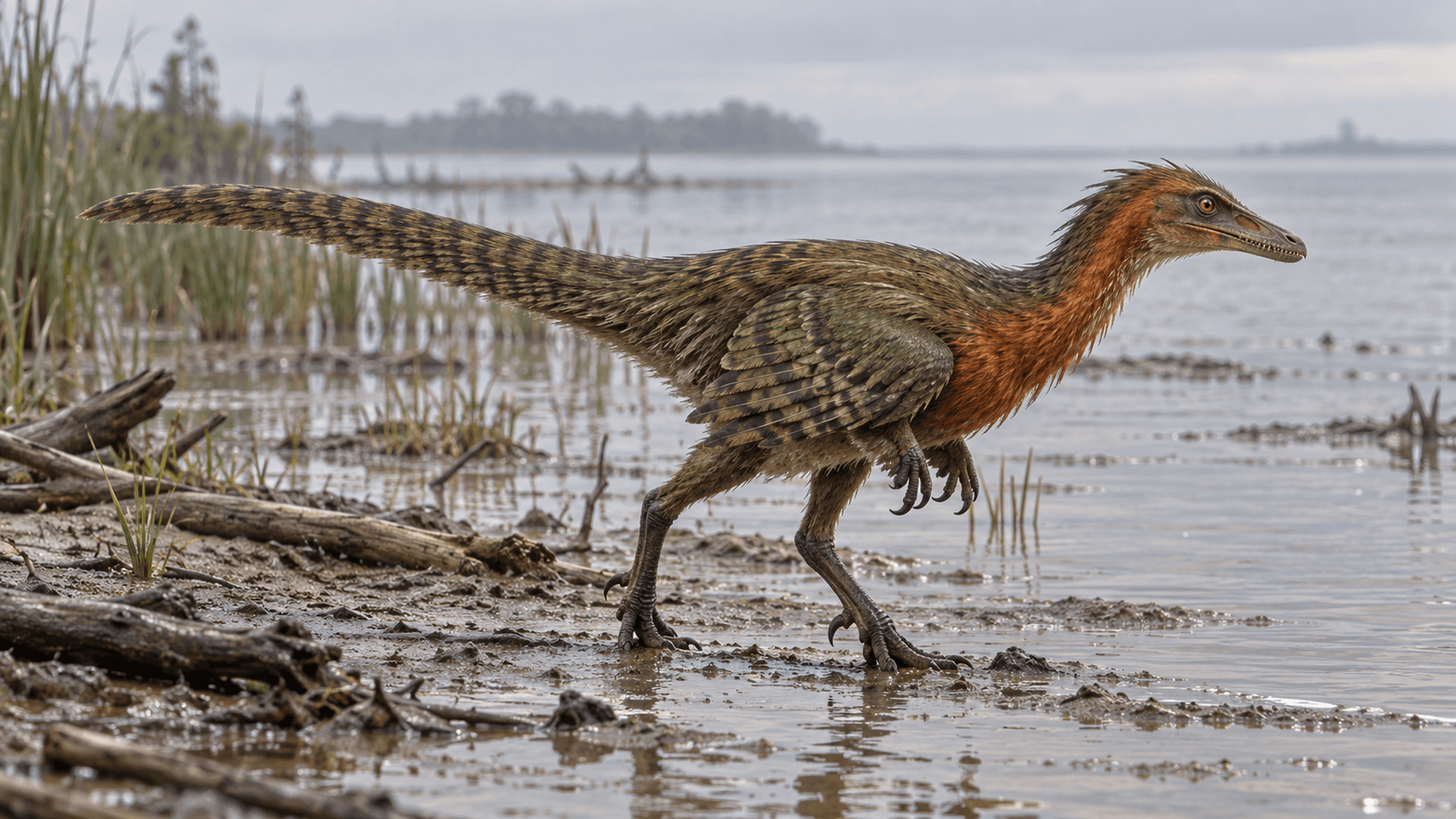
AI life reconstruction of a small non-avian paravian dinosaur (Paraves indet.) from the lower Barremian of Sesimbra, Portugal – based on fragmentary arm bones, roughly the size of a modern male turkey. · Image: Tiefenzeit · AI-generated illustration
Three bones from the cliffs of Cabo Espichel in Portugal date from the Early Cretaceous, and they did not belong to an early bird: their shape and size rule that out. They fit a small predatory dinosaur from the birds’ closest circle of relatives. Two of the arm bones may come from a single animal about the size of a modern male turkey. Such small predatory dinosaurs are barely known from the Iberian Peninsula.
The finds comprise part of an ulna, the shoulder end of an upper arm bone and a wrist bone. No further material exists. Even so, that is enough to dismiss a suspicion that small arm bones from this period immediately raise.
Lagoon, delta and an arm in the rock
Today, a cliff near Sesimbra drops to the Atlantic. During the Barremian, a stage of the Early Cretaceous, this was a landscape of lagoons and a delta. Their deposits now form the Papo-Seco Formation.
At the Areia do Mastro site, the piece of ulna and the upper-arm fragment lay close together in the rock, so both may come from the same animal. The wrist bone, by contrast, came from the rubble at the foot of the cliff, no longer in its original layer.
A bird? The bones say no
Small, delicate arm bones from the Cretaceous first make specialists think of enantiornithines. This extinct group of primitive birds was widespread at the time, and many of them could fly.
The researchers compared the shape and size of the Portuguese bones. The result: a flight-capable enantiornithine is ruled out. The ulna is slender but not specialised for any particular task, and the upper arm is only moderately robust. That fits a paravian outside the birds. Paraves is the group that contains birds and their closest relatives among the predatory dinosaurs. The exact subgroup remains open, so the researchers write ‘Paraves indet.’, meaning ‘paravian, not identified more precisely’.
Perhaps an early relative of the dromaeosaurs
The authors consider it possible that the animal belonged to an early side branch of the dromaeosaurs, the family of agile predatory dinosaurs that also includes Velociraptor. This is not certain. The researchers explicitly do not assign a new scientific name, because three fragments are not enough for one.
The find still matters. Small maniraptorans – predatory dinosaurs from the large group that also contains paravians and birds – are scarcely documented on the Iberian Peninsula. The authors therefore see two possibilities: the bones could belong to a previously unrecognised, primitive European lineage, and small predatory dinosaurs found nowhere else might have lived in Barremian Iberia.
Whether a distinct European lineage is really emerging here can only be settled with more complete skeletons.
---
At a glance
A small dinosaur from Portugal is known from three fragmentary arm and wrist bones. Their shape and size rule out a flight-capable enantiornithine and support identification as a non-avian paravian. The find confirms that small bird-like predatory dinosaurs lived in Early Cretaceous Iberia, but no new species, dromaeosaur assignment or unknown European lineage is proven.
The fossils come from the Lower Barremian Papo-Seco Formation near Cabo Espichel in Portugal.
The material comprises parts of an ulna and upper arm plus a wrist bone.
Shape and size rule out a flight-capable enantiornithine.
The bones are assigned to a non-avian paravian.
The animal was roughly the size of a male turkey.
Neither a new species nor a secure dromaeosaur assignment is supported.
Frequently asked questions
Which bones were found in Portugal?
The finds comprise part of an ulna, the shoulder end of an upper arm bone and a wrist bone. The ulna and upper-arm fragment lay close together, while the wrist bone was found among rubble below the cliff.
Why do the bones not belong to an early bird?
Comparisons of their shape and size rule out a flight-capable enantiornithine. The slender, unspecialised ulna and moderately robust upper arm instead fit a non-avian paravian.
Was a new dinosaur species discovered?
No. The three fragmentary bones are insufficient to establish a new taxon or scientific name. Their precise position within Paraves remains unresolved.
Why is the find important for Europe?
Small maniraptorans are scarcely documented on the Iberian Peninsula. The fossils confirm their presence in Early Cretaceous Portugal, while an unknown European lineage remains only a possibility.
Around 77 million years ago, an unknown predator stalked the floodplains of what is now Alberta. Now the animal has a name: *Tromerosaurus solumons*, a new tyrannosaur from Canada’s Oldman Formation. Its upper jaw combines features of two famous relatives and shakes the family tree of the giant predators.
CheckedSource: A new albertosaurine from the Oldman Formation, Alberta, Canada, illuminates ambiguity between albertosaurine and tyrannosaurine characteristics
Three 66-million-year-old teeth from the Hell Creek Formation in North America provide a concrete measurement of T. rex body temperature: 36.3 degrees Celsius, plus or minus 2.5 degrees. That put the Late Cretaceous predator in the range of modern mammals and birds. Scientists have argued over this question for decades, but hard measurements have been scarce. Now they have one.
CheckedSource: The body temperature of Tyrannosaurus rex
The sacrum of an *Edmontosaurus* still contains remnants of the animal’s own protein. More precisely: fragments of collagen, the structural protein that keeps bones strong and flexible. A team led by Lucien Tuinstra found three independent lines of evidence for it. The fossil comes from the Late Cretaceous of South Dakota — and is fuelling a dispute that has occupied researchers for decades.
CheckedSource: Evidence for Endogenous Collagen in Edmontosaurus Fossil Bone