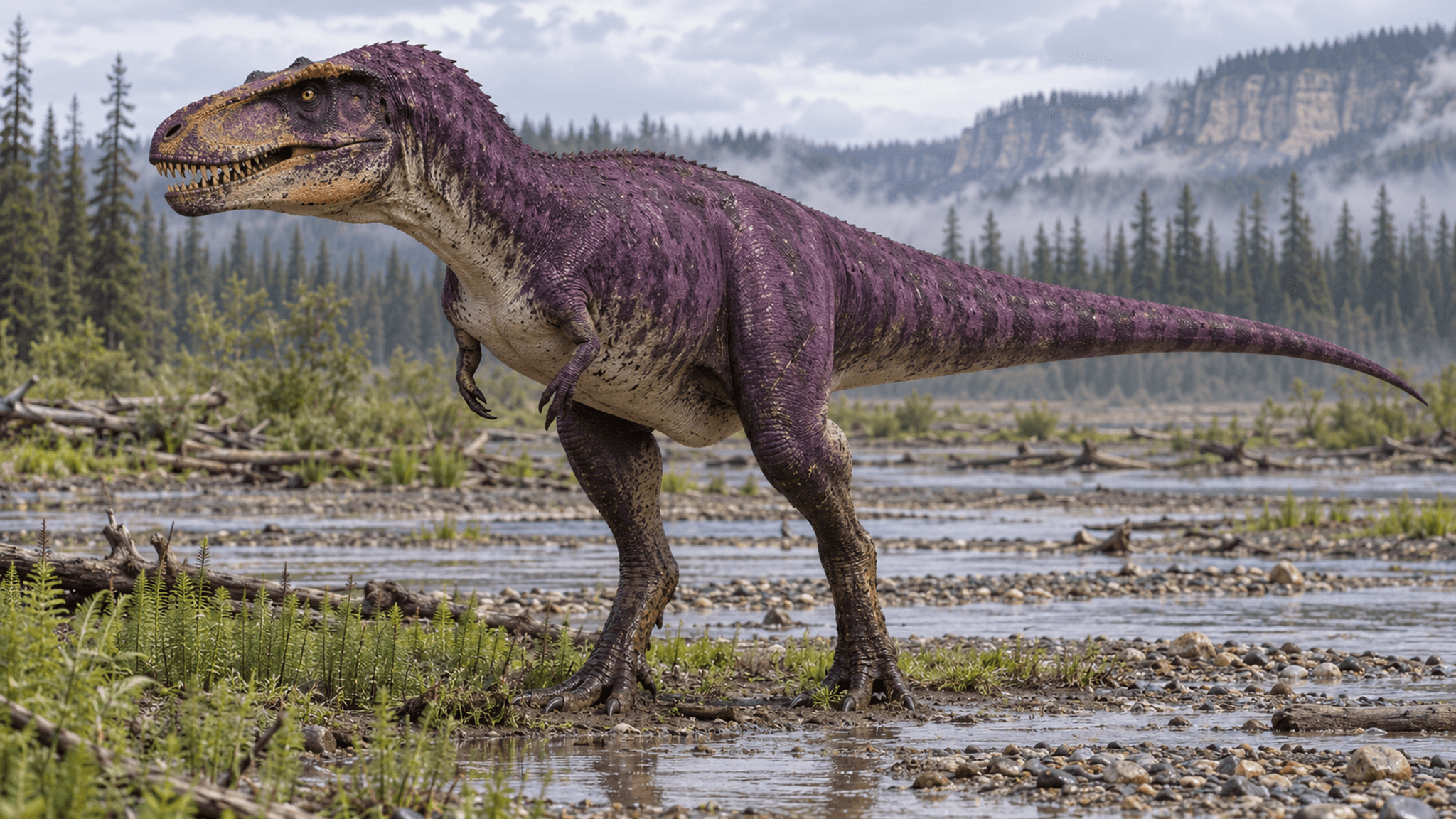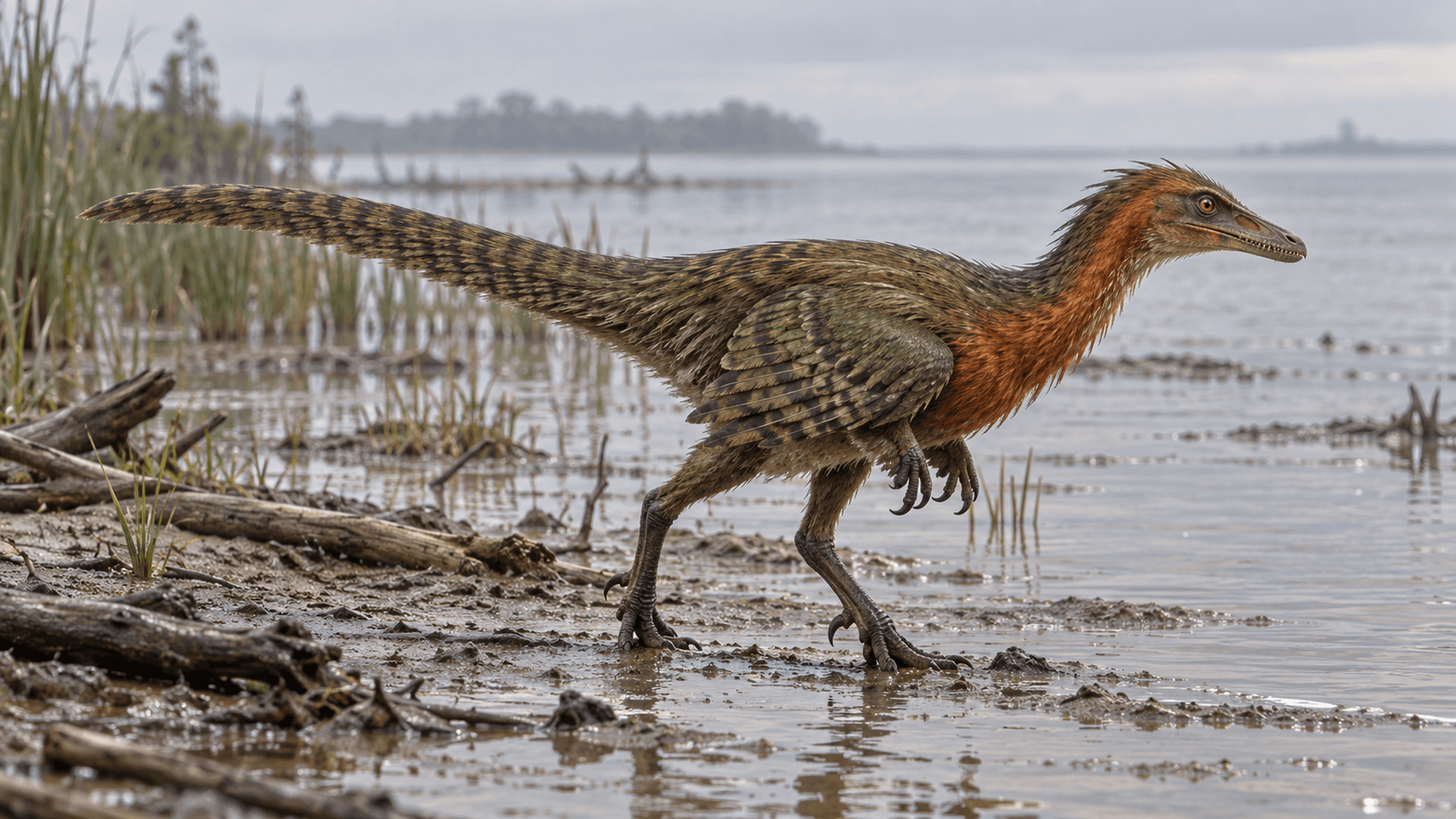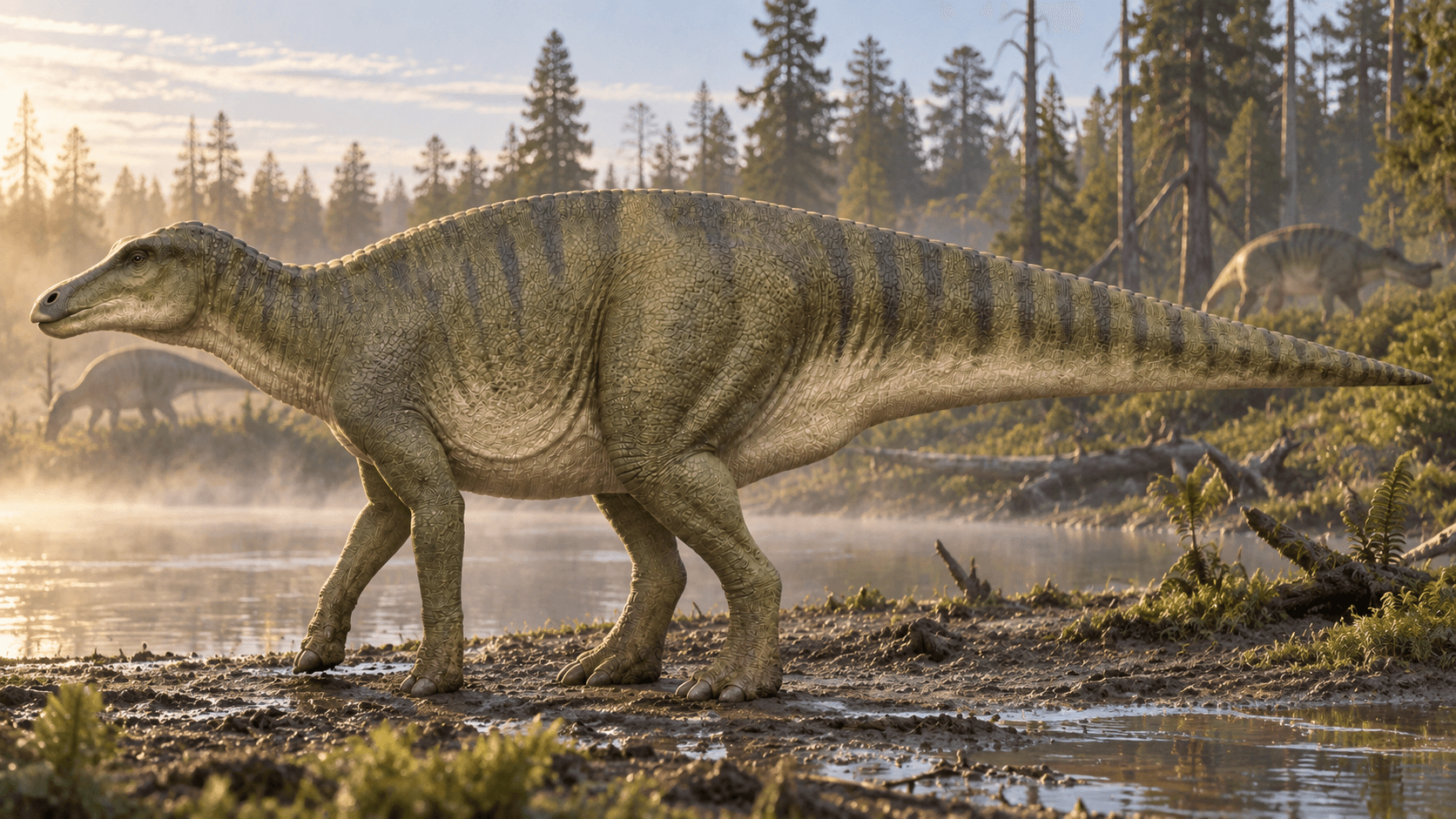
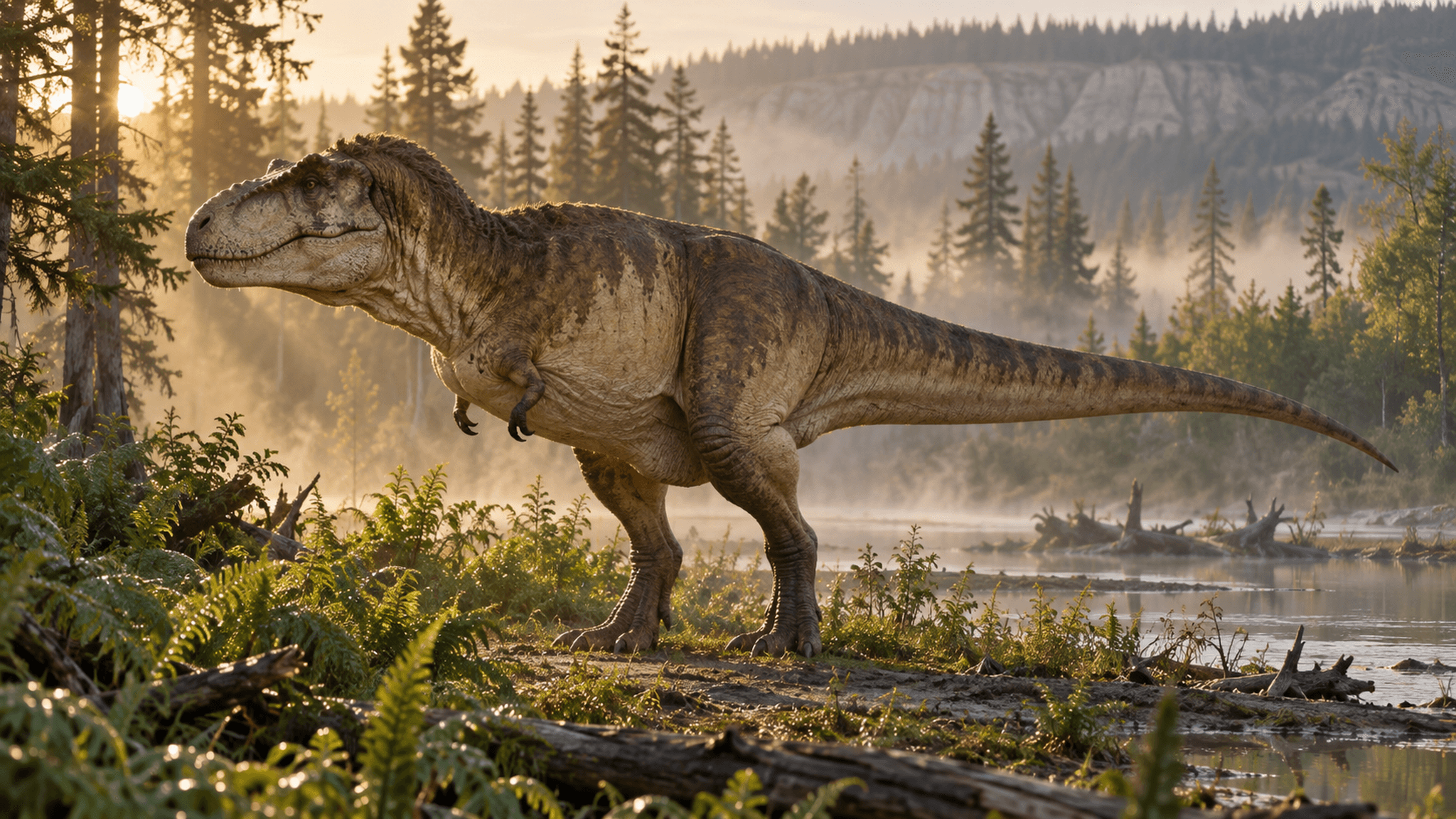
The study appeared in the journal Science Advances on 18 September 2026. One of the oldest disputes in dinosaur research has become a measurement. A second witness supports the result: crocodiles that lived in the same place at the same time.
The measurement comes from a team led by Randon J. Flores of the University of California, Los Angeles.
The Thermometer Is Locked in the Enamel
Tooth enamel grows inside a living animal, at that animal’s body temperature. As it forms, it incorporates carbon and oxygen atoms, including rare, slightly heavier variants. The temperature-dependent isotope pattern in the enamel turned the tooth into a thermometer.
Specialists call these clumped isotopes: heavy atoms that have, in effect, clustered together. The method rests on thermodynamics, the physics of heat and energy. The tooth becomes a thermometer that preserved the warmth of its owner.
The research team examined three teeth from Tyrannosaurus rex. Together, they produced an average of 36.3 degrees Celsius. The 2.5 degrees represent the standard error, meaning how precisely that average was determined.
But one number alone proves little. A warm result could simply mean that Hell Creek itself was hot. This is where the crocodiles enter the story.
Crocodiles Provide the Control Test
Hell Creek was no empty stage in the age of T. rex. Rivers wound through the landscape, and crocodiles waited beside the water. Both animals experienced the same climate, the same scorching afternoons and the same cool nights.
Crocodiles are the classic example of animals whose body heat depends heavily on their surroundings. Their teeth therefore make an ideal comparison. They show what an animal from this place records when it draws most of its warmth from outside its body.
The team also measured crocodile teeth from the same formation. They were markedly cooler than the T. rex teeth. That contrast is what gives the figure of 36.3 degrees its force.
Same place, same time, same weather — yet a clear temperature gap. That gap shows that T. rex kept its body warmer than the landscape around it. This is the study’s real punchline.
T. rex Was Warmer Than Its World
The researchers added another test. They compared the measurement with temperatures preserved in natural climate archives in the rock and with computer simulations of the climate at the time. The result was the same: T. rex kept its body warmer than its surroundings.
The model therefore yielded more than a number. The animal maintained a body warmer than its environment, but the metabolism behind that warmth remains unresolved. The finding fits modern endotherms, yet it does not completely define the metabolism of T. rex.
Close to Mammals, but Not a Human with Teeth
The paper’s headline says that T. rex was “nearly as warm as a human”. Its scientific core makes a more cautious claim: the value is comparable with those of modern endothermic animals. That is strong enough without the human comparison.
A warm measurement reveals temperature, not the entire metabolism behind it. Calling T. rex a “warm-blooded animal in the modern sense” would go beyond the evidence. Nor does the measurement tell us anything about every other dinosaur, because the researchers examined only T. rex.
The crucial limitation lies in the teeth themselves. Three teeth make a small sample. The method also works only if the enamel was not chemically altered inside the rock, because any later transformation would reset the built-in thermometer.
A Warm Body Opens the North
The temperature means more than a line in the scientific literature. The team calculated which regions an animal with this body temperature could inhabit. According to that projection, much of the North American continent of the time lay open to T. rex.
That included cooler regions farther north. A predator whose body remained warmer than its environment was probably less dependent on warm, sunny days. Cold mornings at higher latitudes need not have stopped it.
This, however, remains a model calculation. It shows where T. rex could have travelled, not where its bones have been found.
What a Tooth Still Knows After 66 Million Years
For decades, researchers inferred the body heat of T. rex mainly from its bone structure, size and way of life. Now a piece of tooth enamel provides a direct measurement. It becomes convincing only because of a crocodile lying in the same river at the same time.
A feature of the living body can thus be recovered from an extinct animal. The heat vanished long ago. Its record still survives in the tooth enamel.
---