A team led by Jerit L. Mitchell of the University of Regina presented the discovery in the journal “Scientific Reports” in July 2025. Using extremely powerful X-rays, the researchers revealed the network of tubes in its original position inside the bone. According to the study, no one had previously measured such large, newly formed vascular structures in a dinosaur in three dimensions while also analysing their chemistry.
A Giant with a Broken Rib
Around 67 million years ago, Scotty lived in a temperate river landscape now known as the Frenchman Formation. It was comparable in age to the better-known Hell Creek Formation in Montana. At some point, one of his ribs broke. The bone does not reveal why.
The giant survived the injury. His body began patching the damage. That very repair site has survived in stone.
New Blood Vessels Grew around the Break
When a bone heals, a callus forms around the break: a bulge of fresh bone tissue. This rebuilding demands a rich blood supply, so new vessels grow into the area. Scotty’s fracture had not fully healed, and according to the researchers, that increased the chance of finding such young vessels.
The tubes appear only in the broken section of the rib. On the other side of the bone, right beside the callus, some reach about one millimetre in diameter.
Far Too Thick for Normal Bone Canals
One millimetre may sound tiny, but it is large for vessels inside bone. The usual supply channels, known as Haversian and Volkmann’s canals, measure between 0.05 and 0.6 millimetres, according to the study.
Earlier vascular finds in dinosaurs were much finer, only a few hundredths of a millimetre thick. They probably belonged to this normal canal network and were not considered the result of an injury. Scotty’s tubes do not fit that pattern.
The Veins Are Made of Fool’s Gold and Rust
The view inside came from a synchrotron, a particle accelerator that produces enormously bright X-rays. Its 3D images show the tubular network exactly where it lies within the bone. Further X-ray measurements revealed which chemical elements the tubes contain and what forms they take.
Light and electron microscopes added more data. The tubes consist of pyrite, a shiny iron mineral commonly called fool’s gold. Some of it has transformed into goethite or haematite, two iron oxides also found in rust.
The mineral occurs in two separate layers. It filled the former cavities as plaster fills a mould.
Soft Tissue? Not This Time
Traces of blood vessels in T. rex bones have made headlines for years. In 2005, palaeontologist Mary Schweitzer described flexible, unmineralised vessel remains with possible traces of protein in the specimen “B-rex”. Whether these really were original tissues remains disputed among researchers.
With Scotty, that question does not arise. His tubes consist entirely of minerals. The researchers found no original tissue using their methods, and the casts cannot currently be tested for organic remains. The team infers that newly grown blood vessels left these impressions solely from their shape and position.
B-rex contains soft, possibly organic remains. In Scotty, fossilised casts show where blood probably flowed towards the wound.
The Patient Is a Record-Breaking Tyrannosaurus
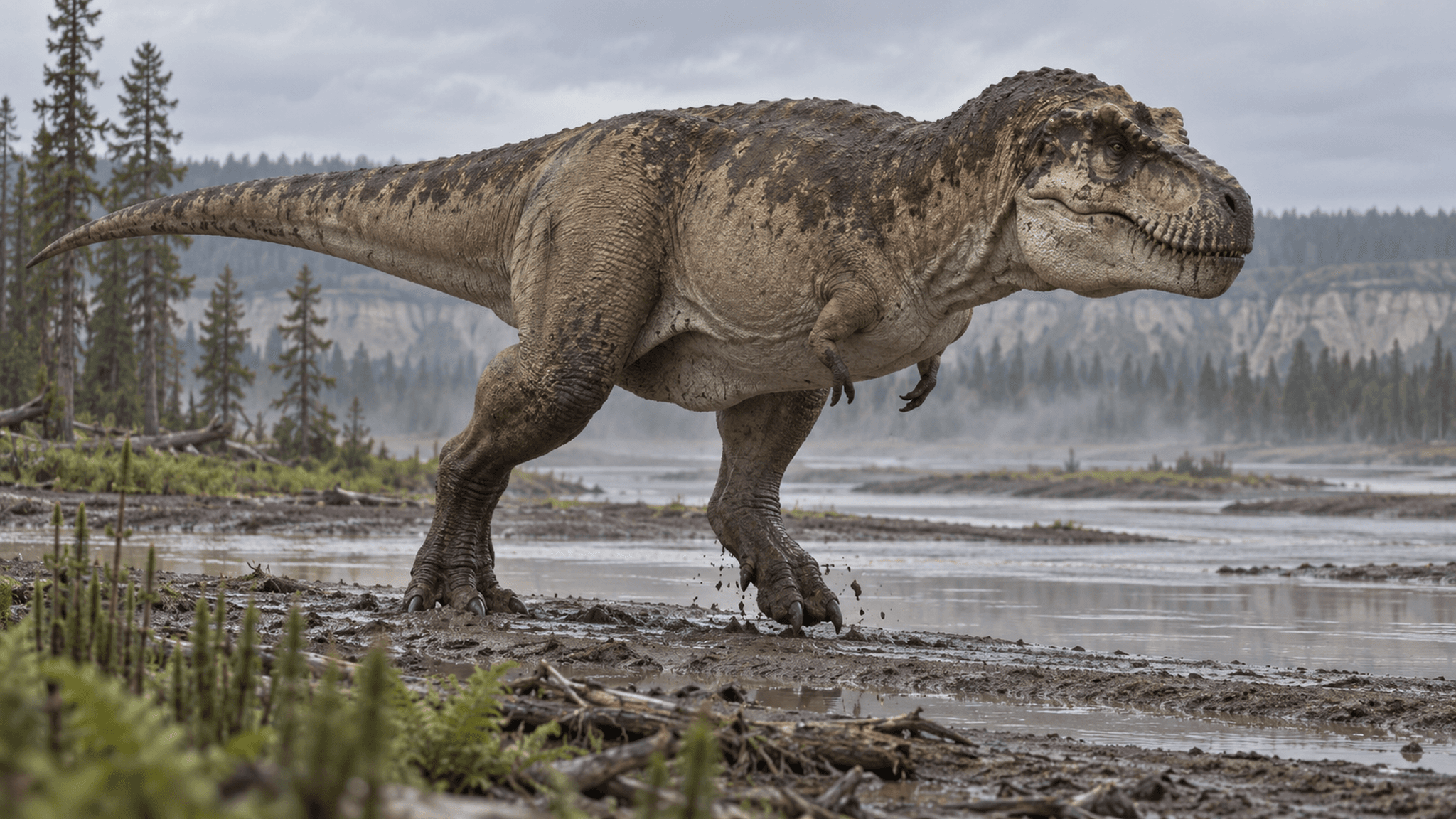
On 16 August 1991, headteacher Robert Gebhardt found the first bones near the town of Eastend. The Royal Saskatchewan Museum spent more than 20 years freeing the animal from hard, iron-rich sandstone. With 65 per cent of the skeleton preserved, Scotty ranks among the most complete specimens of Tyrannosaurus rex.
The study’s authors describe him as the largest T. rex recovered so far. A 2019 analysis placed him just ahead of “Sue” in Chicago, while curators at the Field Museum regard the two animals as statistically tied.
The broken rib was not Scotty’s only wound. His skeleton bears several healed injuries.
Bone Fractures Become the Next Research Target
The authors now want to search specifically where bones heal and regrow. By combining several methods, they hope to reveal how well dinosaurs could repair injuries.
Mitchell, Mauricio Barbi and their team have since examined the rib using neutron imaging at Oak Ridge National Laboratory in April 2026. That information comes from a laboratory press release issued in September 2026. No separate study has yet appeared, so no results are currently available.
If the authors’ interpretation is correct, Scotty’s body was working on a wound 67 million years ago. Today, that same wound reveals what the giant looked like inside.
---